

386
CHAPTER 42
42.88
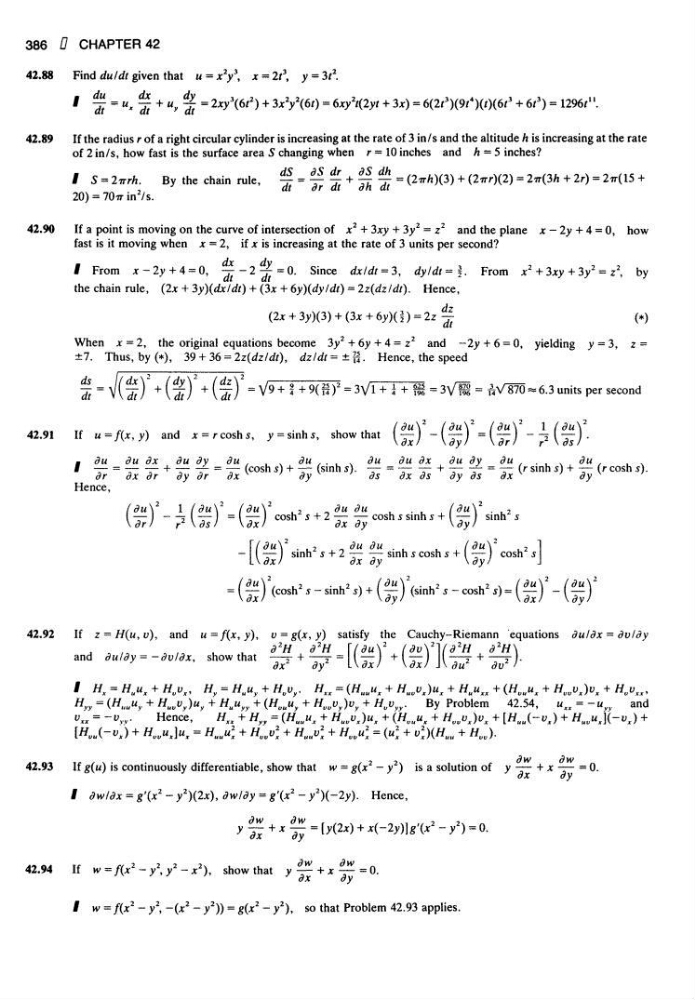
Find duldt given that u = x
2 y\ x = 2t\ y = 3t
2 .
42.89
If the radius r of a right circular cylinder is increasing at the rate of 3 in/s and the altitude h is increasing at the rate
of 2 in/s, how fast is the surface area 5 changing when r= 10 inches and h = 5 inches?
By the chain rule,
42.90 If a point is moving on the curve of intersection of x
2 + 3xy + 3y
2 = z
2
and the plane x - 2y + 4 = 0, how
fast is it moving when x = 2, if x is increasing at the rate of 3 units per second?
From x - 2y + 4 = 0,
Since dxldt = 3, dy/dt = |. From x
2 + 3xy + 3y
2 = z
2 , by
the chain rule, (2x + 3y)(dx/dt) + (3x + 6y)(dy/dt) = 2z(dz/dt). Hence,
(2x + 3y)(3) + (3x + 6y)(l) = 2z
When x = 2, the original equations become 3y
2 + 6y + 4 = z
2 and -2>> + 6 = 0, yielding y-3, z =
±1. Thus, by (*), 39 + 36 = 2z(dz/dt), dz/dt = ± g. Hence, the speed
units per second
42.91
If u-f(x, y) and x = rcoshs, y = sinhs, show that
Hence,
42.92
If z = H(u,v), and «=/(*, y), v = e(x, y) satisfy the Cauchy-Riemann 'equations 3uldx = dvldy
and duldy = -dvldx, show that
H, = Huux + Hvux, Hy = Huuy + Hvvy. Hxx = (Huuux + Huuv,)u, + Huulf + (Hvuux + Hvuvx)vx + H,vx,,
Hfy = (Huuuy + Huuvy)uy + Huuyy + (Hauuy + Havvr)vy + Havyy. By Problem 42.54, «„ = -«„. and
va = -vn. Hence, //„ + H,, = (Huuux + Huvvx)u, + (Hvuux + //„„<;>, + [Hm(-vt) + H^u.K-v,) +
[»™(-wJ + «W«J«, = Huuu2x + Hmv} + Huuv2 + Hmu\ = (u2x + v\)(Hm + Hm).
42.93 If g(u) is continuously differentiable, show that w - g(x
2 — y
2 ) is a solution of
dwldx = g'(x
2 - y
2 )(2x), dwldy = g'(x
2 - y
2 )(-2y). Hence,
42.94
If w=f( x
2 -y
2 , y
2 -x
2 ), show that
w = f(x
2 - y
2 , -(x
2 -y
2 )) = g(x
2 - y
2 ), so that Problem 42.93 applies.
5 = 2wrh.
= (2irh)(3) + (2i7T)(2) = 2ir(3h + 2r) = 2ir(15 +
20) = 707T in
2 /s.
CHAPTER 42
42.88
Find duldt given that u = x
2 y\ x = 2t\ y = 3t
2 .
42.89
If the radius r of a right circular cylinder is increasing at the rate of 3 in/s and the altitude h is increasing at the rate
of 2 in/s, how fast is the surface area 5 changing when r= 10 inches and h = 5 inches?
By the chain rule,
42.90 If a point is moving on the curve of intersection of x
2 + 3xy + 3y
2 = z
2
and the plane x - 2y + 4 = 0, how
fast is it moving when x = 2, if x is increasing at the rate of 3 units per second?
From x - 2y + 4 = 0,
Since dxldt = 3, dy/dt = |. From x
2 + 3xy + 3y
2 = z
2 , by
the chain rule, (2x + 3y)(dx/dt) + (3x + 6y)(dy/dt) = 2z(dz/dt). Hence,
(2x + 3y)(3) + (3x + 6y)(l) = 2z
When x = 2, the original equations become 3y
2 + 6y + 4 = z
2 and -2>> + 6 = 0, yielding y-3, z =
±1. Thus, by (*), 39 + 36 = 2z(dz/dt), dz/dt = ± g. Hence, the speed
units per second
42.91
If u-f(x, y) and x = rcoshs, y = sinhs, show that
Hence,
42.92
If z = H(u,v), and «=/(*, y), v = e(x, y) satisfy the Cauchy-Riemann 'equations 3uldx = dvldy
and duldy = -dvldx, show that
H, = Huux + Hvux, Hy = Huuy + Hvvy. Hxx = (Huuux + Huuv,)u, + Huulf + (Hvuux + Hvuvx)vx + H,vx,,
Hfy = (Huuuy + Huuvy)uy + Huuyy + (Hauuy + Havvr)vy + Havyy. By Problem 42.54, «„ = -«„. and
va = -vn. Hence, //„ + H,, = (Huuux + Huvvx)u, + (Hvuux + //„„<;>, + [Hm(-vt) + H^u.K-v,) +
[»™(-wJ + «W«J«, = Huuu2x + Hmv} + Huuv2 + Hmu\ = (u2x + v\)(Hm + Hm).
42.93 If g(u) is continuously differentiable, show that w - g(x
2 — y
2 ) is a solution of
dwldx = g'(x
2 - y
2 )(2x), dwldy = g'(x
2 - y
2 )(-2y). Hence,
42.94
If w=f( x
2 -y
2 , y
2 -x
2 ), show that
w = f(x
2 - y
2 , -(x
2 -y
2 )) = g(x
2 - y
2 ), so that Problem 42.93 applies.
5 = 2wrh.
= (2irh)(3) + (2i7T)(2) = 2ir(3h + 2r) = 2ir(15 +
20) = 707T in
2 /s.