

PARTIAL DERIVATIVES
385
42.80
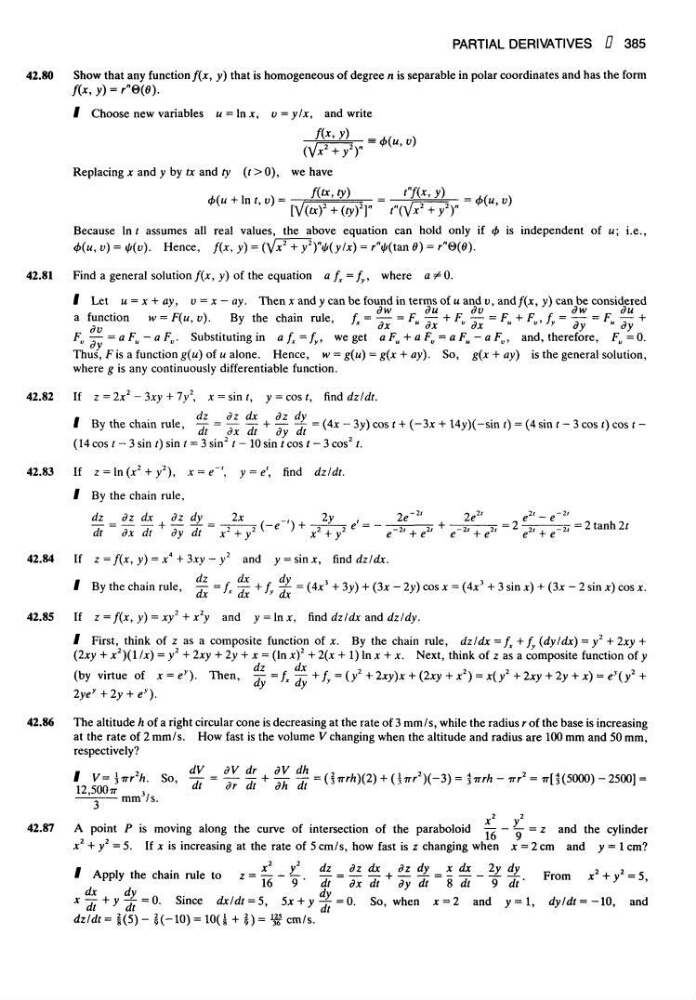
Show that any function/(*, y) that is homogeneous of degree n is separable in polar coordinates and has the form
fa, y) = r"®(0).
Choose new variables u = In x, v = ylx, and write
Replacing x and y by tx and ty (t> 0), we have
Because In t assumes all real values, the above equation can hold only if is independent of u; i.e.,
42.81
Find a general solution f(x, y) of the equation a fx = fy, where a 5^0.
Let u = x + ay, v=x-ay. Then x and yean be found in terms of u and v, and f(x, y) can be considered
a function
w = F(u, v).
By the chain rule,
Substituting in a fx = fy, we get a Fu + a Fv = a Fu — a Fv, and, therefore, F0=0.
Thus, F is a function g(u) of u alone. Hence, w = g(u) = g(x + ay). So, g(x + ay) is the general solution,
where g is any continuously differentiable function.
42.82 If z = 2x
2 - 3xy + ly
2 , x = sin t, y = cost, finddz/dt.
By the chain rule,
(14 cos t - 3 sin t) sin t = 3 sin" t — 10 sin / cos t — 3 cos t.
42.83 If z = In (x2 + y2), x = e~', y = e', find dzldt.
By the chain rule,
42.84
If z = f(x, y) = x
4 + 3xy - y
2
and y = sin x, find dzldx.
By the chain rule,
= (4;t
3 + 3 v) + (3* - ly) cos x = (4*
3 + 3 sin x) + (3x-2 sin AT) cos x.
42.85 If z = /(x, y) = xy
2 + *
2
.y and y = In x, find dz/dx and dz/dy.
First, think of z as a composite function of x. By the chain rule, dzldx =fI+fjr (dy/dx) = y2 + 2xy +
(2xy + x2)(l/x) = y2 + 2xy + 2y + x = (In x)2 + 2(x + 1) In x + x. Next, think of z as a composite function of y
(by virtue of x = e"). Then,
2yey +2y + ey).
42.86 The altitude h of a right circular cone is decreasing at the rate of 3 mm/s, while the radius r of the base is increasing
at the rate of 2 mm/s. How fast is the volume V changing when the altitude and radius are 100 mm and 50 mm,
respectively?
So,
42.87 A point P is moving along the curve of intersection of the paraboloid
= z and the cylinder
x + y = 5. If A; is increasing at the rate of 5 cm/s, how fast is z changing when x = 2 cm and y = 1 cm?
Apply the chain rule to
From x
2 + y
2 = 5,
Since dx/dt = 5,
So, when x = 2 and y = l, dyldt--\Q, and
4(u,v) =
2 + y
2 )"(ylx) = /->(tan 0) = r"&(0).
= (4x - 3y) cos t + (-3;c + 14y)(-sin t) = (4 sin t - 3 cos t) cos t -
= (y2 + 2xy)x + (2xy + x2) = x(y2 + 2xy + 2y + x) = ey(y2 +
385
42.80
Show that any function/(*, y) that is homogeneous of degree n is separable in polar coordinates and has the form
fa, y) = r"®(0).
Choose new variables u = In x, v = ylx, and write
Replacing x and y by tx and ty (t> 0), we have
Because In t assumes all real values, the above equation can hold only if
42.81
Find a general solution f(x, y) of the equation a fx = fy, where a 5^0.
Let u = x + ay, v=x-ay. Then x and yean be found in terms of u and v, and f(x, y) can be considered
a function
w = F(u, v).
By the chain rule,
Substituting in a fx = fy, we get a Fu + a Fv = a Fu — a Fv, and, therefore, F0=0.
Thus, F is a function g(u) of u alone. Hence, w = g(u) = g(x + ay). So, g(x + ay) is the general solution,
where g is any continuously differentiable function.
42.82 If z = 2x
2 - 3xy + ly
2 , x = sin t, y = cost, finddz/dt.
By the chain rule,
(14 cos t - 3 sin t) sin t = 3 sin" t — 10 sin / cos t — 3 cos t.
42.83 If z = In (x2 + y2), x = e~', y = e', find dzldt.
By the chain rule,
42.84
If z = f(x, y) = x
4 + 3xy - y
2
and y = sin x, find dzldx.
By the chain rule,
= (4;t
3 + 3 v) + (3* - ly) cos x = (4*
3 + 3 sin x) + (3x-2 sin AT) cos x.
42.85 If z = /(x, y) = xy
2 + *
2
.y and y = In x, find dz/dx and dz/dy.
First, think of z as a composite function of x. By the chain rule, dzldx =fI+fjr (dy/dx) = y2 + 2xy +
(2xy + x2)(l/x) = y2 + 2xy + 2y + x = (In x)2 + 2(x + 1) In x + x. Next, think of z as a composite function of y
(by virtue of x = e"). Then,
2yey +2y + ey).
42.86 The altitude h of a right circular cone is decreasing at the rate of 3 mm/s, while the radius r of the base is increasing
at the rate of 2 mm/s. How fast is the volume V changing when the altitude and radius are 100 mm and 50 mm,
respectively?
So,
42.87 A point P is moving along the curve of intersection of the paraboloid
= z and the cylinder
x + y = 5. If A; is increasing at the rate of 5 cm/s, how fast is z changing when x = 2 cm and y = 1 cm?
Apply the chain rule to
From x
2 + y
2 = 5,
Since dx/dt = 5,
So, when x = 2 and y = l, dyldt--\Q, and
4(u,v) =
2 )"
= (4x - 3y) cos t + (-3;c + 14y)(-sin t) = (4 sin t - 3 cos t) cos t -
= (y2 + 2xy)x + (2xy + x2) = x(y2 + 2xy + 2y + x) = ey(y2 +