

384
CHAPTER 42
Hence,
Problem
we get
Using
42.73 Let z = M
3 i>
5 , where u = x + y and v = x — y. Find
(a) by the chain rule, (b) by substitution and
explicit computation.
(a)
(b)
Hence,
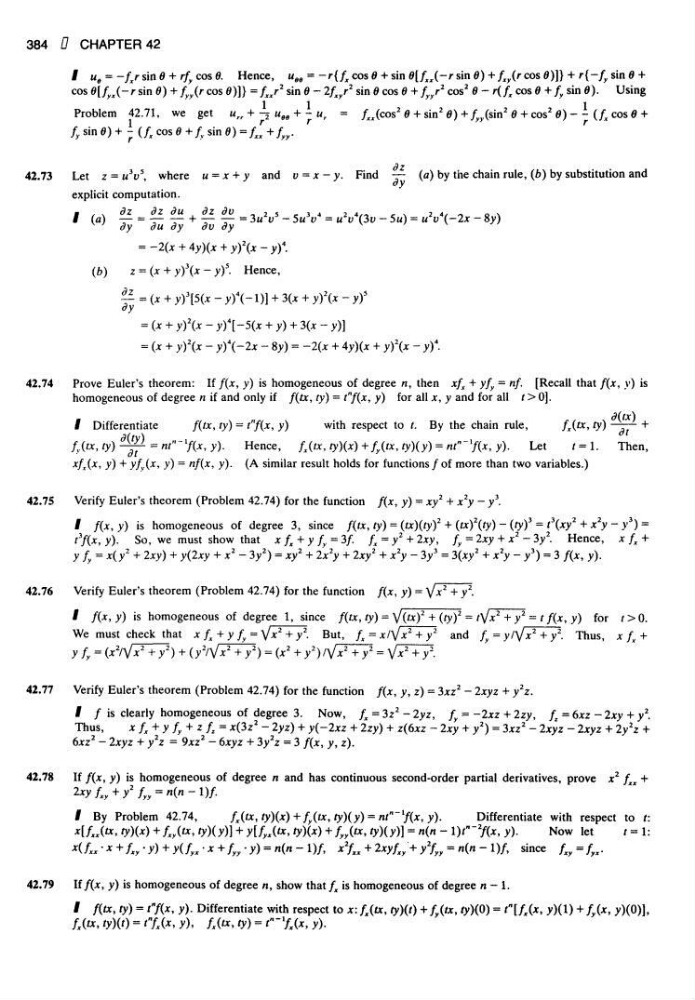
42.74 Prove Euler's theorem: If f(x, y) is homogeneous of degree n, then xfx + yfy = nf. [Recall that f(x, y) is
homogeneous of degree n if and only if f(tx, ty) = t"f(x, y) for all x, y and for all t > 0).
Differentiate
f(tx, ty) = t"f(x, y)
with respect to t. By the chain rule,
Hence, fj,(tx,ty)(x)+f,(tx,ty)(y) = nt"-lf(x,y). Let t = l. Then,
*/,(*> y) + yfy(x> y) = "/(*> y)- (A similar result holds for functions/of more than two variables.)
42.75 Verify Euler's theorem (Problem 42.74) for the function f(x, y) = xy2 + x2y - y3.
f(x, y) is homogeneous of degree 3, since f(tx, ty) = (tx)(ty)2 + (tx)2(ty) - (ty)3 = f(xy2 + x2y - y3) =
t*f(x,y). So, we must show that xfx + yfy=3f. fx=y2 + 2xy, fy=2xy + x2-3y2. Hence, x fx +
y fy = x(y2 + 2*y) + y(2xy + *2 - 3y2) = xy2 + 2x2y + 2xy2 + x2y - 3y3 = 3(xy2 + x2y - y3) = 3 f(x, y).
42.76
Verify Euler's theorem (Problem 42.74) for the function f(x, y) =
f(x, y) is homogeneous of degree 1, since f(tx, ty) =
for t > 0.
We must check that
But,
and
Thus,
42.77
Verify Euler's theorem (Problem 42.74) for the function f(x, y, z) = 3xz
2 - 2xyz + y
2 z.
f is clearly homogeneous of degree 3. Now, £ = 3z2 - 2yz, fy = -2*z + 2zy, ft = 6xz - 2xy + y2.
Thus, xft + yfy + zf^ x(3z2 - 2yz) + y(-2xz + 2zy) + z(6xz - 2xy + y2) = 3xz2 - 2xyz - 2xyz + 2y2z +
6*z2 - 2xyz + y2z = 9xz2 - 6xyz + 3/z = 3 f(x, y, z).
42.78
If f(x, y) is homogeneous of degree n and has continuous second-order partial derivatives, prove x
2 f +
i*y /„ + //„ = n(n-i)/.
By Problem 42.74,
f x (tx, ty)(x) + f y (tx, ty)(y) = nt" f(x, y).
Differentiate with respect to t:
x(f,^,ty)(x)+f,y(^,^)(y)} + y[f^tx,ty)(x)+fyy(^,ty)(y)]^n(n-l)t''-2f(x,y). Now let r = l:
42.79
If f(x, y) is homogeneous of degree n, show that f, is homogeneous of degree n - 1.
/(<*, fy) = t"f(x, y). Differentiate with respect to x:f,(tx, ty)(t)+f(tx, ty)(0) = t"[f,(x, y)(l) + f y (x, y)(0)],
f,(tx, 00(0 = ff,(*> >-). /.(ft. ty) = t"~lf,(x, y)*(/«•*+f,,-y) + y(fy,-x +fyy-y) = «(«-!)/, x2f,, + 2xyf,y + y2fyy = n(n-l)f, since f,y=fy,.
CHAPTER 42
Hence,
Problem
we get
Using
42.73 Let z = M
3 i>
5 , where u = x + y and v = x — y. Find
(a) by the chain rule, (b) by substitution and
explicit computation.
(a)
(b)
Hence,
42.74 Prove Euler's theorem: If f(x, y) is homogeneous of degree n, then xfx + yfy = nf. [Recall that f(x, y) is
homogeneous of degree n if and only if f(tx, ty) = t"f(x, y) for all x, y and for all t > 0).
Differentiate
f(tx, ty) = t"f(x, y)
with respect to t. By the chain rule,
Hence, fj,(tx,ty)(x)+f,(tx,ty)(y) = nt"-lf(x,y). Let t = l. Then,
*/,(*> y) + yfy(x> y) = "/(*> y)- (A similar result holds for functions/of more than two variables.)
42.75 Verify Euler's theorem (Problem 42.74) for the function f(x, y) = xy2 + x2y - y3.
f(x, y) is homogeneous of degree 3, since f(tx, ty) = (tx)(ty)2 + (tx)2(ty) - (ty)3 = f(xy2 + x2y - y3) =
t*f(x,y). So, we must show that xfx + yfy=3f. fx=y2 + 2xy, fy=2xy + x2-3y2. Hence, x fx +
y fy = x(y2 + 2*y) + y(2xy + *2 - 3y2) = xy2 + 2x2y + 2xy2 + x2y - 3y3 = 3(xy2 + x2y - y3) = 3 f(x, y).
42.76
Verify Euler's theorem (Problem 42.74) for the function f(x, y) =
f(x, y) is homogeneous of degree 1, since f(tx, ty) =
for t > 0.
We must check that
But,
and
Thus,
42.77
Verify Euler's theorem (Problem 42.74) for the function f(x, y, z) = 3xz
2 - 2xyz + y
2 z.
f is clearly homogeneous of degree 3. Now, £ = 3z2 - 2yz, fy = -2*z + 2zy, ft = 6xz - 2xy + y2.
Thus, xft + yfy + zf^ x(3z2 - 2yz) + y(-2xz + 2zy) + z(6xz - 2xy + y2) = 3xz2 - 2xyz - 2xyz + 2y2z +
6*z2 - 2xyz + y2z = 9xz2 - 6xyz + 3/z = 3 f(x, y, z).
42.78
If f(x, y) is homogeneous of degree n and has continuous second-order partial derivatives, prove x
2 f +
i*y /„ + //„ = n(n-i)/.
By Problem 42.74,
f x (tx, ty)(x) + f y (tx, ty)(y) = nt" f(x, y).
Differentiate with respect to t:
x(f,^,ty)(x)+f,y(^,^)(y)} + y[f^tx,ty)(x)+fyy(^,ty)(y)]^n(n-l)t''-2f(x,y). Now let r = l:
42.79
If f(x, y) is homogeneous of degree n, show that f, is homogeneous of degree n - 1.
/(<*, fy) = t"f(x, y). Differentiate with respect to x:f,(tx, ty)(t)+f(tx, ty)(0) = t"[f,(x, y)(l) + f y (x, y)(0)],
f,(tx, 00(0 = ff,(*> >-). /.(ft. ty) = t"~lf,(x, y)*(/«•*+f,,-y) + y(fy,-x +fyy-y) = «(«-!)/, x2f,, + 2xyf,y + y2fyy = n(n-l)f, since f,y=fy,.