

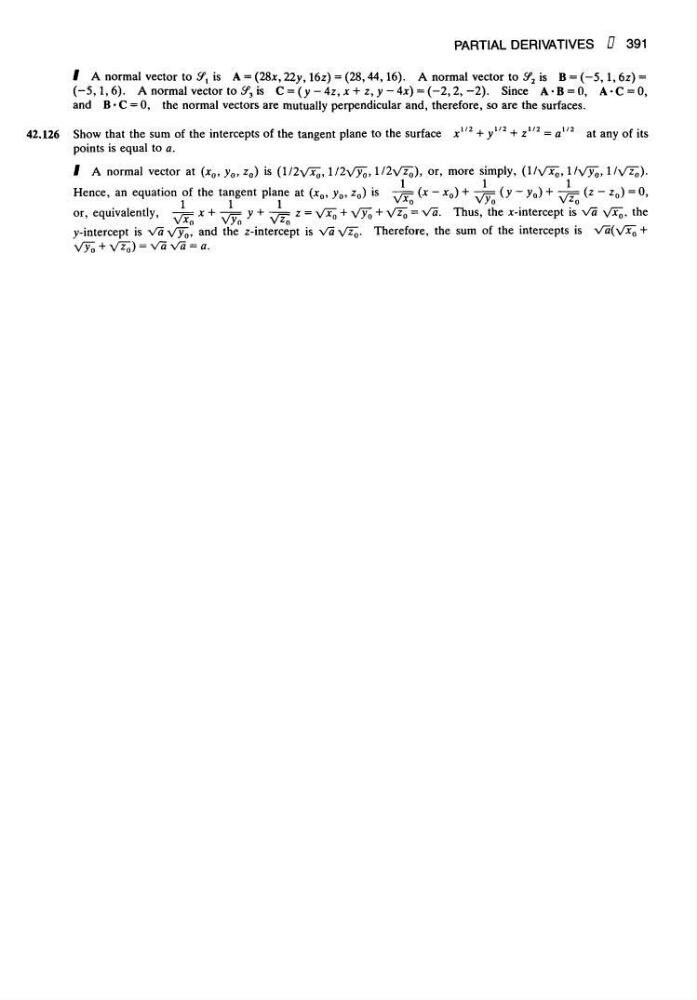
A normal vector to 5^, is A = (28*, 22y, 16z) = (28,44,16). A normal vector to 5^ 2 is B = (-5, l,6z) =
(-5,1,6). A normal vector to Zf 3 is C = (y -4z, .* + z,y -4x) = (-2,2, -2). Since A-B = 0, A-C = 0,
and B • C = 0, the normal vectors are mutually perpendicular and, therefore, so are the surfaces.
42.126 Show that the sum of the intercepts of the tangent plane to the surface x
112 + y
1 '
2 + z
172 = a
1 '
2 at any of its
points is equal to a.
PARTIAL DERIVATIVES
391
A normal vector at (x0, y0, z0) is
Hence, an equation of the tangent plane at
Thus, the ^-intercept is
the
or, equivalently,
and the z-intercept is
Therefore, the sum of the intercepts is
y-intercept is
is
or, more simply,
(-5,1,6). A normal vector to Zf 3 is C = (y -4z, .* + z,y -4x) = (-2,2, -2). Since A-B = 0, A-C = 0,
and B • C = 0, the normal vectors are mutually perpendicular and, therefore, so are the surfaces.
42.126 Show that the sum of the intercepts of the tangent plane to the surface x
112 + y
1 '
2 + z
172 = a
1 '
2 at any of its
points is equal to a.
PARTIAL DERIVATIVES
391
A normal vector at (x0, y0, z0) is
Hence, an equation of the tangent plane at
Thus, the ^-intercept is
the
or, equivalently,
and the z-intercept is
Therefore, the sum of the intercepts is
y-intercept is
is
or, more simply,