

PARTIAL DERIVATIVES
377
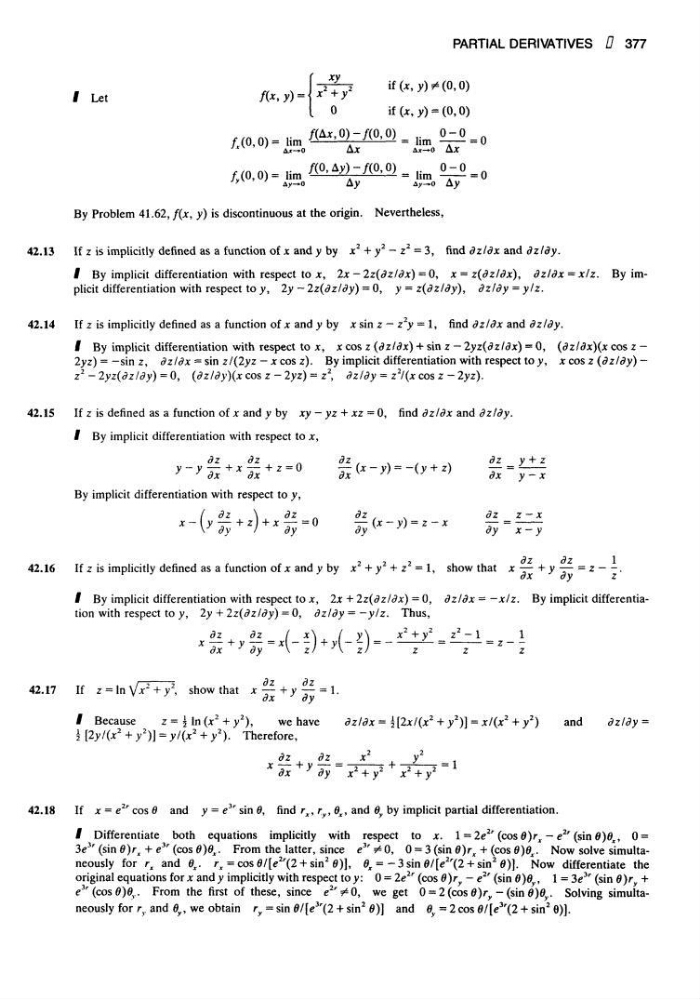
By Problem 41.62, f(x, y) is discontinuous at the origin. Nevertheless,
Let
42.13
42.14
42.15
42.16
42.17
42.18
If z is implicitly defined as a function of x and y by x
2 + y
2 — z
2 = 3, find dzldx and dzldy.
By implicit differentiation with respect to x, 2x - 2z(dzldx) = 0, x = z(dzldx), dzldx = xlz. By implicit differentiation with respect to y, 2y — 2z(dzldy) = 0, y = z(dzldy), dzldy = ylz.
If z is implicitly defined as a function of x and y by x sin z — z2y — I, find dzldx and dzldy.
By implicit differentiation with respect to x, x cos z (dzldx) + sin z - 2yz(dzldx~) - 0, (dzldx)(x cos z -
2yz) = -sin z, z2-2yz(dzIdy) = 0, (o>z/')(;t cos z - 2}>z) = z2, >z).
If z is defined as a function of x and y by xy - yz + xz = 0, find dzldx and dzldy.
By implicit differentiation with respect to x,
By implicit differentiation with respect to y,
If z is implicitly defined as a function of * and y by x
2 + y
2 + z
2 = 1, show that
By implicit differentiation with respect to *, 2x + 2z(dzldx) = 0, dzldx=—xlz. By implicit differentiation with respect to y, 2y + 2z(dzldy) = 0, dzldy = -ylz. Thus,
If z = In
show that
If x = e
2r cos6 and y = e
lr sin 6, find r,, r,,, 0 X , and O y by implicit partial differentiation.
Differentiate both equations implicitly with respect to x. 1 = 2e
2 ' (cosQ)r lt - e
2r (sin 0)0,, 0 =
3e
3
' (sin 0)r, + e
3r (cos 0)0,. From the latter, since e
3r ¥= 0, 0 = 3 (sin 0)r, + (cos 0)0,. Now solve simultaneously for r, and 0,. r, =cos0/[e
2r (2 + sin
2 e)], 0, = -3 sin 0/[e
2r (2 + sin
2 0)]. Now differentiate the
original equations for x and y implicitly with respect toy: 0 = 2e
2r (cos0)r y - e
2 ' (sin 0)0 y , 1 =3e
3r (sin 0)^ +
e
3r (cos0)0 v . From the first of these, since e
2l VO, we get 0 = 2(cos0)r,, -($^0)0^. Solving simultaneously for r y and 0 y , we obtain r y = sin 0/[e
3 '(2 + sin
2 0)] and O y = 2cos 0/[e
3r (2 + sin
2 9)].
Because
we have
Therefore,
and
377
By Problem 41.62, f(x, y) is discontinuous at the origin. Nevertheless,
Let
42.13
42.14
42.15
42.16
42.17
42.18
If z is implicitly defined as a function of x and y by x
2 + y
2 — z
2 = 3, find dzldx and dzldy.
By implicit differentiation with respect to x, 2x - 2z(dzldx) = 0, x = z(dzldx), dzldx = xlz. By implicit differentiation with respect to y, 2y — 2z(dzldy) = 0, y = z(dzldy), dzldy = ylz.
If z is implicitly defined as a function of x and y by x sin z — z2y — I, find dzldx and dzldy.
By implicit differentiation with respect to x, x cos z (dzldx) + sin z - 2yz(dzldx~) - 0, (dzldx)(x cos z -
2yz) = -sin z, z2-2yz(dzIdy) = 0, (o>z/')(;t cos z - 2}>z) = z2, >z).
If z is defined as a function of x and y by xy - yz + xz = 0, find dzldx and dzldy.
By implicit differentiation with respect to x,
By implicit differentiation with respect to y,
If z is implicitly defined as a function of * and y by x
2 + y
2 + z
2 = 1, show that
By implicit differentiation with respect to *, 2x + 2z(dzldx) = 0, dzldx=—xlz. By implicit differentiation with respect to y, 2y + 2z(dzldy) = 0, dzldy = -ylz. Thus,
If z = In
show that
If x = e
2r cos6 and y = e
lr sin 6, find r,, r,,, 0 X , and O y by implicit partial differentiation.
Differentiate both equations implicitly with respect to x. 1 = 2e
2 ' (cosQ)r lt - e
2r (sin 0)0,, 0 =
3e
3
' (sin 0)r, + e
3r (cos 0)0,. From the latter, since e
3r ¥= 0, 0 = 3 (sin 0)r, + (cos 0)0,. Now solve simultaneously for r, and 0,. r, =cos0/[e
2r (2 + sin
2 e)], 0, = -3 sin 0/[e
2r (2 + sin
2 0)]. Now differentiate the
original equations for x and y implicitly with respect toy: 0 = 2e
2r (cos0)r y - e
2 ' (sin 0)0 y , 1 =3e
3r (sin 0)^ +
e
3r (cos0)0 v . From the first of these, since e
2l VO, we get 0 = 2(cos0)r,, -($^0)0^. Solving simultaneously for r y and 0 y , we obtain r y = sin 0/[e
3 '(2 + sin
2 0)] and O y = 2cos 0/[e
3r (2 + sin
2 9)].
Because
we have
Therefore,
and