

CHAPTER 42
Partial Derivatives
42.1
42.2
42.3
42.4
42.5
42.6
42.7
42.8
42.9
42.10
42.11
42.12
376
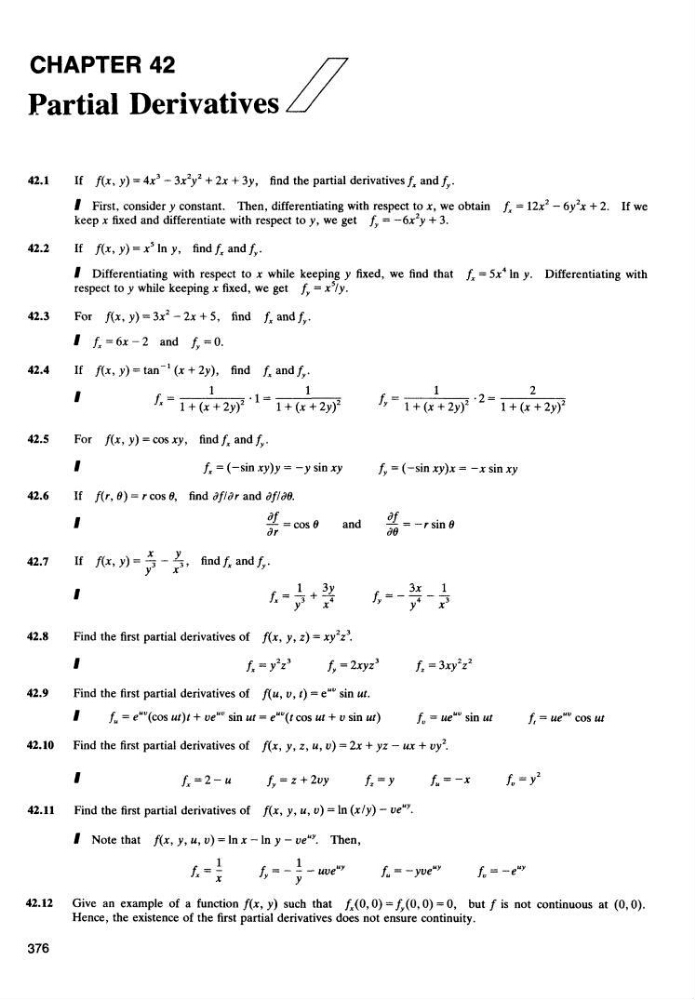
If f(x, y) = 4x3 - 3x2y2 + 2x + 3y, find the partial derivatives £ and f
y .
First, consider y constant. Then, differentiating with respect to x, we obtain f f = I2x
2 — 6y
2 x + 2. If we
keep x fixed and differentiate with respect to y, we get f y = —6x
2 y + 3.
If f(x, y) = x5 In y, find £ and f y .
Differentiating with respect to x while keeping y fixed, we find that f x = 5x* In y. Differentiating with
respect to y while keeping x fixed, we get fy — xs/y.
For f(x, y) = 3x2-2x + 5, find fxandfy.
f x=6x-2 and fy = 0.
If f(x,y) = tanl (x + 2y), find /.and/,.
For /(AC , y) = cos xy, find £ and /j,.
A = (-sin *y);y = -y sin *y /y = (-sin xy)x = -x sin xy
If /(r, 0) = r cos 0, find and
If /(*,y) =
Find the first partial derivatives of f(x, y, z) = xy
2 z
3 .
Find the first partial derivatives of f(u, v, t) — e
uv sin ut.
Find the first partial derivatives of f(x, y, z, u, u) = 2x + yz — ux + vy
2 .
Find the first partial derivatives of f(x, y, u, v) = In (x/y) - ve"
y .
Note that f(x, y, u, v) = In x — In y — ve
uy . Then,
Give an example of a function f(x, y) such that £(0,0) =/j,(0,0) = 0, but / is not continuous at (0,0).
Hence, the existence of the first partial derivatives does not ensure continuity.
f, = y2*3
/„ = ue
u " sin ut
f, = ue"
v cos ut
/„ = e
u "(cos ut)t + ve"" sin ut = e
uv (t cos ut + v sin wf)
A = 2-«
/, = z + 2yy
A = y
/. = -*
/. = y
2
/„ = -yve
uy
/„ = -*""
find fx and /j,.
/,=3xyV
fy=2xyz3
Partial Derivatives
42.1
42.2
42.3
42.4
42.5
42.6
42.7
42.8
42.9
42.10
42.11
42.12
376
If f(x, y) = 4x3 - 3x2y2 + 2x + 3y, find the partial derivatives £ and f
y .
First, consider y constant. Then, differentiating with respect to x, we obtain f f = I2x
2 — 6y
2 x + 2. If we
keep x fixed and differentiate with respect to y, we get f y = —6x
2 y + 3.
If f(x, y) = x5 In y, find £ and f y .
Differentiating with respect to x while keeping y fixed, we find that f x = 5x* In y. Differentiating with
respect to y while keeping x fixed, we get fy — xs/y.
For f(x, y) = 3x2-2x + 5, find fxandfy.
f x=6x-2 and fy = 0.
If f(x,y) = tanl (x + 2y), find /.and/,.
For /(AC , y) = cos xy, find £ and /j,.
A = (-sin *y);y = -y sin *y /y = (-sin xy)x = -x sin xy
If /(r, 0) = r cos 0, find and
If /(*,y) =
Find the first partial derivatives of f(x, y, z) = xy
2 z
3 .
Find the first partial derivatives of f(u, v, t) — e
uv sin ut.
Find the first partial derivatives of f(x, y, z, u, u) = 2x + yz — ux + vy
2 .
Find the first partial derivatives of f(x, y, u, v) = In (x/y) - ve"
y .
Note that f(x, y, u, v) = In x — In y — ve
uy . Then,
Give an example of a function f(x, y) such that £(0,0) =/j,(0,0) = 0, but / is not continuous at (0,0).
Hence, the existence of the first partial derivatives does not ensure continuity.
f, = y2*3
/„ = ue
u " sin ut
f, = ue"
v cos ut
/„ = e
u "(cos ut)t + ve"" sin ut = e
uv (t cos ut + v sin wf)
A = 2-«
/, = z + 2yy
A = y
/. = -*
/. = y
2
/„ = -yve
uy
/„ = -*""
find fx and /j,.
/,=3xyV
fy=2xyz3