

378
CHAPTER 42
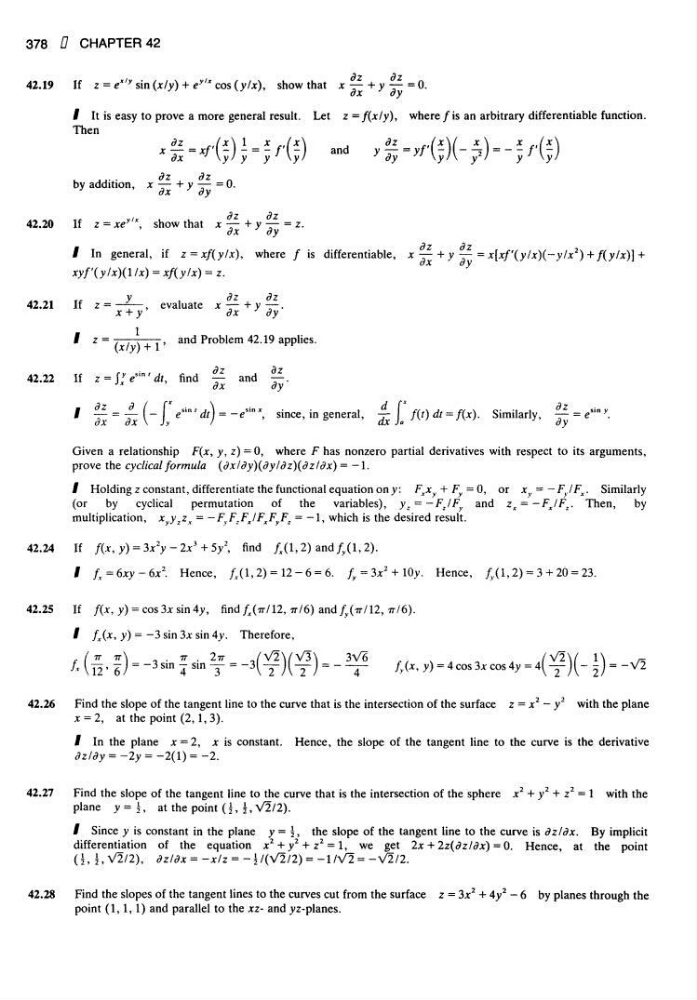
42.19
42.20
42.21
42.22
42.24
42.25
42.26
42.27
42.28
Find the slopes of the tangent lines to the curves cut from the surface z = 3x
2 + 4y
2 -6 by planes through the
point (1,1,1) and parallel to the xz- and yz-planes.
Find the slope of the tangent line to the curve that is the intersection of the sphere x
2 + y
2 + z
2 = 1 with the
plane y=f, at the point (j, j, V2/2).
In the plane x = 2, x is constant. Hence, the slope of the tangent line to the curve is the derivative
dzldy = -2y = -2(1) = -2.
Find the slope of the tangent line to the curve that is the intersection of the surface z = x
2 — y
2
with the plane
x = 2, at the point (2,1,3).
/,.(•*» y) = 4 cos 3x cos 4y = 4
f r(x, y) = ~3 sin 3x sin 4y. Therefore,
If f(x, y) = cos 3x sin 4y, find £(ir/12, 77/6) and f(ir/U, ir/6).
f r=6xy-6x2. Hence, £(1,2) = 12-6 = 6. /, = 3x2 + IQy. Hence, £(1,2) = 3 + 20 = 23.
If f(x, y) = Ix2y - 2x + 5y2, find £(1,2) and/v(l,2).
If z = e"ysin(x/y) + ey"tcos(y/x),show that
It is easy to prove a more general result. Let z=f(x/y), where/is an arbitrary differentiable function.
Then
and
by addition,
If z = xe
y '*, show that
In general, if z = xf(y/x), where / is differentiable,
evaluate
If
If
and Problem 42.19 applies.
find
and
since, in general,
Similarly,
Given a relationship F(x, y, z) = 0, where F has nonzero partial derivatives with respect to its arguments,
prove the cyclical formula (dxldy)(dyldz)(dz/dx)
= -1.
Holding z constant, differentiate the functional equation on y: F x x y + F y =-0, or x y = -F y IF x . Similarly
(or by cyclical permutation of the variables), y :
= ~F l /F y and z x =-F >t /F 2 . Then, by
multiplication, x y y z z x = —F y F.FJF x F y F I = — 1, which is the desired result.
Since y is constant in the plane y = 5, the slope of the tangent line to the curve is dzldx. By implicit
differentiation of the equation x
2 + y
2 + z
2 = l, we get 2x + 2z(dzldx) = 0. Hence, at the point
(\, \, V2/2), dzldx= -jc/z = -4/(V2/2)= -1/V2= -V2/2.
CHAPTER 42
42.19
42.20
42.21
42.22
42.24
42.25
42.26
42.27
42.28
Find the slopes of the tangent lines to the curves cut from the surface z = 3x
2 + 4y
2 -6 by planes through the
point (1,1,1) and parallel to the xz- and yz-planes.
Find the slope of the tangent line to the curve that is the intersection of the sphere x
2 + y
2 + z
2 = 1 with the
plane y=f, at the point (j, j, V2/2).
In the plane x = 2, x is constant. Hence, the slope of the tangent line to the curve is the derivative
dzldy = -2y = -2(1) = -2.
Find the slope of the tangent line to the curve that is the intersection of the surface z = x
2 — y
2
with the plane
x = 2, at the point (2,1,3).
/,.(•*» y) = 4 cos 3x cos 4y = 4
f r(x, y) = ~3 sin 3x sin 4y. Therefore,
If f(x, y) = cos 3x sin 4y, find £(ir/12, 77/6) and f(ir/U, ir/6).
f r=6xy-6x2. Hence, £(1,2) = 12-6 = 6. /, = 3x2 + IQy. Hence, £(1,2) = 3 + 20 = 23.
If f(x, y) = Ix2y - 2x + 5y2, find £(1,2) and/v(l,2).
If z = e"ysin(x/y) + ey"tcos(y/x),show that
It is easy to prove a more general result. Let z=f(x/y), where/is an arbitrary differentiable function.
Then
and
by addition,
If z = xe
y '*, show that
In general, if z = xf(y/x), where / is differentiable,
evaluate
If
If
and Problem 42.19 applies.
find
and
since, in general,
Similarly,
Given a relationship F(x, y, z) = 0, where F has nonzero partial derivatives with respect to its arguments,
prove the cyclical formula (dxldy)(dyldz)(dz/dx)
= -1.
Holding z constant, differentiate the functional equation on y: F x x y + F y =-0, or x y = -F y IF x . Similarly
(or by cyclical permutation of the variables), y :
= ~F l /F y and z x =-F >t /F 2 . Then, by
multiplication, x y y z z x = —F y F.FJF x F y F I = — 1, which is the desired result.
Since y is constant in the plane y = 5, the slope of the tangent line to the curve is dzldx. By implicit
differentiation of the equation x
2 + y
2 + z
2 = l, we get 2x + 2z(dzldx) = 0. Hence, at the point
(\, \, V2/2), dzldx= -jc/z = -4/(V2/2)= -1/V2= -V2/2.