

FUNCTIONS OF SEVERAL VARIABLES
373
41.65
41.66
Find the domain of definition of the function f(x, y) = In (16 - x
2 - y
2 ) + In (x
2 + y
2 - 1).
This is defined when the arguments of the In function are positive, that is, when 16 - x
2 — y
2 > 0 and
Ar
2 + y
2 -l>0, or, equivalently, 1
2 < 16. Thus, the domain consists of all points between the
concentric circles around the origin of radii 1 and 4.
Find the domain of definition of f(x, y) = e* In (xy).
The function is defined when and only when xy > 0, that is, in the first and third quadrants (and not on the
axes).
CYLINDRICAL AND SPHERICAL COORDINATES
41.67
41.68
41.69
41.70
41.71
41.72
41.73
41.74
41.75
41.76
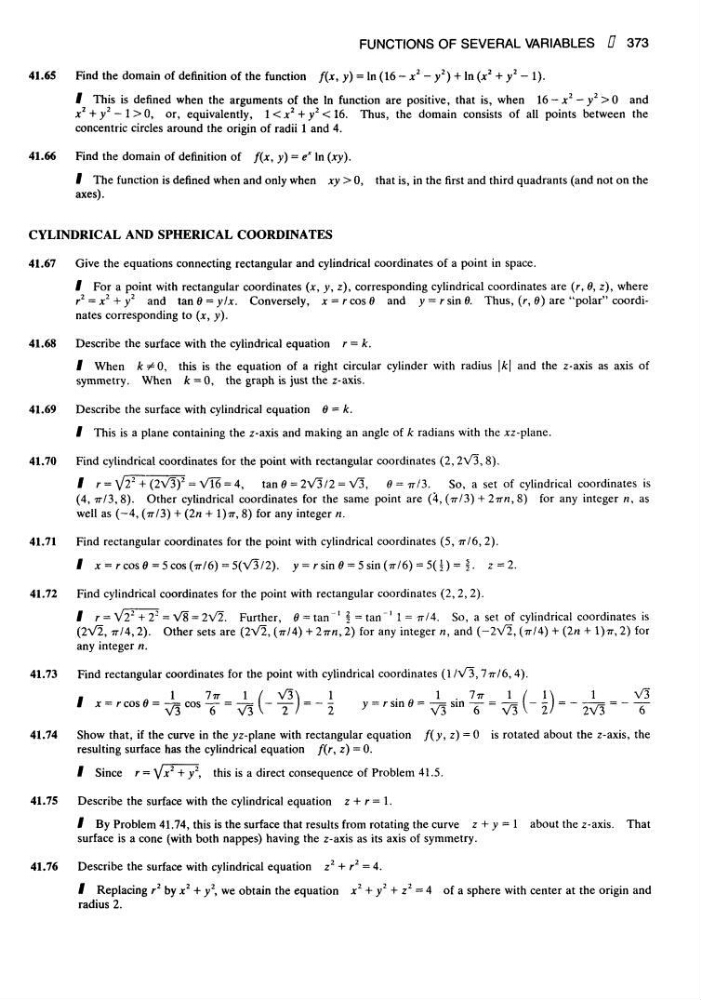
Give the equations connecting rectangular and cylindrical coordinates of a point in space
For a point with rectangular coordinates (x, y, z), corresponding cylindrical coordinates are (r, 0, z), where
r
2 = x
2 + y
2
and tanO = y/x. Conversely, ;t = rcos0 and y = rsin0. Thus, (r, 0) are "polar" coordinates corresponding to (x, y).
Describe the surface with the cylindrical equation r = k.
When k ^0, this is the equation of a right circular cylinder with radius \k\ and the z-axis as axis of
symmetry. When k = 0, the graph is just the z-axis.
Describe the surface with cylindrical equation 6 = k.
This is a plane containing the z-axis and making an angle of k radians with the *z-plane.
Find cylindrical coordinates for the point with rectangular coordinates (2, 2V5, 8).
So, a set of cylindrical coordinates is
(4, Tr/3,8). Other cylindrical coordinates for the same point are (4, (i7/3) + 2-rrn, 8) for any integer n, as
well as (-4, (w/3) + (in + I)TT, 8) for any integer n.
Find rectangular coordinates for the point with cylindrical coordinates (5,77/6, 2).
Find cylindrical coordinates for the point with rectangular coordinates (2, 2, 2).
Other sets are
for any integer n, and
So, a set of cylindrical coordinates is
for
any integer n.
z = 2.
Find rectangular coordinates for the point with cylindrical coordinates (1/V3, 7ir/6, 4).
Show that, if the curve in the yz-plane with rectangular equation f(y, z) = 0 is rotated about the z-axis, the
resulting surface has the cylindrical equation f(r, z) = 0.
Since
this is a direct consequence of Problem 41.5.
Describe the surface with the cylindrical equation z + r — 1.
By Problem 41.74, this is the surface that results from rotating the curve z + y - 1 about the z-axis. That
surface is a cone (with both nappes) having the z-axis as its axis of symmetry.
Describe the surface with cylindrical equation z
2 + r
2 = 4.
Replacing r
2 by x
2 + y
2 , we obtain the equation x
2 + y
2 + z
2 = 4 of a sphere with center at the origin and
radius 2.
Further,
x = r cos 6 = 5 cos (77/6) = 5(V5/2). y = r sin 0 = 5 sin (Tr/6) = 5( |) = |.
r = V? + (2V3)
2 = VIS = 4, tane = 2V3/2 = V3,
6 = IT 13.
373
41.65
41.66
Find the domain of definition of the function f(x, y) = In (16 - x
2 - y
2 ) + In (x
2 + y
2 - 1).
This is defined when the arguments of the In function are positive, that is, when 16 - x
2 — y
2 > 0 and
Ar
2 + y
2 -l>0, or, equivalently, 1
2 < 16. Thus, the domain consists of all points between the
concentric circles around the origin of radii 1 and 4.
Find the domain of definition of f(x, y) = e* In (xy).
The function is defined when and only when xy > 0, that is, in the first and third quadrants (and not on the
axes).
CYLINDRICAL AND SPHERICAL COORDINATES
41.67
41.68
41.69
41.70
41.71
41.72
41.73
41.74
41.75
41.76
Give the equations connecting rectangular and cylindrical coordinates of a point in space
For a point with rectangular coordinates (x, y, z), corresponding cylindrical coordinates are (r, 0, z), where
r
2 = x
2 + y
2
and tanO = y/x. Conversely, ;t = rcos0 and y = rsin0. Thus, (r, 0) are "polar" coordinates corresponding to (x, y).
Describe the surface with the cylindrical equation r = k.
When k ^0, this is the equation of a right circular cylinder with radius \k\ and the z-axis as axis of
symmetry. When k = 0, the graph is just the z-axis.
Describe the surface with cylindrical equation 6 = k.
This is a plane containing the z-axis and making an angle of k radians with the *z-plane.
Find cylindrical coordinates for the point with rectangular coordinates (2, 2V5, 8).
So, a set of cylindrical coordinates is
(4, Tr/3,8). Other cylindrical coordinates for the same point are (4, (i7/3) + 2-rrn, 8) for any integer n, as
well as (-4, (w/3) + (in + I)TT, 8) for any integer n.
Find rectangular coordinates for the point with cylindrical coordinates (5,77/6, 2).
Find cylindrical coordinates for the point with rectangular coordinates (2, 2, 2).
Other sets are
for any integer n, and
So, a set of cylindrical coordinates is
for
any integer n.
z = 2.
Find rectangular coordinates for the point with cylindrical coordinates (1/V3, 7ir/6, 4).
Show that, if the curve in the yz-plane with rectangular equation f(y, z) = 0 is rotated about the z-axis, the
resulting surface has the cylindrical equation f(r, z) = 0.
Since
this is a direct consequence of Problem 41.5.
Describe the surface with the cylindrical equation z + r — 1.
By Problem 41.74, this is the surface that results from rotating the curve z + y - 1 about the z-axis. That
surface is a cone (with both nappes) having the z-axis as its axis of symmetry.
Describe the surface with cylindrical equation z
2 + r
2 = 4.
Replacing r
2 by x
2 + y
2 , we obtain the equation x
2 + y
2 + z
2 = 4 of a sphere with center at the origin and
radius 2.
Further,
x = r cos 6 = 5 cos (77/6) = 5(V5/2). y = r sin 0 = 5 sin (Tr/6) = 5( |) = |.
r = V? + (2V3)
2 = VIS = 4, tane = 2V3/2 = V3,
6 = IT 13.