

374
CHAPTER 41
41.77
41.78
41.79
41.80
41.81
41.82
41.83
41.84
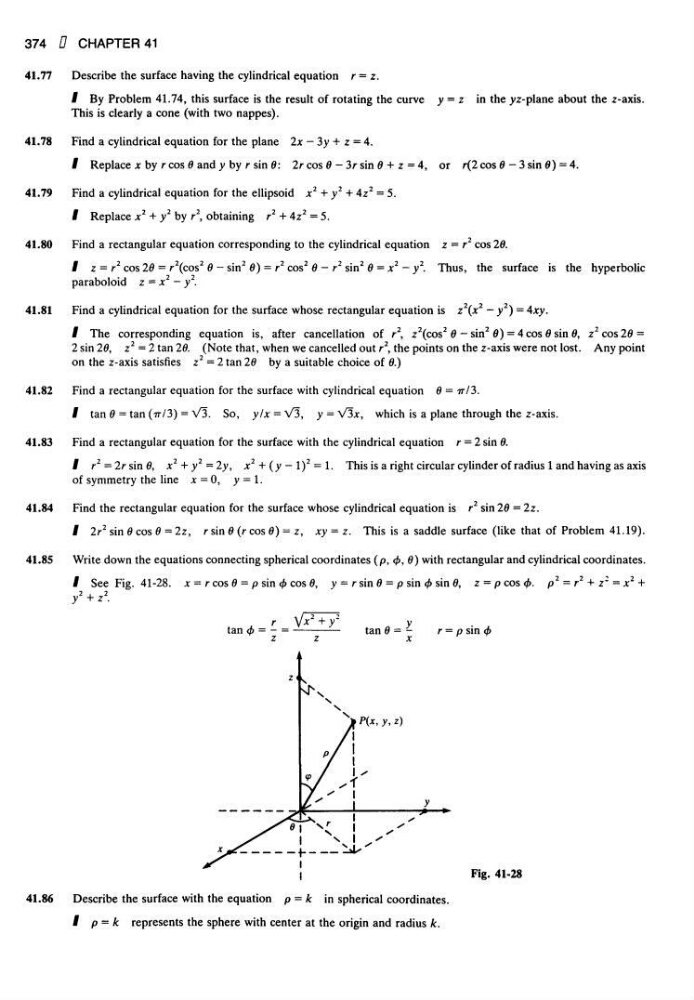
41.85
41.86
Describe the surface having the cylindrical equation r — z.
By Problem 41.74, this surface is the result of rotating the curve y = z in the yz-plane about the z-axis.
This is clearly a cone (with two nappes).
Find a cylindrical equation for the plane 2x — 3y + z = 4.
Replace x by r cos 6 and y by r sin 0: 2rcosO — 3rsmd + z=4, or r(2cos0 — 3sin0) = 4.
Find a cylindrical equation for the ellipsoid x
2 + y
2 + 4z
2 = 5.
Replace x
2 + y
2 by r
2 , obtaining r
2 + 4z
2 = 5.
Find a rectangular equation corresponding to the cylindrical equation z = r
2 cos 26.
paraboloid z = x — y .
Find a cylindrical equation for the surface whose rectangular equation is z2(x2 - y2) = 4xy.
The corresponding equation is, after cancellation of r
2 , z
2 (cos
2 0 - sin
2 0) = 4 cos 0 sin 0, z
2 cos 20 =
2 sin 20, z
2 =2 tan 26. (Note that, when we cancelled out r
2 , the points on the z-axis were not lost. Any point
on the z-axis satisfies z
2 = 2 tan 26 by a suitable choice of 6.)
Find a rectangular equation for the surface with cylindrical equation 6 = Tr/3.
which is a plane through the z-axis.
Find a rectangular equation for the surface with the cylindrical equation r = 2 sin 6.
r
2 = 2rsin6, x
2 +y
2 =2y, x
2 + (y - I)
2 = 1. This is a right circular cylinder of radius 1 and having as axis
of symmetry the line x = Q, y = l.
Find the rectangular equation for the surface whose cylindrical equation is r
2 sin 20 = 2z.
2r
2 sin 6 cos 6 = 2z, r sin 6 (r cos 6) = z, xy = z. This is a saddle surface (like that of Problem 41.19).
Write down the equations connecting spherical coordinates (p,, 6) with rectangular and cylindrical coordinates.
See Fig. 41-28. x = r cos 6 = p sin cos 6, y = r sin 6 = p sin sin 0, z = p cos 4>. p
2 = r
2 + z
: = x
2 +
Fig. 41-28
Describe the surface with the equation p = k in spherical coordinates.
p = k represents the sphere with center at the origin and radius k.
z = r2 cos 20 = r2(cos2 0 - sin2 0) = r2 cos2 6 - r2 sin2 0 = x2 - y2.Thus, the surface is the hyperbolic
_ -
~>
•)
So,
tan 0 = tan (ir/3) = V5.
y/x = V5, y = V3x,
y2 + z2.
CHAPTER 41
41.77
41.78
41.79
41.80
41.81
41.82
41.83
41.84
41.85
41.86
Describe the surface having the cylindrical equation r — z.
By Problem 41.74, this surface is the result of rotating the curve y = z in the yz-plane about the z-axis.
This is clearly a cone (with two nappes).
Find a cylindrical equation for the plane 2x — 3y + z = 4.
Replace x by r cos 6 and y by r sin 0: 2rcosO — 3rsmd + z=4, or r(2cos0 — 3sin0) = 4.
Find a cylindrical equation for the ellipsoid x
2 + y
2 + 4z
2 = 5.
Replace x
2 + y
2 by r
2 , obtaining r
2 + 4z
2 = 5.
Find a rectangular equation corresponding to the cylindrical equation z = r
2 cos 26.
paraboloid z = x — y .
Find a cylindrical equation for the surface whose rectangular equation is z2(x2 - y2) = 4xy.
The corresponding equation is, after cancellation of r
2 , z
2 (cos
2 0 - sin
2 0) = 4 cos 0 sin 0, z
2 cos 20 =
2 sin 20, z
2 =2 tan 26. (Note that, when we cancelled out r
2 , the points on the z-axis were not lost. Any point
on the z-axis satisfies z
2 = 2 tan 26 by a suitable choice of 6.)
Find a rectangular equation for the surface with cylindrical equation 6 = Tr/3.
which is a plane through the z-axis.
Find a rectangular equation for the surface with the cylindrical equation r = 2 sin 6.
r
2 = 2rsin6, x
2 +y
2 =2y, x
2 + (y - I)
2 = 1. This is a right circular cylinder of radius 1 and having as axis
of symmetry the line x = Q, y = l.
Find the rectangular equation for the surface whose cylindrical equation is r
2 sin 20 = 2z.
2r
2 sin 6 cos 6 = 2z, r sin 6 (r cos 6) = z, xy = z. This is a saddle surface (like that of Problem 41.19).
Write down the equations connecting spherical coordinates (p,
See Fig. 41-28. x = r cos 6 = p sin
2 = r
2 + z
: = x
2 +
Fig. 41-28
Describe the surface with the equation p = k in spherical coordinates.
p = k represents the sphere with center at the origin and radius k.
z = r2 cos 20 = r2(cos2 0 - sin2 0) = r2 cos2 6 - r2 sin2 0 = x2 - y2.Thus, the surface is the hyperbolic
_ -
~>
•)
So,
tan 0 = tan (ir/3) = V5.
y/x = V5, y = V3x,
y2 + z2.