

372
CHAPTER 41
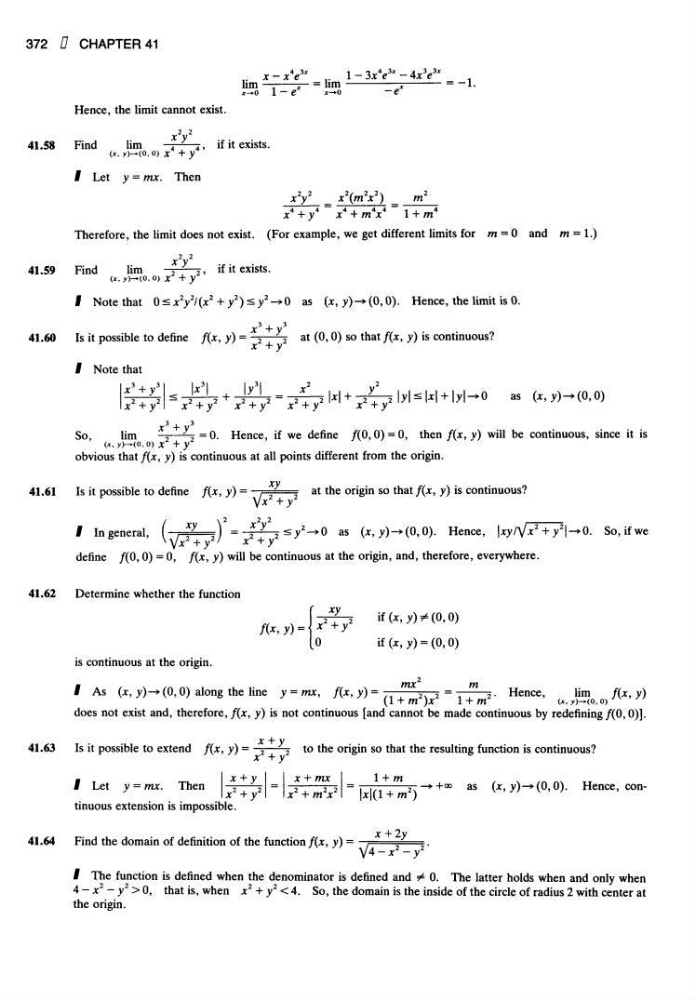
Hence, the limit cannot exist.
41.58
41.59
41.60
41.61
41.62
41.63
41.64
The function is defined when the denominator is defined and ^ 0. The latter holds when and only when
4 - x
2 - y
2 > 0, that is, when x
2 + y
1 < 4. So, the domain is the inside of the circle of radius 2 with center at
the origin.
Find the domain of definition of the function f(x, y) =
tinuous extension is impossible.
Let y = mx. Then
Is it possible to extend f(x, y) =
to the origin so that the resulting function is continuous?
as (x, y)-»(0, 0). Hence, conAs (x, y)-»(0,0) along the line y = mx, f(x, y) =
Hence,
does not exist and, therefore, f(x, y) is not continuous land cannot be made continuous by redefining /(0,0)]
is continuous at the origin.
Determine whether the function
In general,
as (x, y)-* (0,0). Hence,
So, if we
define /(0,0) = 0, f(x, y) will be continuous at the origin, and, therefore, everywhere.
Hence, if we define /(0,0) = 0, then f(x, y) will be continuous, since it is
obvious that f(x, y) is continuous at all points different from the origin.
Is it possible to define f(x, y) =
at the origin so that f(x, y) is continuous?
So,
Note that
Is it possible to define f(x, y) =
at (0,0) so that f(x, y) is continuous?
Notethat Q
Find
if it exists.
Let y = mx. Then
Find
if it exists.
as (x, y)-+(Q,Q)
CHAPTER 41
Hence, the limit cannot exist.
41.58
41.59
41.60
41.61
41.62
41.63
41.64
The function is defined when the denominator is defined and ^ 0. The latter holds when and only when
4 - x
2 - y
2 > 0, that is, when x
2 + y
1 < 4. So, the domain is the inside of the circle of radius 2 with center at
the origin.
Find the domain of definition of the function f(x, y) =
tinuous extension is impossible.
Let y = mx. Then
Is it possible to extend f(x, y) =
to the origin so that the resulting function is continuous?
as (x, y)-»(0, 0). Hence, conAs (x, y)-»(0,0) along the line y = mx, f(x, y) =
Hence,
does not exist and, therefore, f(x, y) is not continuous land cannot be made continuous by redefining /(0,0)]
is continuous at the origin.
Determine whether the function
In general,
as (x, y)-* (0,0). Hence,
So, if we
define /(0,0) = 0, f(x, y) will be continuous at the origin, and, therefore, everywhere.
Hence, if we define /(0,0) = 0, then f(x, y) will be continuous, since it is
obvious that f(x, y) is continuous at all points different from the origin.
Is it possible to define f(x, y) =
at the origin so that f(x, y) is continuous?
So,
Note that
Is it possible to define f(x, y) =
at (0,0) so that f(x, y) is continuous?
Notethat Q
Find
if it exists.
Let y = mx. Then
Find
if it exists.
as (x, y)-+(Q,Q)