

FUNCTIONS OF SEVERAL VARIABLES
363
Of what curve in the yz-plane is the surface x
2 + y
2 — z
2 = 1 a surface of revolution?
It is equivalent to
which is obtained from the hyperbola y
2 — z
2 = 1 by rotation
around the z-axis.
41.11
41.12
41.13
From what curve in the Jty-plane is the surface 9x
2 + 25y
2 + 9z
2 = 225 obtained by rotation abo'ut the y-axis?
It is equivalent to
which is obtained from 9x
2 + 25y
2 = 225 by rotation
about the y-axis. The latter curve is the ellipse
Describe and sketch the graph of
where a, b,c>0.
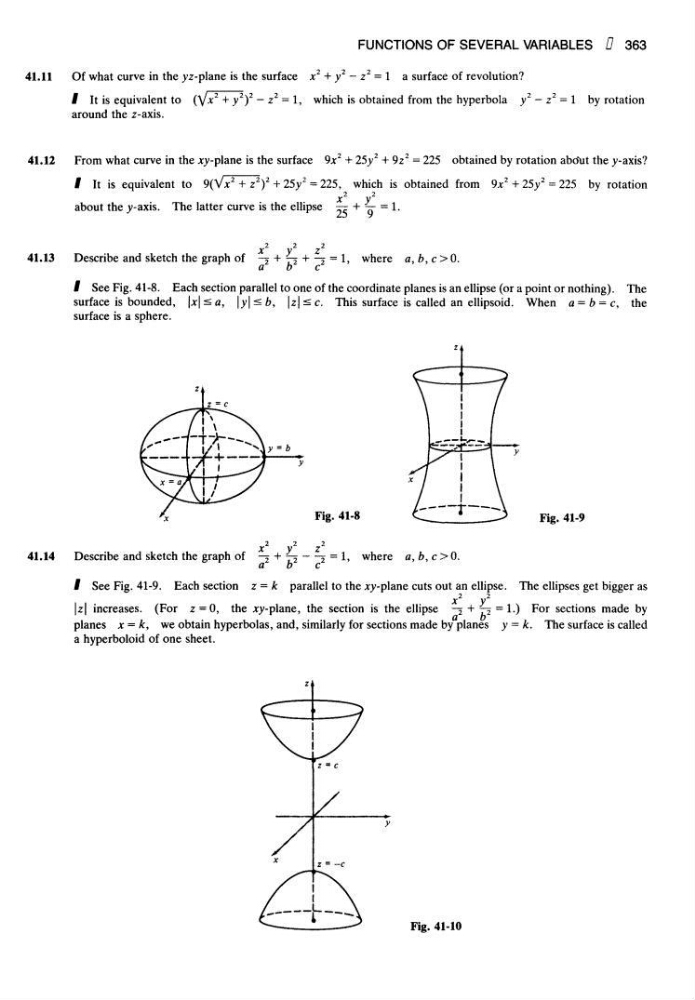
See Fig. 41-8. Each section parallel to one of the coordinate planes is an ellipse (or a point or nothing). The
surface is bounded, \x\ < a, \y\
41.14
Describe and sketch the graph of
Fig. 41-8
Fig. 41-9
where a, b, c>0.
See Fig. 41-9. Each section z = k parallel to the xy-plane cuts out an ellipse. The ellipses get bigger as
|z| increases. (For z=0, the ry-plane, the section is the ellipse
For sections made by
planes x = k, we obtain hyperbolas, and, similarly for sections made by planes y = k. The surface is called
a hyperboloid of one sheet.
Fig. 41-10
363
Of what curve in the yz-plane is the surface x
2 + y
2 — z
2 = 1 a surface of revolution?
It is equivalent to
which is obtained from the hyperbola y
2 — z
2 = 1 by rotation
around the z-axis.
41.11
41.12
41.13
From what curve in the Jty-plane is the surface 9x
2 + 25y
2 + 9z
2 = 225 obtained by rotation abo'ut the y-axis?
It is equivalent to
which is obtained from 9x
2 + 25y
2 = 225 by rotation
about the y-axis. The latter curve is the ellipse
Describe and sketch the graph of
where a, b,c>0.
See Fig. 41-8. Each section parallel to one of the coordinate planes is an ellipse (or a point or nothing). The
surface is bounded, \x\ < a, \y\
41.14
Describe and sketch the graph of
Fig. 41-8
Fig. 41-9
where a, b, c>0.
See Fig. 41-9. Each section z = k parallel to the xy-plane cuts out an ellipse. The ellipses get bigger as
|z| increases. (For z=0, the ry-plane, the section is the ellipse
For sections made by
planes x = k, we obtain hyperbolas, and, similarly for sections made by planes y = k. The surface is called
a hyperboloid of one sheet.
Fig. 41-10