

364
CHAPTER 41
41.15
Describe and sketch the graph of
where a, b, c > 0.
See Fig. 41-10. Note that
Hence, \z\ & c. The sections by planes z = k,
with \k\ > c, are ellipses. When |z| = c, we obtain a point (0,0, ± c). The sections determined by planes
x = k or y = k are hyperbolas. The surface is called a hyperboloid of two sheets.
41.16
Describe and sketch the graph of
where a, b, c>0.
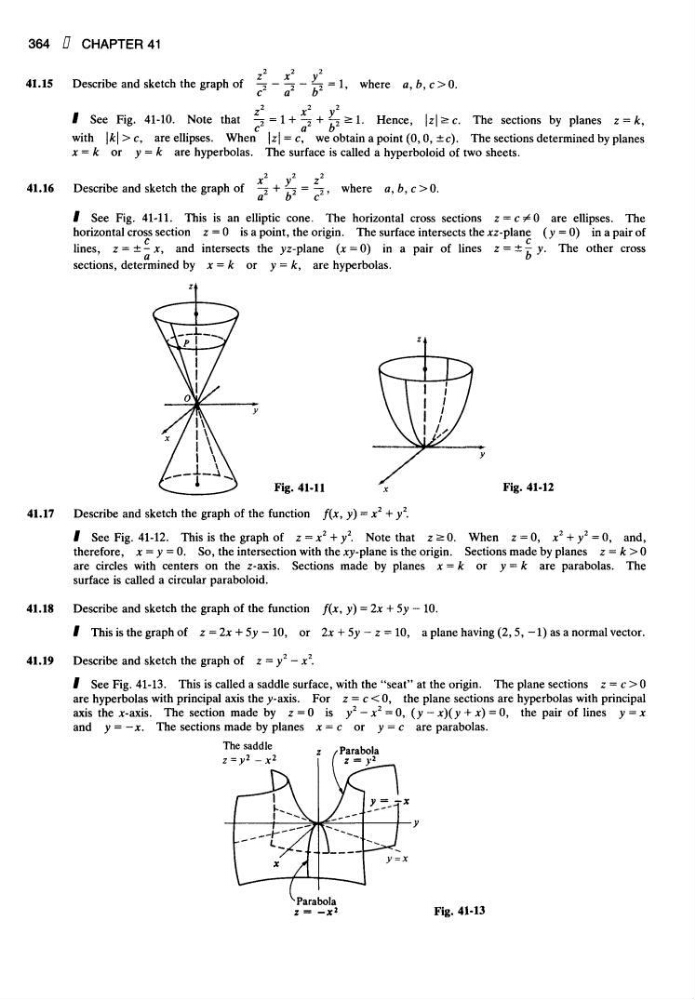
See Fig. 41-11. This is an elliptic cone. The horizontal cross sections z = c^0 are ellipses. The
horizontal cross section z = 0 is a point, the origin. The surface intersects the xz-plane (y = 0) in a pair of
lines, z = ±- x, and intersects the yz-plane (x = 0) in a pair of lines Z = ±T y. The other cross
sections, determined by x = k or y = k, are hyperbolas.
Fig. 41-11
Fig. 41-12
Describe and sketch the graph of the function f(x, y) = x
2 + y
2 .
See Fig. 41-12. This is the graph of z = x
2 + y
2 . Note that z > 0. When z = 0, x
2 + y
2 = 0, and,
therefore, x = y = 0. So, the intersection with the xy-plane is the origin. Sections made by planes z = fc>0
are circles with centers on the z-axis. Sections made by planes x = k or y = k are parabolas. The
surface is called a circular paraboloid.
41.17
41.18
41.19
Describe and sketch the graph of the function f(x, y) = 2x + 5y - 10.
This is the graph of z = 2x + 5y — 10, or 2x + 5y - z = 10, a plane having (2,5, -1) as a normal vector.
Describe and sketch the graph of z = y — x .
See Fig. 41-13. This is called a saddle surface, with the "seat" at the origin. The plane sections 2 = c > 0
are hyperbolas with principal axis the _y-axis. For z = c < 0, the plane sections are hyperbolas with principal
axis the ^-axis. The section made by z = 0 is y
2 - x
2 =0, (y - x)(y + x) = 0, the pair of lines y = x
and y = —x. The sections made by planes x = c or y = c are parabolas.
Fig. 41-13
Download
from Wow! eBook
CHAPTER 41
41.15
Describe and sketch the graph of
where a, b, c > 0.
See Fig. 41-10. Note that
Hence, \z\ & c. The sections by planes z = k,
with \k\ > c, are ellipses. When |z| = c, we obtain a point (0,0, ± c). The sections determined by planes
x = k or y = k are hyperbolas. The surface is called a hyperboloid of two sheets.
41.16
Describe and sketch the graph of
where a, b, c>0.
See Fig. 41-11. This is an elliptic cone. The horizontal cross sections z = c^0 are ellipses. The
horizontal cross section z = 0 is a point, the origin. The surface intersects the xz-plane (y = 0) in a pair of
lines, z = ±- x, and intersects the yz-plane (x = 0) in a pair of lines Z = ±T y. The other cross
sections, determined by x = k or y = k, are hyperbolas.
Fig. 41-11
Fig. 41-12
Describe and sketch the graph of the function f(x, y) = x
2 + y
2 .
See Fig. 41-12. This is the graph of z = x
2 + y
2 . Note that z > 0. When z = 0, x
2 + y
2 = 0, and,
therefore, x = y = 0. So, the intersection with the xy-plane is the origin. Sections made by planes z = fc>0
are circles with centers on the z-axis. Sections made by planes x = k or y = k are parabolas. The
surface is called a circular paraboloid.
41.17
41.18
41.19
Describe and sketch the graph of the function f(x, y) = 2x + 5y - 10.
This is the graph of z = 2x + 5y — 10, or 2x + 5y - z = 10, a plane having (2,5, -1) as a normal vector.
Describe and sketch the graph of z = y — x .
See Fig. 41-13. This is called a saddle surface, with the "seat" at the origin. The plane sections 2 = c > 0
are hyperbolas with principal axis the _y-axis. For z = c < 0, the plane sections are hyperbolas with principal
axis the ^-axis. The section made by z = 0 is y
2 - x
2 =0, (y - x)(y + x) = 0, the pair of lines y = x
and y = —x. The sections made by planes x = c or y = c are parabolas.
Fig. 41-13
Download
from Wow! eBook