

362
CHAPTER 41
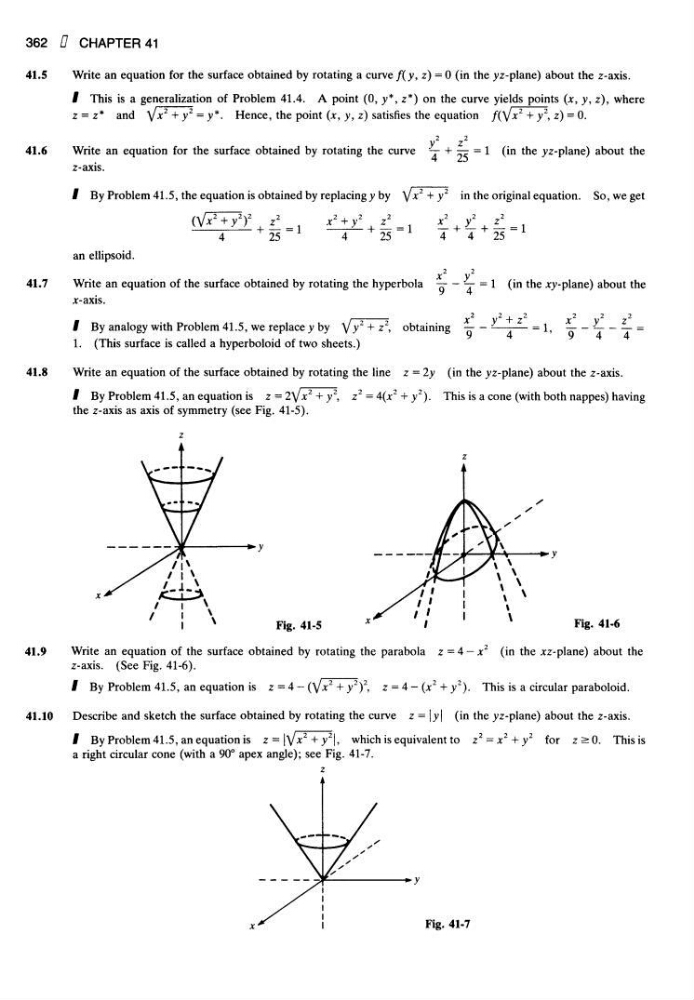
Fig. 41-7
Fig. 41-6
Fig. 41-5
Describe and sketch the surface obtained by rotating the curve z = \y\ (in the yz-plane) about the z-axis.
By Problem 41.5. an equation is
which is equivalent to z
2 = x
2 + y
2
for z a 0. This is
a right circular cone (with a 90° apex angle); see Fig. 41-7.
By Problem 41.5, an equation is z = 4 — i
41.9
41.10
Write an equation of the surface obtained by rotating the parabola z = 4 — x
2
(in the xz-plane) about the
z-axis. (See Fig. 41-6).
z = 4 - (x
2 + y
2 ). This is a circular paraboloid.
41.5
41.6
41.7
41.8
Write an equation for the surface obtained by rotating a curve f(y, z) = 0 (in the yz-plane) about the z-axis.
This is a generalization of Problem 41.4. A point (0, y*, z*) on the curve yields points (x, y, z), where
Hence, the point (x, y, z) satisfies the equation
z = z* and
Write an equation for the surface obtained by rotating the curve
z-axis.
(in the yz-plane) about the
By Problem 41.5, the equation is obtained by replacing y by
in the original equation. So, we get
an ellipsoid.
Write an equation of the surface obtained by rotating the hyperbola
*-axis.
(in the ry-plane) about the
obtaining
By analogy with Problem 41.5, we replace y by
1. (This surface is called a hyperboloid of two sheets.)
Write an equation of the surface obtained by rotating the line z = 2y (in the yz-plane) about the z-axis.
By Problem 41.5, an equation is
This is a cone (with both nappes) having
the z-axis as axis of symmetry (see Fig. 41-5)
CHAPTER 41
Fig. 41-7
Fig. 41-6
Fig. 41-5
Describe and sketch the surface obtained by rotating the curve z = \y\ (in the yz-plane) about the z-axis.
By Problem 41.5. an equation is
which is equivalent to z
2 = x
2 + y
2
for z a 0. This is
a right circular cone (with a 90° apex angle); see Fig. 41-7.
By Problem 41.5, an equation is z = 4 — i
41.9
41.10
Write an equation of the surface obtained by rotating the parabola z = 4 — x
2
(in the xz-plane) about the
z-axis. (See Fig. 41-6).
z = 4 - (x
2 + y
2 ). This is a circular paraboloid.
41.5
41.6
41.7
41.8
Write an equation for the surface obtained by rotating a curve f(y, z) = 0 (in the yz-plane) about the z-axis.
This is a generalization of Problem 41.4. A point (0, y*, z*) on the curve yields points (x, y, z), where
Hence, the point (x, y, z) satisfies the equation
z = z* and
Write an equation for the surface obtained by rotating the curve
z-axis.
(in the yz-plane) about the
By Problem 41.5, the equation is obtained by replacing y by
in the original equation. So, we get
an ellipsoid.
Write an equation of the surface obtained by rotating the hyperbola
*-axis.
(in the ry-plane) about the
obtaining
By analogy with Problem 41.5, we replace y by
1. (This surface is called a hyperboloid of two sheets.)
Write an equation of the surface obtained by rotating the line z = 2y (in the yz-plane) about the z-axis.
By Problem 41.5, an equation is
This is a cone (with both nappes) having
the z-axis as axis of symmetry (see Fig. 41-5)