

VECTORS IN SPACE. LINES AND PLANES
351
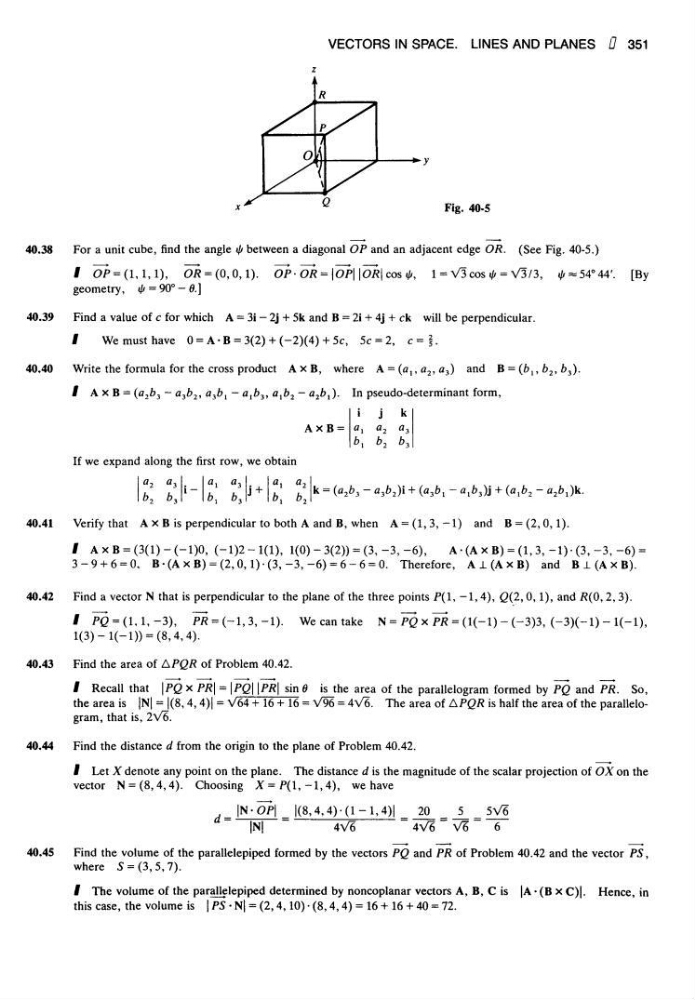
Fig. 40-5
40.38
40.39
40.40
40.41
40.42
40.43
40.44
40.45
For a unit cube, find the angle geometry, i/» = 90°— B.\
Find a value of c for which A = 3i - 2j + 5k and B = 2i + 4j + ck will be perpendicular.
We must have 0 = A • B = 3(2) + (-2)(4) + 5c, 5c = 2, c = |.
Write the formula for the cross product AxB, where A = (a,,a 2 , a 3 ) and B = (b^ b 2 , b,).
If we expand along the first row, we obtain
Verify that A x B is perpendicular to both A and B, when A = (1,3, -1) and B = (2,0,1).
AxB = (3(l)-(-l)0, (-1)2-1(1), 1(0)-3(2)) = (3,-3,-6),
A-(A x B) = (1, 3, -!)• (3, -3, -6) =
3-9 + 6 = 0, B-(AxB) = (2,0, l)-(3, -3, -6) = 6-6 = 0. Therefore, A 1 (A x B) and Bl(AxB).
Find a vector N that is perpendicular to the plane of the three points P(l, -1,4), Q(2,0,1), and ft(0, 2,3).
We can take
Find the area of &PQR of Problem 40.42.
Recall that |PQ x />fl| = [PQ| |P/?| sin 6 is the area of the parallelogram formed bv PO and PR. So,
and
So,
The area of APQR is half the area of the parallelothe area is |N| = |(8, 4, 4)| =
gram, that is,
Find the distance d from the origin to the plane of Problem 40.42.
Let X denote any point on the plane. The distance d is the magnitude of the scalar projection ofOX
vector N = (8,4,4). Choosing X = P(l, -1,4), we have
on the
Find the volume of the parallelepiped formed by the vectors PQ and PR of Problem 40.42 and the vector PS
where 5 = (3, 5,7)
The volume of the parallelepiped determined by noncoplanar vectors A, B, C is |A-(B x C)|. Hence, in
this case, the volume is IPS • N = (2,4,10)• (8,4,4) = 16 + 16 + 40 = 72.
[By
A x B = (a 2 b 3 - a 3 b 2 , a 3 b l - a t b 3 , a l b 2 — a 2 b t ). In pseudo-determinant form.
PC = (1,1,-3), PR = (-1,3, -1).
N = PQ x PR = (l(-l) - (-3)3, (-3)(-l) - 1(-1),
1(3)-!(-!)) = (8, 4, 4).
0P=(1,1,1), OR = (0,0,l). OP • OR = \OP\\OR\ cost, 1 = V3cos .//= V5/3, ^«54°44'.
351
Fig. 40-5
40.38
40.39
40.40
40.41
40.42
40.43
40.44
40.45
For a unit cube, find the angle geometry, i/» = 90°— B.\
Find a value of c for which A = 3i - 2j + 5k and B = 2i + 4j + ck will be perpendicular.
We must have 0 = A • B = 3(2) + (-2)(4) + 5c, 5c = 2, c = |.
Write the formula for the cross product AxB, where A = (a,,a 2 , a 3 ) and B = (b^ b 2 , b,).
If we expand along the first row, we obtain
Verify that A x B is perpendicular to both A and B, when A = (1,3, -1) and B = (2,0,1).
AxB = (3(l)-(-l)0, (-1)2-1(1), 1(0)-3(2)) = (3,-3,-6),
A-(A x B) = (1, 3, -!)• (3, -3, -6) =
3-9 + 6 = 0, B-(AxB) = (2,0, l)-(3, -3, -6) = 6-6 = 0. Therefore, A 1 (A x B) and Bl(AxB).
Find a vector N that is perpendicular to the plane of the three points P(l, -1,4), Q(2,0,1), and ft(0, 2,3).
We can take
Find the area of &PQR of Problem 40.42.
Recall that |PQ x />fl| = [PQ| |P/?| sin 6 is the area of the parallelogram formed bv PO and PR. So,
and
So,
The area of APQR is half the area of the parallelothe area is |N| = |(8, 4, 4)| =
gram, that is,
Find the distance d from the origin to the plane of Problem 40.42.
Let X denote any point on the plane. The distance d is the magnitude of the scalar projection ofOX
vector N = (8,4,4). Choosing X = P(l, -1,4), we have
on the
Find the volume of the parallelepiped formed by the vectors PQ and PR of Problem 40.42 and the vector PS
where 5 = (3, 5,7)
The volume of the parallelepiped determined by noncoplanar vectors A, B, C is |A-(B x C)|. Hence, in
this case, the volume is IPS • N = (2,4,10)• (8,4,4) = 16 + 16 + 40 = 72.
[By
A x B = (a 2 b 3 - a 3 b 2 , a 3 b l - a t b 3 , a l b 2 — a 2 b t ). In pseudo-determinant form.
PC = (1,1,-3), PR = (-1,3, -1).
N = PQ x PR = (l(-l) - (-3)3, (-3)(-l) - 1(-1),
1(3)-!(-!)) = (8, 4, 4).
0P=(1,1,1), OR = (0,0,l). OP • OR = \OP\\OR\ cost, 1 = V3cos .//= V5/3, ^«54°44'.