

352
CHAPTER 40
40.46
40.47
40.48
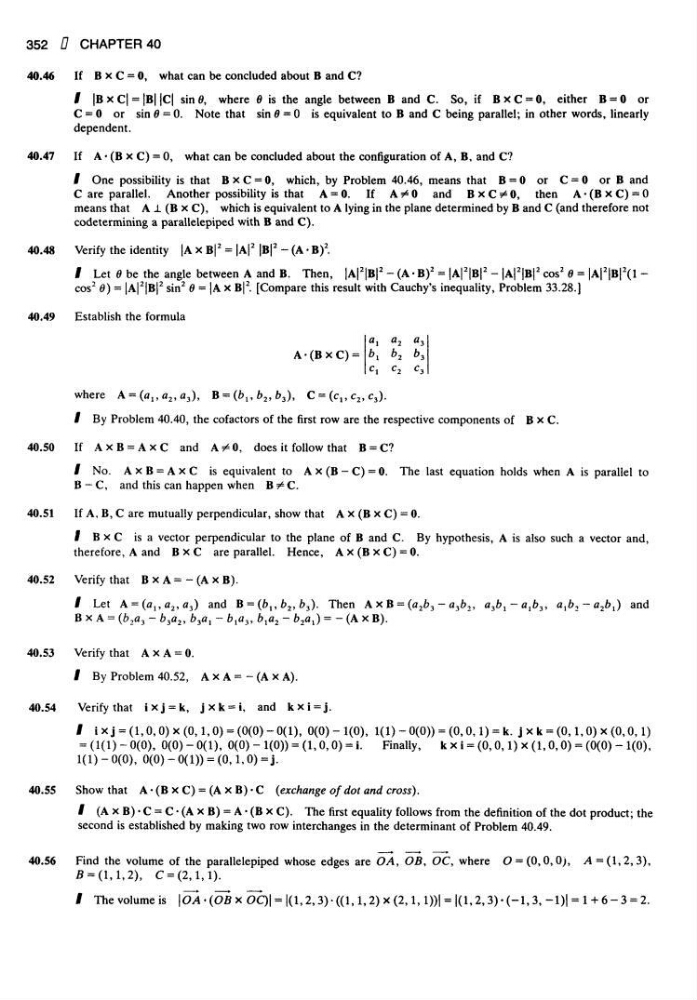
40.49
40.50
40.51
40.52
40.53
40.54
40.55
40.56
If B x C = 0, what can be concluded about B and C?
|B x C| = |B| |C| sin 0, where 0 is the angle between B and C. So, if B x C = 0, either B = 0 or
C = 0 or sin 0 = 0. Note that sin 0 = 0 is equivalent to B and C being parallel; in other words, linearly
dependent.
If A • (B x C) = 0, what can be concluded about the configuration of A, B, and C?
One possibility is that B x C = 0, which, by Problem 40.46, means that B = 0 or C = 0 orB and
C are parallel. Another possibility is that A = 0. If A ^ 0 and B x C * 0, then A • (B x C) = 0
means that A 1 (B x C), which is equivalent to A lying in the plane determined by B and C (and therefore not
codetermining a parallelepiped with B and C).
Verify the identity |A x B|
2 = |A|
2 |B|
2 - (A • B)
2
.
Let 6 be the angle between A and B. Then, |A|2|B|2 - (A • B)2 = |A|2|B|2 - |A|2|B|2 cos2 0 = |A|2|B|2(1 -
cos
2 8) = |A|
2 |B|
2 sin
2 0 = \\ x B|
2
. [Compare this result with Cauchy's inequality, Problem 33.28.]
Establish the formula
where A = (a,, a 2 , a 3 ), B = (b l , b 2 ,b 3 ), C = (c,, c 2) c 3 ).
By Problem 40.40, the cofactors of the first row are the respective components of B x C.
If A x B = A x C and A ^ 0, does it follow that B = C?
No. AxB = AxC is equivalent to A x (B - C) = 0. The last equation holds when A is parallel to
B-C, and this can happen when B^C.
If A, B, C are mutually perpendicular, show that A x (B x C) = 0.
B x C is a vector perpendicular to the plane of B and C. By hypothesis, A is also such a vector and,
therefore, A and B x C are parallel. Hence, A x (B x C) = 0.
Verify that B x A = - (A x B).
Let A = (a 1 ,a 2 ,a 3 ) and E = (b l ,b 2 ,b 3 ). Then A x B = (a 2 b 3 — a 3 b 2 , a 3 b l — a l b 3 , a l b 2 — a 2 b l ) and
B x A = (b2a3 - b,a2, b,a, - bta3, b,a2 - &,«,) = - (A x B).
Verify that A x A = 0.
By Problem 40.52, A x A = - (A x A).
Verify that ixj = k, jxk=i, and kxi=j.
i x j = (1,0,0) x (0,1,0) = (0(0) - 0(1), 0(0) - 1(0), 1(1) - 0(0)) = (0,0,1) = k. j x k = (0,1,0) x (0,0,1)
= (1(1)-0(0), 0(0)-0(1), 0(0)-l(0)) = (l,0,0) = i. Finally, kx i = (0,0,1) x (1,0,0) = (0(0) - 1(0),
1(1)-0(0), 0(0) -0(1)) = (0,1,0) =j.
Show that A • (B x C) = (A x B) • C (exchange of dot and cross).
(A x B) • C = C • (A x B) = A • (B x C). The first equality follows from the definition of the dot product; the
second is established by making two row interchanges in the determinant of Problem 40.49.
Find the volume of the parallelepiped whose edges are where O = (0,0,0), A = (1,2,3),
B = (1,1,2), C = (2,1,1).
Fhe volume is \OA • (OB x OC)\ = |(1,2,3) • ((1,1,2) x (2,1,1))| = |(1,2,3) • (-1,3, -1)| = 1 + 6 - 3 = 2.
CHAPTER 40
40.46
40.47
40.48
40.49
40.50
40.51
40.52
40.53
40.54
40.55
40.56
If B x C = 0, what can be concluded about B and C?
|B x C| = |B| |C| sin 0, where 0 is the angle between B and C. So, if B x C = 0, either B = 0 or
C = 0 or sin 0 = 0. Note that sin 0 = 0 is equivalent to B and C being parallel; in other words, linearly
dependent.
If A • (B x C) = 0, what can be concluded about the configuration of A, B, and C?
One possibility is that B x C = 0, which, by Problem 40.46, means that B = 0 or C = 0 orB and
C are parallel. Another possibility is that A = 0. If A ^ 0 and B x C * 0, then A • (B x C) = 0
means that A 1 (B x C), which is equivalent to A lying in the plane determined by B and C (and therefore not
codetermining a parallelepiped with B and C).
Verify the identity |A x B|
2 = |A|
2 |B|
2 - (A • B)
2
.
Let 6 be the angle between A and B. Then, |A|2|B|2 - (A • B)2 = |A|2|B|2 - |A|2|B|2 cos2 0 = |A|2|B|2(1 -
cos
2 8) = |A|
2 |B|
2 sin
2 0 = \\ x B|
2
. [Compare this result with Cauchy's inequality, Problem 33.28.]
Establish the formula
where A = (a,, a 2 , a 3 ), B = (b l , b 2 ,b 3 ), C = (c,, c 2) c 3 ).
By Problem 40.40, the cofactors of the first row are the respective components of B x C.
If A x B = A x C and A ^ 0, does it follow that B = C?
No. AxB = AxC is equivalent to A x (B - C) = 0. The last equation holds when A is parallel to
B-C, and this can happen when B^C.
If A, B, C are mutually perpendicular, show that A x (B x C) = 0.
B x C is a vector perpendicular to the plane of B and C. By hypothesis, A is also such a vector and,
therefore, A and B x C are parallel. Hence, A x (B x C) = 0.
Verify that B x A = - (A x B).
Let A = (a 1 ,a 2 ,a 3 ) and E = (b l ,b 2 ,b 3 ). Then A x B = (a 2 b 3 — a 3 b 2 , a 3 b l — a l b 3 , a l b 2 — a 2 b l ) and
B x A = (b2a3 - b,a2, b,a, - bta3, b,a2 - &,«,) = - (A x B).
Verify that A x A = 0.
By Problem 40.52, A x A = - (A x A).
Verify that ixj = k, jxk=i, and kxi=j.
i x j = (1,0,0) x (0,1,0) = (0(0) - 0(1), 0(0) - 1(0), 1(1) - 0(0)) = (0,0,1) = k. j x k = (0,1,0) x (0,0,1)
= (1(1)-0(0), 0(0)-0(1), 0(0)-l(0)) = (l,0,0) = i. Finally, kx i = (0,0,1) x (1,0,0) = (0(0) - 1(0),
1(1)-0(0), 0(0) -0(1)) = (0,1,0) =j.
Show that A • (B x C) = (A x B) • C (exchange of dot and cross).
(A x B) • C = C • (A x B) = A • (B x C). The first equality follows from the definition of the dot product; the
second is established by making two row interchanges in the determinant of Problem 40.49.
Find the volume of the parallelepiped whose edges are where O = (0,0,0), A = (1,2,3),
B = (1,1,2), C = (2,1,1).
Fhe volume is \OA • (OB x OC)\ = |(1,2,3) • ((1,1,2) x (2,1,1))| = |(1,2,3) • (-1,3, -1)| = 1 + 6 - 3 = 2.