

350
40.28
40.29
40.30
40.31
40.32
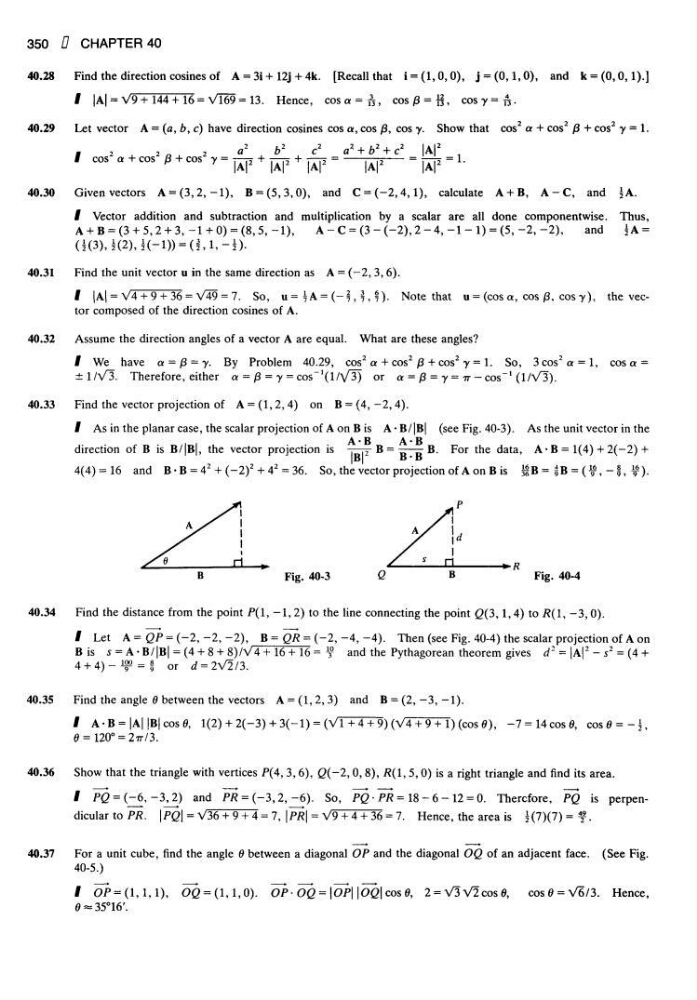
40.33
40.34
40.35
40.36
40.37
Find the direction cosines of A = 3i + 12j + 4k. [Recall that i = (1,0,0), j = (0,1,0), and k = (0,0,1).]
Let vector A = (a, b, c) have direction cosines cos a, cos /3, cos y. Show that cos
2 a + cos
2 j3 + cos
2 y = l.
Hence,
Given vectors A = (3,2,-l), B = (5,3,0), and C = (-2,4,1), calculate A + B, A-C, and jA.
Vector addition and subtraction and multiplication by a scalar are all done componentwise. Thus.
A + B = (3 + 5,2 + 3, -1 + 0) = (8,5, -1),
A -C = (3 - (-2),2 -4, -1 - 1) = (5, -2, -2),
and |A =
(i(3),i(2),J(-l)) = (M,-i).
Find the unit vector u in the same direction as A = (-2,3,6).
Note that u = (cos a, cos /3, cos y),
tor composed of the direction cosines of A.
the vecAssume the direction angles of a vector A are equal. What are these angles?
We have a = B = y. Bv Problem 40.29, cos
2 a + cos
2 B + cos
2 y = 1. So, 3 cos
2 a = 1, cos a =
Therefore, either a =/3 = y = cos (1/V3) or a =/3 = y = TT-cos ' (l/Vli).
Find the vector projection of A = (1,2, 4) on B = (4, -2, 4).
As in the planar case, the scalar projection of Aon B is A-B/|B| (see Fig. 40-3). As the unit vector in the
direction of B is B/|B|, the vector projection is
For the data, A • B = 1(4) + 2(-2) +
4(4) = 16 and B-B = 4
2 + (-2)
2 + 4
2 = 36. So, the vector projection of A on B is
Fig. 40-3
Fig. 40-4
Find the distance from the point F(l, -1, 2) to the line connecting the point Q(3,1,4) to /?(!, -3,0).
Then (see Fig. 40-4) the scalar projection of A on
and the Pythagorean theorem gives
Find the angle 0 between the vectors A = (1,2, 3) and B = (2, -3, -1).
Show that the triangle with vertices P(4, 3,6), Q(-2, 0,8), R(l, 5,0) is a right triangle and find its area.
Hence, the area is
Therefore,
is perpendicular to PR
For a unit cube, find the angle 6 between a diagonal OP and the diagonal OQ of an adjacent face. (See Fig.
40-5.)
Hence,
CHAPTER 40
So,
Let
or
and
So,
±1/V3.
40.28
40.29
40.30
40.31
40.32
40.33
40.34
40.35
40.36
40.37
Find the direction cosines of A = 3i + 12j + 4k. [Recall that i = (1,0,0), j = (0,1,0), and k = (0,0,1).]
Let vector A = (a, b, c) have direction cosines cos a, cos /3, cos y. Show that cos
2 a + cos
2 j3 + cos
2 y = l.
Hence,
Given vectors A = (3,2,-l), B = (5,3,0), and C = (-2,4,1), calculate A + B, A-C, and jA.
Vector addition and subtraction and multiplication by a scalar are all done componentwise. Thus.
A + B = (3 + 5,2 + 3, -1 + 0) = (8,5, -1),
A -C = (3 - (-2),2 -4, -1 - 1) = (5, -2, -2),
and |A =
(i(3),i(2),J(-l)) = (M,-i).
Find the unit vector u in the same direction as A = (-2,3,6).
Note that u = (cos a, cos /3, cos y),
tor composed of the direction cosines of A.
the vecAssume the direction angles of a vector A are equal. What are these angles?
We have a = B = y. Bv Problem 40.29, cos
2 a + cos
2 B + cos
2 y = 1. So, 3 cos
2 a = 1, cos a =
Therefore, either a =/3 = y = cos (1/V3) or a =/3 = y = TT-cos ' (l/Vli).
Find the vector projection of A = (1,2, 4) on B = (4, -2, 4).
As in the planar case, the scalar projection of Aon B is A-B/|B| (see Fig. 40-3). As the unit vector in the
direction of B is B/|B|, the vector projection is
For the data, A • B = 1(4) + 2(-2) +
4(4) = 16 and B-B = 4
2 + (-2)
2 + 4
2 = 36. So, the vector projection of A on B is
Fig. 40-3
Fig. 40-4
Find the distance from the point F(l, -1, 2) to the line connecting the point Q(3,1,4) to /?(!, -3,0).
Then (see Fig. 40-4) the scalar projection of A on
and the Pythagorean theorem gives
Find the angle 0 between the vectors A = (1,2, 3) and B = (2, -3, -1).
Show that the triangle with vertices P(4, 3,6), Q(-2, 0,8), R(l, 5,0) is a right triangle and find its area.
Hence, the area is
Therefore,
is perpendicular to PR
For a unit cube, find the angle 6 between a diagonal OP and the diagonal OQ of an adjacent face. (See Fig.
40-5.)
Hence,
CHAPTER 40
So,
Let
or
and
So,
±1/V3.