

VECTORS IN SPACE. LINES AND PLANES
349
40.19
40.20
40.21
40.22
40.23
40.24
40.25
40.26
40.27
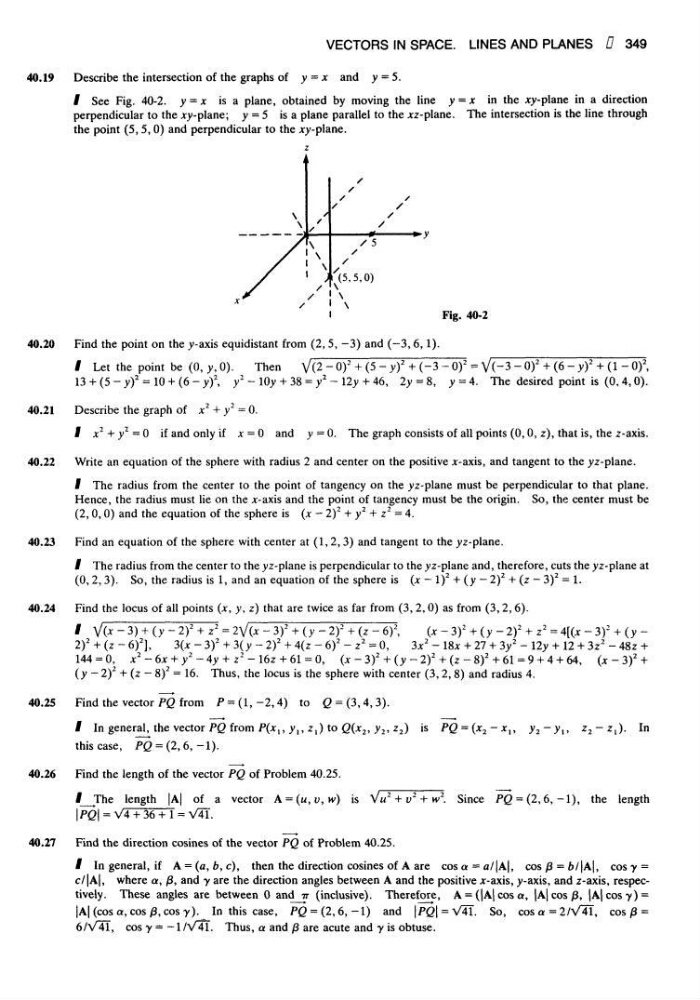
Describe the intersection of the graphs of y = x and y = 5.
See Fig. 40-2. y = x is a plane, obtained by moving the line y = x in the xy-plane in a direction
perpendicular to the ry-plane; y = 5 is a plane parallel to the *z-plane. The intersection is the line through
the point (5,5, 0) and perpendicular to the *y-plane.
Fig. 40-2
Find the point on the y-axis equidistant from (2, 5, —3) and (—3,6,1).
Then
Let the point be (0, y,0).
The desired point is (0, 4,0).
Describe the graph of x
2 + y
2 = 0.
x
2 + y
2 = 0 if and only if x = 0 and y = 0. The graph consists of all points (0,0, z), that is, the z-axis.
Write an equation of the sphere with radius 2 and center on the positive *-axis, and tangent to the yz-plane.
The radius from the center to the point of tangency on the yz-plane must be perpendicular to that plane.
Hence, the radius must lie on the jt-axis and the point of tangency must be the origin. So, the center must be
(2, 0,0) and the equation of the sphere is (x - 2)
2 + y
2 + z
2 = 4.
Find an equation of the sphere with center at (1, 2, 3) and tangent to the yz-plane.
The radius from the center to the yz-plane is perpendicular to the yz-plane and, therefore, cuts the yz-plane at
(0,2, 3). So, the radius is 1, and an equation of the sphere is (x - I)
2 + (y - 2)
2 + (z - 3)
2 = 1.
Find the locus of all points (x, y, z) that are twice as far from (3, 2,0) as from (3,2, 6).
In general, the vector PQ from F(jc t , y,, z,) to Q(x 2 , y 2 , z 2 ) is PQ = (x 2 -x., y 2 -y,, z 2 -z.). In
this case, PQ = (2, 6, -1).
Find the vector PQ from /> = (!,-2,4) to <2 = (3,4,3).
Find the length of the vector PQ of Problem 40.25.
the length
Since
is
of a vector
The length
Find the direction cosines of the vector PQ of Problem 40.25.
In general, if A = (a, b, c), then the direction cosines of A are cos a = a/|A|, cos B = fe/|A|, cos y =
c/lAl, where a, B, and y are the direction angles between A and the positive *-axis, v-axis, and z-axis, respectively. These angles are between 0 and
(inclusive). Therefore,
Thus, a and B are acute and y is obtuse.
In this case,
and
So,
V(* - 3) + (y - 2)
2 + z
2 = 2\/(* - 3)
2 + (y -2)
2 + (z - 6)
2
,
(* -3)
2 + (y -2)
2 + z
2 = 4[(jc -3)
2 + (y -
2)2 + (z - 6)2], 3(* - 3)2 + 3(y - 2)2 + 4(z - 6)2 - z2 = 0, 3;c2 - 18* + 27 + 3y2 - 12y + 12 + 3z2 - 48z +
144 = 0, x
2 - 6x + y
2 - 4y + z
2 - 16z + 61 = 0, (x -3)
2 + (y -2)
2 + (z - 8)
2 + 61 = 9 + 4 + 64, (* - 3)
2 +
(y - 2)
2 + (z - 8)
2 = 16. Thus, the locus is the sphere with center (3,2, 8) and radius 4.
13 + (5 - yY = 10 + (6 - y)\ y
2 - Wy + 38 = y
2 - 12y + 46, 2y = 8, y = 4.
|A|
A= (u, v,w)
PQ=(2,6,-1)
349
40.19
40.20
40.21
40.22
40.23
40.24
40.25
40.26
40.27
Describe the intersection of the graphs of y = x and y = 5.
See Fig. 40-2. y = x is a plane, obtained by moving the line y = x in the xy-plane in a direction
perpendicular to the ry-plane; y = 5 is a plane parallel to the *z-plane. The intersection is the line through
the point (5,5, 0) and perpendicular to the *y-plane.
Fig. 40-2
Find the point on the y-axis equidistant from (2, 5, —3) and (—3,6,1).
Then
Let the point be (0, y,0).
The desired point is (0, 4,0).
Describe the graph of x
2 + y
2 = 0.
x
2 + y
2 = 0 if and only if x = 0 and y = 0. The graph consists of all points (0,0, z), that is, the z-axis.
Write an equation of the sphere with radius 2 and center on the positive *-axis, and tangent to the yz-plane.
The radius from the center to the point of tangency on the yz-plane must be perpendicular to that plane.
Hence, the radius must lie on the jt-axis and the point of tangency must be the origin. So, the center must be
(2, 0,0) and the equation of the sphere is (x - 2)
2 + y
2 + z
2 = 4.
Find an equation of the sphere with center at (1, 2, 3) and tangent to the yz-plane.
The radius from the center to the yz-plane is perpendicular to the yz-plane and, therefore, cuts the yz-plane at
(0,2, 3). So, the radius is 1, and an equation of the sphere is (x - I)
2 + (y - 2)
2 + (z - 3)
2 = 1.
Find the locus of all points (x, y, z) that are twice as far from (3, 2,0) as from (3,2, 6).
In general, the vector PQ from F(jc t , y,, z,) to Q(x 2 , y 2 , z 2 ) is PQ = (x 2 -x., y 2 -y,, z 2 -z.). In
this case, PQ = (2, 6, -1).
Find the vector PQ from /> = (!,-2,4) to <2 = (3,4,3).
Find the length of the vector PQ of Problem 40.25.
the length
Since
is
of a vector
The length
Find the direction cosines of the vector PQ of Problem 40.25.
In general, if A = (a, b, c), then the direction cosines of A are cos a = a/|A|, cos B = fe/|A|, cos y =
c/lAl, where a, B, and y are the direction angles between A and the positive *-axis, v-axis, and z-axis, respectively. These angles are between 0 and
(inclusive). Therefore,
Thus, a and B are acute and y is obtuse.
In this case,
and
So,
V(* - 3) + (y - 2)
2 + z
2 = 2\/(* - 3)
2 + (y -2)
2 + (z - 6)
2
,
(* -3)
2 + (y -2)
2 + z
2 = 4[(jc -3)
2 + (y -
2)2 + (z - 6)2], 3(* - 3)2 + 3(y - 2)2 + 4(z - 6)2 - z2 = 0, 3;c2 - 18* + 27 + 3y2 - 12y + 12 + 3z2 - 48z +
144 = 0, x
2 - 6x + y
2 - 4y + z
2 - 16z + 61 = 0, (x -3)
2 + (y -2)
2 + (z - 8)
2 + 61 = 9 + 4 + 64, (* - 3)
2 +
(y - 2)
2 + (z - 8)
2 = 16. Thus, the locus is the sphere with center (3,2, 8) and radius 4.
13 + (5 - yY = 10 + (6 - y)\ y
2 - Wy + 38 = y
2 - 12y + 46, 2y = 8, y = 4.
|A|
A= (u, v,w)
PQ=(2,6,-1)