

348
CHAPTER 40
Find an equation of the sphere with the points P(7, -1, -2) and G(3,4,6) as the ends of a diameter.
The center is the midpoint of the segment PQ, namely, (5, |,4). The length of the diameter is
So, the radius is jV"57. Thus, an equation of the
sphere is (x - 5)
2 + (y - §)
2 + (z - 4)
2 = f.
40.12
40.13
40.14
40.15
40.16
40.17
40.18
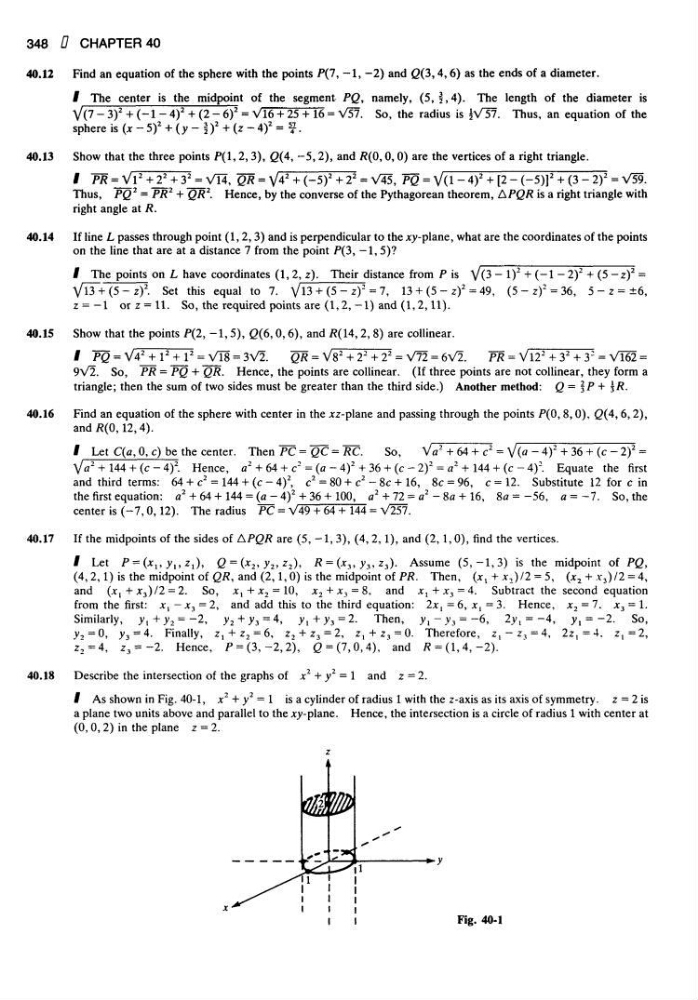
Fig. 40-1
Describe the intersection of the graphs of x
2 + y
2 = 1 and z = 2.
As shown in Fig. 40-1, *
2 + _y
2 = l is a cylinder of radius 1 with the z-axis as its axis of symmetry. z = 2is
a plane two units above and parallel to the xy-plane. Hence, the intersection is a circle of radius 1 with center at
(0,0, 2) in the plane z = 2.
Let P = (*,, _y,, zj, Q = (x 2 , y 2 , z 2 ), R = (x 3 , y 3 , z 3 ). Assume (5,-1,3) is the midpoint of PQ,
(4,2,1) is the midpoint of QR, and (2,1,0) is the midpoint of PR. Then, (x 1 +x 2 )/2 = 5, (x 2 + -v 3 )/2 = 4,
and (x l +x 3 )/2 = 2. So, x t +x 2 = 10, x 2 + x*, = 8, and .*! + * 3 = 4. Subtract the second equation
from the first: x t — x 3 = 2, and add this to the third equation: 2x t = 6, x l = 3. Hence, x 2 = 7. * 3 = 1.
Similarly, y,+y 2 = -2, y 2 + y, = 4, y l +y, = 2. Then, y,-y 3 = -6, 2y, =-4, y l = -2. So,
>"2
= 0' y3
= 4- Finally, z, + z 2 = 6, z 2 + z 3 = 2, z, + z, = 0. Therefore, z, - z, = 4, 2z,=4. z t =2,
z 2 =4, z 3 = -2. Hence, P = (3, -2,2), Q = (7,0,4), "and /? = (!,4,-2).
[f the midpoints of the sides of PQR are (5, -1,3), (4,2,1), and (2,1,0), find the vertices.
Let C(a, 0, c) be the center. Then
Hence,
and third terms: 64 + c
2 = 144 + (c - 4)
2
, c
2 = 80 + c
2 - 8c + 16, 8c = 96, c = 12. Substitute 12 for c in
the first equation: a
2 + 64 + 144 = (a - 4)
2 + 36 + 100, a
2 + 72= a
2 - 8a + 16, 8a = -56, a = -7. So, the
Equate the first
So,
center is (-7,0,12). The radius
Find an equation of the sphere with center in the *z-plane and passing through the points P(0,8,0), Q(4, 6,2),
and R(0,12,4).
Hence, the points are collinear. (If three points are not collinear, they form a
triangle; then the sum of two sides must be greater than the third side.) Another method
Show that the points P(2, -1,5), 2(6,0,6), and R(14,2, 8) are collinear.
The points on L have coordinates (1,2, z). Their distance from P is
Set this equal to 7.
So, the required points are (1,2, —1) and (1,2,11).
If line L passes through point (1, 2,3) and is perpendicular to the xy-plane, what are the coordinates of the points
on the line that are at a distance 7 from the point P(3, -1,5)?
Hence, by the converse of the Pythagorean theorem, &.PQR is a right triangle with
Thus,
ight angle at R.
Show that the three points P(l, 2, 3), Q(4, -5,2), and R(0,0,0) are the vertices of a right triangle.
= 7, 13 + (5-z)
2 = 49, (5-z)
2 = 36, 5 - r = ±6,
z = -l orz = ll.
So,
CHAPTER 40
Find an equation of the sphere with the points P(7, -1, -2) and G(3,4,6) as the ends of a diameter.
The center is the midpoint of the segment PQ, namely, (5, |,4). The length of the diameter is
So, the radius is jV"57. Thus, an equation of the
sphere is (x - 5)
2 + (y - §)
2 + (z - 4)
2 = f.
40.12
40.13
40.14
40.15
40.16
40.17
40.18
Fig. 40-1
Describe the intersection of the graphs of x
2 + y
2 = 1 and z = 2.
As shown in Fig. 40-1, *
2 + _y
2 = l is a cylinder of radius 1 with the z-axis as its axis of symmetry. z = 2is
a plane two units above and parallel to the xy-plane. Hence, the intersection is a circle of radius 1 with center at
(0,0, 2) in the plane z = 2.
Let P = (*,, _y,, zj, Q = (x 2 , y 2 , z 2 ), R = (x 3 , y 3 , z 3 ). Assume (5,-1,3) is the midpoint of PQ,
(4,2,1) is the midpoint of QR, and (2,1,0) is the midpoint of PR. Then, (x 1 +x 2 )/2 = 5, (x 2 + -v 3 )/2 = 4,
and (x l +x 3 )/2 = 2. So, x t +x 2 = 10, x 2 + x*, = 8, and .*! + * 3 = 4. Subtract the second equation
from the first: x t — x 3 = 2, and add this to the third equation: 2x t = 6, x l = 3. Hence, x 2 = 7. * 3 = 1.
Similarly, y,+y 2 = -2, y 2 + y, = 4, y l +y, = 2. Then, y,-y 3 = -6, 2y, =-4, y l = -2. So,
>"2
= 0' y3
= 4- Finally, z, + z 2 = 6, z 2 + z 3 = 2, z, + z, = 0. Therefore, z, - z, = 4, 2z,=4. z t =2,
z 2 =4, z 3 = -2. Hence, P = (3, -2,2), Q = (7,0,4), "and /? = (!,4,-2).
[f the midpoints of the sides of PQR are (5, -1,3), (4,2,1), and (2,1,0), find the vertices.
Let C(a, 0, c) be the center. Then
Hence,
and third terms: 64 + c
2 = 144 + (c - 4)
2
, c
2 = 80 + c
2 - 8c + 16, 8c = 96, c = 12. Substitute 12 for c in
the first equation: a
2 + 64 + 144 = (a - 4)
2 + 36 + 100, a
2 + 72= a
2 - 8a + 16, 8a = -56, a = -7. So, the
Equate the first
So,
center is (-7,0,12). The radius
Find an equation of the sphere with center in the *z-plane and passing through the points P(0,8,0), Q(4, 6,2),
and R(0,12,4).
Hence, the points are collinear. (If three points are not collinear, they form a
triangle; then the sum of two sides must be greater than the third side.) Another method
Show that the points P(2, -1,5), 2(6,0,6), and R(14,2, 8) are collinear.
The points on L have coordinates (1,2, z). Their distance from P is
Set this equal to 7.
So, the required points are (1,2, —1) and (1,2,11).
If line L passes through point (1, 2,3) and is perpendicular to the xy-plane, what are the coordinates of the points
on the line that are at a distance 7 from the point P(3, -1,5)?
Hence, by the converse of the Pythagorean theorem, &.PQR is a right triangle with
Thus,
ight angle at R.
Show that the three points P(l, 2, 3), Q(4, -5,2), and R(0,0,0) are the vertices of a right triangle.
= 7, 13 + (5-z)
2 = 49, (5-z)
2 = 36, 5 - r = ±6,
z = -l orz = ll.
So,