

342
CHAPTER 39
39.16
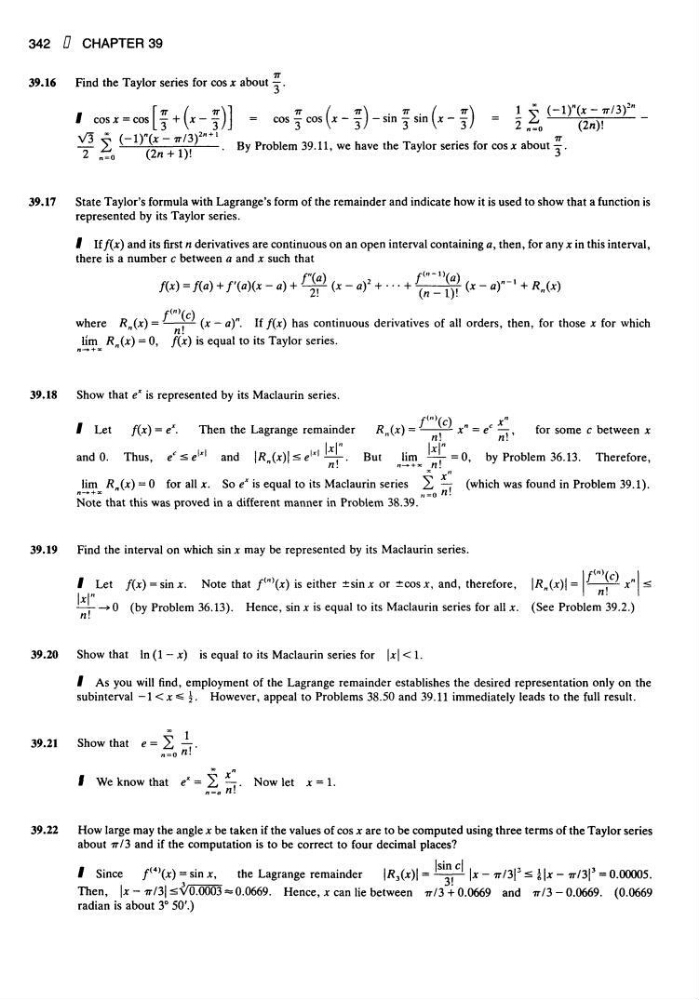
Find the Taylor series for cos x about
By Problem 39.11, we have the Taylor series for cos* about
39.17
State Taylor's formula with Lagrange's form of the remainder and indicate how it is used to show that a function is
represented by its Taylor series.
If f(x) and its first n derivatives are continuous on an open interval containing a, then, for any x in this interval,
there is a number c between a and x such that
where
If f(x) has continuous derivatives of all orders, then, for those x for which
R H (
X )
= 0> /(•*)
is equal to its Taylor series.
39.18
Show that e* is represented by its Maclaurin series.
Let
f(x) = e*. Then the Lagrange remainder
for some c between x
by Problem 36.13. Therefore,
But
and 0. Thus,
and
R n (x) — 0 for all A:. So e* is equal to its Maclaurin series
(which was found in Problem 39.1).
Note that this was proved in a different manner in Problem 38.39.
39.19
Find the interval on which sin* may be represented by its Maclaurin series.
Let /(*) = sin *. Note that f("\x) is either ±sin* or ±cosx, and, therefore,
(by Problem 36.13). Hence, sin x is equal to its Maclaurin series for all x. (See Problem 39.2.)
39.20
Show that In(l-jt) is equal to its Maclaurin series for |*|<1.
As you will find, employment of the Lagrange remainder establishes the desired representation only on the
subinterval —1< x =s \. However, appeal to Problems 38.50 and 39.11 immediately leads to the full result.
39.21
Show that
We know that
Now let x — 1.
39.22
How large may the angle x be taken if the values of cos x are to be computed using three terms of the Taylor series
about 77/3 and if the computation is to be correct to four decimal places?
Since
/
<4) (je) = sin x,
the Lagrange remainder
Then,
Hence, x can lie between ir/3 + 0.0669 and 7T/3 - 0.0669. (0.0669
radian is about 3° 50'.)
CHAPTER 39
39.16
Find the Taylor series for cos x about
By Problem 39.11, we have the Taylor series for cos* about
39.17
State Taylor's formula with Lagrange's form of the remainder and indicate how it is used to show that a function is
represented by its Taylor series.
If f(x) and its first n derivatives are continuous on an open interval containing a, then, for any x in this interval,
there is a number c between a and x such that
where
If f(x) has continuous derivatives of all orders, then, for those x for which
R H (
X )
= 0> /(•*)
is equal to its Taylor series.
39.18
Show that e* is represented by its Maclaurin series.
Let
f(x) = e*. Then the Lagrange remainder
for some c between x
by Problem 36.13. Therefore,
But
and 0. Thus,
and
R n (x) — 0 for all A:. So e* is equal to its Maclaurin series
(which was found in Problem 39.1).
Note that this was proved in a different manner in Problem 38.39.
39.19
Find the interval on which sin* may be represented by its Maclaurin series.
Let /(*) = sin *. Note that f("\x) is either ±sin* or ±cosx, and, therefore,
(by Problem 36.13). Hence, sin x is equal to its Maclaurin series for all x. (See Problem 39.2.)
39.20
Show that In(l-jt) is equal to its Maclaurin series for |*|<1.
As you will find, employment of the Lagrange remainder establishes the desired representation only on the
subinterval —1< x =s \. However, appeal to Problems 38.50 and 39.11 immediately leads to the full result.
39.21
Show that
We know that
Now let x — 1.
39.22
How large may the angle x be taken if the values of cos x are to be computed using three terms of the Taylor series
about 77/3 and if the computation is to be correct to four decimal places?
Since
/
<4) (je) = sin x,
the Lagrange remainder
Then,
Hence, x can lie between ir/3 + 0.0669 and 7T/3 - 0.0669. (0.0669
radian is about 3° 50'.)