

TAYLOR AND MACLAURIN SERIES
39.8
Write the first nonzero terms of the Maclaurin series for sec x.
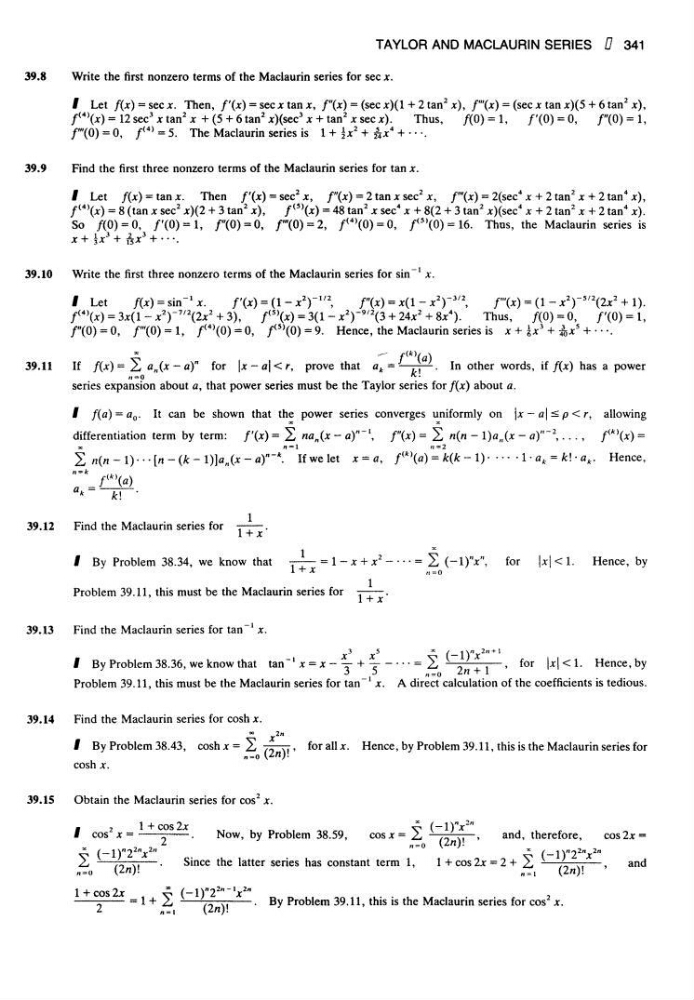
I Let /(x) = secx. Then, /'(*) = sec x tan x, f"(x) = (sec *)(! + 2 tan
2 x), /'"(*) = (sec x tan x)(5 + 6 tan
2 x),
f
w (x) = 12 sec
3 x tan
2 x + (5 + 6 tan
2 x)(sec
3 x + tan
2 x sec x).
Thus,
/(O) = 1, /'(O) = 0,
/"(O) = 1,
/"'(0) = 0, /
(4) =5. The Maclaurin series is 1+ $x
2 + &x* + • • •.
39.9
Find the first three nonzero terms of the Maclaurin series for tan x.
Let /(x) = tan;t. Then /'(*) = sec
2
*, /"(*) = 2 tan x sec
2 x, f'"(x) = 2(sec
4 x + 2 tan
2 x + 2 tan
4 x),
/
(4) (*) = 8 (tan x sec
2 x)(2 + 3 tan
2 x),
/
(5)
(*) = 48 tan
2 x sec
4 x + 8(2 + 3 tan
2 *)(sec
4 x + 2 tan
2 x + 2 tan
4 x).
So /(0) = 0, /'(0) = 1, f'(0) = 0, /"'(0) = 2, /<
4 >(0) = 0, /
<5) (0) = 16. Thus, the Maclaurin series is
*+ 1*3 + &X3 + ••-.
Let /Ot^sirT1*. /'(*) = (I-*2)'1'2, /"(x) = *(1 - Jc2)'3'2, f'"(x) = (1 - x2ys'2(2x2 + 1).
/
(4) (*) = 3*(l-*
2 )7/2 (2*
2 + 3), /
(5)
(*) = 3(1 - *
2 )9/2 (3 + 24*
2 + 8*
4
).
Thus,
/(0) = 0, /'(0) = 1,
/"(O) = 0, /'"(O) = 1, /
<4> (0) = 0, /
(5> (0) = 9. Hence, the Maclaurin series is x + $x
3 + -jex
5 + • • -.
x
39.11
If f(x) = 2 a n (x - a)" for \x - a\ < r, prove that
ii -o
series expansion about a, that power series must be the Taylor series for/(*) about a.
f(a) = a a . It can be shown that the power series converges uniformly on |*-a|
Find the Maclaurin series for
Problem 39.11, this must be the Maclaurin series for
Hence, by
341
In other words, if f(x) has a power
differentiation term by term:
n(n - 1) • • • [/I - (A: - 1)K(* - «)""*- M we let x = a, f
m (a) = k(k-l)
1 • a k = k\ • a k . Hence,
By Problem 38.34, we know that
for
|*| 39.13
Find the Maclaurin series for tan ' x.
By Problem 38.36, we know that
for
Problem 39.11, this must be the Maclaurin series for tan *. A direct calculation of the coefficients is tedious.
39.14
Find the Maclaurin series for cosh *.
By Problem 38.43,
for all *. Hence, by Problem 39.11, this is the Maclaurin series for
cosh *.
39.15
Obtain the Maclaurin series for cos
2 *.
Now, by Problem 38.59,
Since the latter series has constant term 1,
and, therefore,
cos 2* =
and
By Problem 39.11, this is the Maclaurin series for cos
2 *.
39.10 Write the first three nonzero terms of the Maclaurin series for sin -1x.
Download
from Wow! eBook
39.8
Write the first nonzero terms of the Maclaurin series for sec x.
I Let /(x) = secx. Then, /'(*) = sec x tan x, f"(x) = (sec *)(! + 2 tan
2 x), /'"(*) = (sec x tan x)(5 + 6 tan
2 x),
f
w (x) = 12 sec
3 x tan
2 x + (5 + 6 tan
2 x)(sec
3 x + tan
2 x sec x).
Thus,
/(O) = 1, /'(O) = 0,
/"(O) = 1,
/"'(0) = 0, /
(4) =5. The Maclaurin series is 1+ $x
2 + &x* + • • •.
39.9
Find the first three nonzero terms of the Maclaurin series for tan x.
Let /(x) = tan;t. Then /'(*) = sec
2
*, /"(*) = 2 tan x sec
2 x, f'"(x) = 2(sec
4 x + 2 tan
2 x + 2 tan
4 x),
/
(4) (*) = 8 (tan x sec
2 x)(2 + 3 tan
2 x),
/
(5)
(*) = 48 tan
2 x sec
4 x + 8(2 + 3 tan
2 *)(sec
4 x + 2 tan
2 x + 2 tan
4 x).
So /(0) = 0, /'(0) = 1, f'(0) = 0, /"'(0) = 2, /<
4 >(0) = 0, /
<5) (0) = 16. Thus, the Maclaurin series is
*+ 1*3 + &X3 + ••-.
Let /Ot^sirT1*. /'(*) = (I-*2)'1'2, /"(x) = *(1 - Jc2)'3'2, f'"(x) = (1 - x2ys'2(2x2 + 1).
/
(4) (*) = 3*(l-*
2 )7/2 (2*
2 + 3), /
(5)
(*) = 3(1 - *
2 )9/2 (3 + 24*
2 + 8*
4
).
Thus,
/(0) = 0, /'(0) = 1,
/"(O) = 0, /'"(O) = 1, /
<4> (0) = 0, /
(5> (0) = 9. Hence, the Maclaurin series is x + $x
3 + -jex
5 + • • -.
x
39.11
If f(x) = 2 a n (x - a)" for \x - a\ < r, prove that
ii -o
series expansion about a, that power series must be the Taylor series for/(*) about a.
f(a) = a a . It can be shown that the power series converges uniformly on |*-a|
Find the Maclaurin series for
Problem 39.11, this must be the Maclaurin series for
Hence, by
341
In other words, if f(x) has a power
differentiation term by term:
n(n - 1) • • • [/I - (A: - 1)K(* - «)""*- M we let x = a, f
m (a) = k(k-l)
1 • a k = k\ • a k . Hence,
By Problem 38.34, we know that
for
|*| 39.13
Find the Maclaurin series for tan ' x.
By Problem 38.36, we know that
for
Problem 39.11, this must be the Maclaurin series for tan *. A direct calculation of the coefficients is tedious.
39.14
Find the Maclaurin series for cosh *.
By Problem 38.43,
for all *. Hence, by Problem 39.11, this is the Maclaurin series for
cosh *.
39.15
Obtain the Maclaurin series for cos
2 *.
Now, by Problem 38.59,
Since the latter series has constant term 1,
and, therefore,
cos 2* =
and
By Problem 39.11, this is the Maclaurin series for cos
2 *.
39.10 Write the first three nonzero terms of the Maclaurin series for sin -1x.
Download
from Wow! eBook