

CHAPTER 39
Taylor and Maclaurin Series
39.1
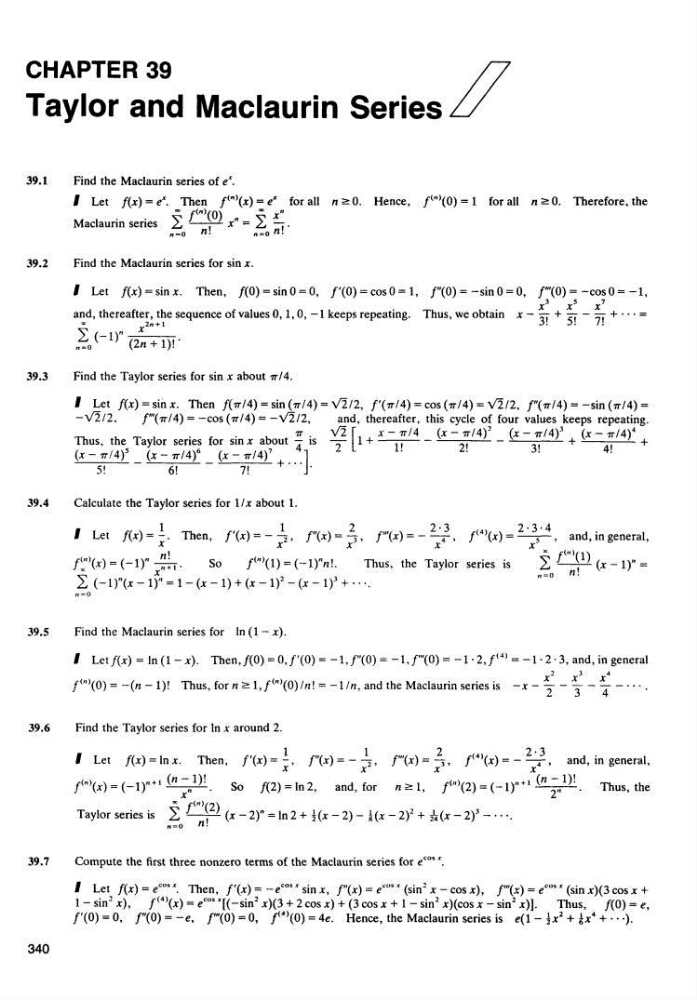
Find the Maclaurin series of e*.
Let /(*) = **. Then f
( "\x) = e' for all «>0. Hence, /'"'(O) = 1 for all n&0. Therefore, the
Maclaurin series
39.2
Find the Maclaurin series for sin x.
Let /(;c) = sin X. Then, /(0) = sinO = 0, /'(O) = cosO= 1, /"(O) = -sin 0 = 0, /"'(O) = -cosO= -1,
and, thereafter, the sequence of values 0,1,0, — 1 keeps repeating. Thus, we obtain
39.3
Find the Taylor series for sin x about ir/4.
Let f(x) = sinx. Then /(ir/4) = sin (ir/4) = V2/2, f'(ir/4) = cos(irf4) = V2/2, f(ir/4) = -sin (77/4) =
and, thereafter, this cycle of four values keeps repeating.
Thus, the Taylor series for sin* about
39.4
Calculate the Taylor series for IIx about 1.
Let
Then,
and, in general,
Thus, the Taylor series is
So
/
( ">(1) = (-!)"«!.
39.5
Find the Maclaurin series for In (1 - x).
Let/(AT) = In (1 - x). Then,/(0) = 0,/'(0) = -1,/"(0) = -1,/"'(0) = -1 -2,/
<4) = -1 • 2 • 3, and, in general
/
( ">(0) = -(„ _ i)i Thus, for n > l,/
(/0 (0)/n! = -1/n, and the Maclaurin series is
39.6
Find the Taylor series for In x around 2.
Let f(x) = lnx. Then,
and, in general,
So /(2) = In 2, and, for n > 1,
Thus, the
Taylor series is
39.7
Compute the first three nonzero terms of the Maclaurin series for e
cos ".
Let f( x ) = e
cos *. Then, f'(x)=-e
cos 'sinx, /"(*) = e'
05 * (sin
2 *-cos*), /'"(x) = e
cos ' (sin jc)(3 cos x +
1-sin
2 *), /
(4)
(;<:) = e
<:osj: [(-sin
2 *)(3 + 2cosA-) + (3cosA: + l-sin
2 Ar)(cosA:-sin
2 jc)].
Thus, /(O) = e,
/'(0) = 0, f"(0) = - e , f"(0) = 0, /
(4) (0) = 4e. Hence, the Maclaurin series is e(l - |*
2 + |x
4 + •••).
340
(x - 2)" = In 2 + i(x - 2) - 4(x - 2)2 + MX - 2)3 - • • •.
Taylor and Maclaurin Series
39.1
Find the Maclaurin series of e*.
Let /(*) = **. Then f
( "\x) = e' for all «>0. Hence, /'"'(O) = 1 for all n&0. Therefore, the
Maclaurin series
39.2
Find the Maclaurin series for sin x.
Let /(;c) = sin X. Then, /(0) = sinO = 0, /'(O) = cosO= 1, /"(O) = -sin 0 = 0, /"'(O) = -cosO= -1,
and, thereafter, the sequence of values 0,1,0, — 1 keeps repeating. Thus, we obtain
39.3
Find the Taylor series for sin x about ir/4.
Let f(x) = sinx. Then /(ir/4) = sin (ir/4) = V2/2, f'(ir/4) = cos(irf4) = V2/2, f(ir/4) = -sin (77/4) =
and, thereafter, this cycle of four values keeps repeating.
Thus, the Taylor series for sin* about
39.4
Calculate the Taylor series for IIx about 1.
Let
Then,
and, in general,
Thus, the Taylor series is
So
/
( ">(1) = (-!)"«!.
39.5
Find the Maclaurin series for In (1 - x).
Let/(AT) = In (1 - x). Then,/(0) = 0,/'(0) = -1,/"(0) = -1,/"'(0) = -1 -2,/
<4) = -1 • 2 • 3, and, in general
/
( ">(0) = -(„ _ i)i Thus, for n > l,/
(/0 (0)/n! = -1/n, and the Maclaurin series is
39.6
Find the Taylor series for In x around 2.
Let f(x) = lnx. Then,
and, in general,
So /(2) = In 2, and, for n > 1,
Thus, the
Taylor series is
39.7
Compute the first three nonzero terms of the Maclaurin series for e
cos ".
Let f( x ) = e
cos *. Then, f'(x)=-e
cos 'sinx, /"(*) = e'
05 * (sin
2 *-cos*), /'"(x) = e
cos ' (sin jc)(3 cos x +
1-sin
2 *), /
(4)
(;<:) = e
<:osj: [(-sin
2 *)(3 + 2cosA-) + (3cosA: + l-sin
2 Ar)(cosA:-sin
2 jc)].
Thus, /(O) = e,
/'(0) = 0, f"(0) = - e , f"(0) = 0, /
(4) (0) = 4e. Hence, the Maclaurin series is e(l - |*
2 + |x
4 + •••).
340
(x - 2)" = In 2 + i(x - 2) - 4(x - 2)2 + MX - 2)3 - • • •.