

POWER SERIES
339
By Problem 38.106,
Therefore,
and
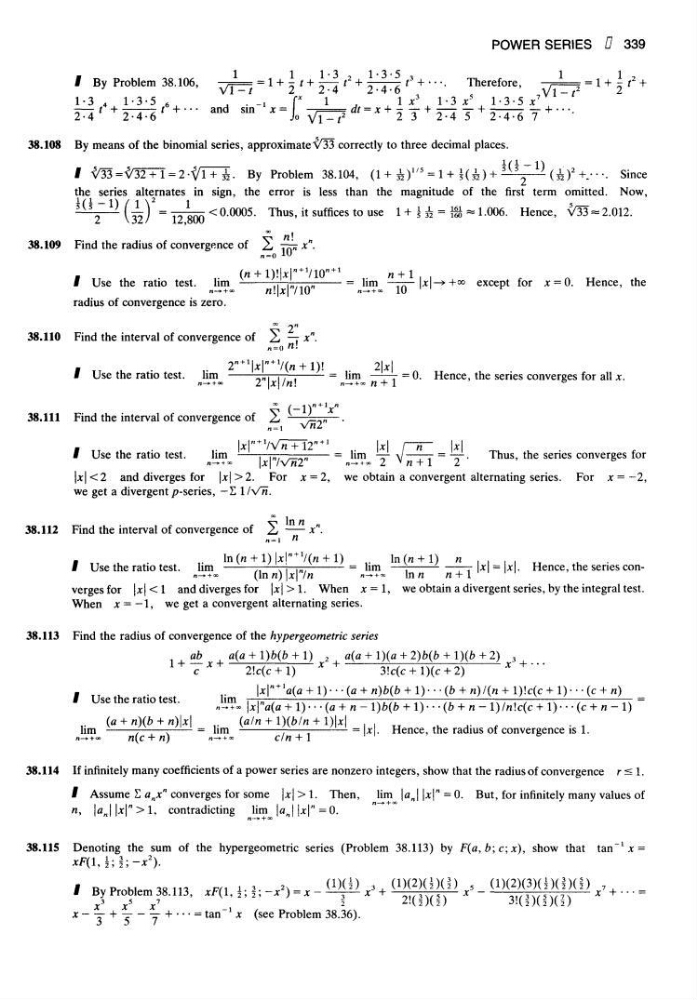
38.108 By means of the binomial series, approximate
1
V
/
33 correctly to three decimal places.
By Problem 38.104,
Since
the series alternates m sign, the error is less than the magnitude of the first term omitted. Now,
Thus, it suffices to use
Hence,
38.109 Find the radius of convergence of
Use the ratio test.
radius of convergence is zero.
except for x = 0. Hence, the
38.110 Find the interval of convergence of
Use the ratio test.
Hence, the series converges for all x.
38.111 Find the interval of convergence of
Use the ratio test.
Thus, the series converges for
|x|<2 and diverges for |x|>2. For x = 2, we obtain a convergent alternating series. For x = -2,
we get a divergent />-series,
38.112 Find the interval of convergence of
Use the ratio test.
Hence, the series converges for U|<1 and diverges for
When x = 1, we obtain a divergent series, by the integral test.
When x — — 1, we get a convergent alternating series.
38.113 Find the radius of convergence of the hypergeometric series
Use the ratio test.
Hence, the radius of convergence is 1.
38.114 If infinitely many coefficients of a power series are nonzero integers, show that the radius of convergence r < 1.
Assume £ a n x" converges for some |*|>1. Then, lim |aj |*|" =0. But, for infinitely many values of
n > l
a nll
jr r
> l' contradicting
38.115 Denoting the sum of the hypergeometric series (Problem 38.113) by F(a, b;c;x), show that tan
l x =
By Problem 38.113,
(see Problem 38.36).
339
By Problem 38.106,
Therefore,
and
38.108 By means of the binomial series, approximate
1
V
/
33 correctly to three decimal places.
By Problem 38.104,
Since
the series alternates m sign, the error is less than the magnitude of the first term omitted. Now,
Thus, it suffices to use
Hence,
38.109 Find the radius of convergence of
Use the ratio test.
radius of convergence is zero.
except for x = 0. Hence, the
38.110 Find the interval of convergence of
Use the ratio test.
Hence, the series converges for all x.
38.111 Find the interval of convergence of
Use the ratio test.
Thus, the series converges for
|x|<2 and diverges for |x|>2. For x = 2, we obtain a convergent alternating series. For x = -2,
we get a divergent />-series,
38.112 Find the interval of convergence of
Use the ratio test.
Hence, the series converges for U|<1 and diverges for
When x = 1, we obtain a divergent series, by the integral test.
When x — — 1, we get a convergent alternating series.
38.113 Find the radius of convergence of the hypergeometric series
Use the ratio test.
Hence, the radius of convergence is 1.
38.114 If infinitely many coefficients of a power series are nonzero integers, show that the radius of convergence r < 1.
Assume £ a n x" converges for some |*|>1. Then, lim |aj |*|" =0. But, for infinitely many values of
n > l
a nll
jr r
> l' contradicting
38.115 Denoting the sum of the hypergeometric series (Problem 38.113) by F(a, b;c;x), show that tan
l x =
By Problem 38.113,
(see Problem 38.36).