

TAYLOR AND MACLAURIN SERIES
343
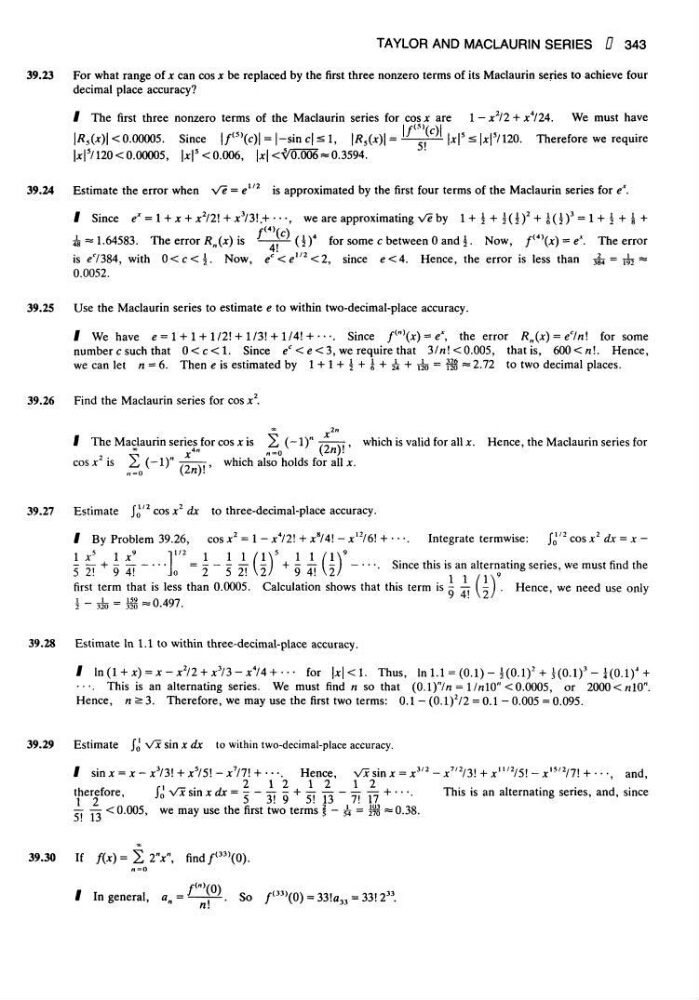
39.23 For what range of x can cos x be replaced by the first three nonzero terms of its Maclaurin series to achieve four
decimal place accuracy?
The first three nonzero terms of the Maclaurin series for cos x are 1 — jc
2 /2 + x
4 /24. We must have
Since
Therefore we require
39.24 Estimate the error when Ve = e"
2 is approximated by the first four terms of the Maclaurin series for e".
Since e" = 1 + x + x
2 /2l + *
3
/3!.+ • • •, we are approximating
by
The error R n (x) is
for some c between 0 and \. Now, /
<4) (jc) = e'. The error
is
with 0
39.25 Use the Maclaurin series to estimate e to within two-decimal-place accuracy.
We have e = 1 + 1 + 1 /2! + 1 /3! + 1 /4! + • • -. Since f("\x) = e', the error Rn(x) = ec/n\ for some
number c such that 0
we can let n = 6. Then e is estimated by
to two decimal places.
39.26 Find the Maclaurin series for cos x
2 .
The Maclaurin series for cos jc is
which is valid for all x. Hence, the Maclaurin series for
which also holds for all x.
39.27
Estimate
cos x
2 dx to three-decimal-place accuracy.
By Problem 39.26, cos x
2 = 1 - x"/2! + *
8
/4! - x
l2 /6\ + •••. Integrate termwise:
Since this is an alternating series, we must find the
first term that is less than 0.0005. Calculation shows that this term
Hence, we need use only
39.28 Estimate In 1.1 to within three-decimal-place accuracy.
In (1 + *) = x- X
2 /2 + x
3 /3-x
4 /4+--- for |*|<1. Thus, In 1.1 = (0.1) - HO-1)
2 + l(O-l)
3 - l(O.l)
4 +
•••. This is an alternating series. We must find n so that (0.!)"/« = 1/nlO" < 0.0005, or 2000<«10".
Hence, n>3. Therefore, we may use the first two terms: 0.1 - (0.1)
2 /2 = 0.1 - 0.005 = 0.095.
39.29 Estimate
to within two-decimal-place accuracy.
Hence,
and,
therefore,
This is an alternating series, and, since
we may use the first two terms
39.30
If f(x) =
2V, find/
(33)
(0).
In general,
So /
<33) (0) = 33!a 31 = 33!2
33
.
cos x
2 is
343
39.23 For what range of x can cos x be replaced by the first three nonzero terms of its Maclaurin series to achieve four
decimal place accuracy?
The first three nonzero terms of the Maclaurin series for cos x are 1 — jc
2 /2 + x
4 /24. We must have
Since
Therefore we require
39.24 Estimate the error when Ve = e"
2 is approximated by the first four terms of the Maclaurin series for e".
Since e" = 1 + x + x
2 /2l + *
3
/3!.+ • • •, we are approximating
by
The error R n (x) is
for some c between 0 and \. Now, /
<4) (jc) = e'. The error
is
with 0
39.25 Use the Maclaurin series to estimate e to within two-decimal-place accuracy.
We have e = 1 + 1 + 1 /2! + 1 /3! + 1 /4! + • • -. Since f("\x) = e', the error Rn(x) = ec/n\ for some
number c such that 0
we can let n = 6. Then e is estimated by
to two decimal places.
39.26 Find the Maclaurin series for cos x
2 .
The Maclaurin series for cos jc is
which is valid for all x. Hence, the Maclaurin series for
which also holds for all x.
39.27
Estimate
cos x
2 dx to three-decimal-place accuracy.
By Problem 39.26, cos x
2 = 1 - x"/2! + *
8
/4! - x
l2 /6\ + •••. Integrate termwise:
Since this is an alternating series, we must find the
first term that is less than 0.0005. Calculation shows that this term
Hence, we need use only
39.28 Estimate In 1.1 to within three-decimal-place accuracy.
In (1 + *) = x- X
2 /2 + x
3 /3-x
4 /4+--- for |*|<1. Thus, In 1.1 = (0.1) - HO-1)
2 + l(O-l)
3 - l(O.l)
4 +
•••. This is an alternating series. We must find n so that (0.!)"/« = 1/nlO" < 0.0005, or 2000<«10".
Hence, n>3. Therefore, we may use the first two terms: 0.1 - (0.1)
2 /2 = 0.1 - 0.005 = 0.095.
39.29 Estimate
to within two-decimal-place accuracy.
Hence,
and,
therefore,
This is an alternating series, and, since
we may use the first two terms
39.30
If f(x) =
2V, find/
(33)
(0).
In general,
So /
<33) (0) = 33!a 31 = 33!2
33
.
cos x
2 is