

PLANAR VECTORS
271
33.24 Find the two unit vectors that are parallel to the vector 7i — j.
same direction as 7i-j, and -A =
Hence,
is a unit vector in the
is the unit vector in the opposite direction.
33.25 Find a vector of length 5 that has the direction opposite to the vector B = 7i + 24j.
Hence, the unit vector in the direction of B is C =
Thus, the desired
vector is -5C =
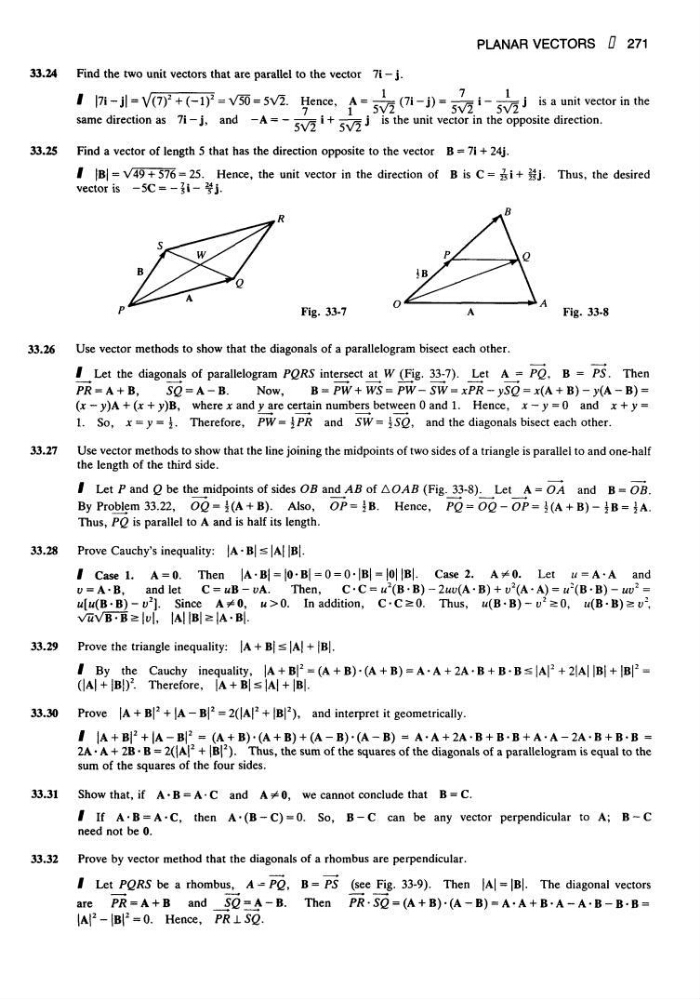
Fig. 33-7
Fig. 33-8
33.26
Use vector methods to show that the diagonals of a parallelogram bisect each other.
Let the diagonals of parallelogram PQRS intersect at W (Fig. 33-7). Let A = PQ, B = PS. Then
PR = A + B,
SQ = \-B.
Now,
B = PW+ WS = PW- SW = xPR -ySQ = *(A + B) -y(\ - B) =
(jc — y)A. + (x + y)B, where x andy are certain numbers between 0 and 1. Hence, x — y=0 and x + y =
1. So, x = y=\. Therefore, PW= \PR and SW= \SQ, and the diagonals bisect each other.
33.27
Use vector methods to show that the line joining the midpoints of two sides of a triangle is parallel to and one-half
the length of the third side.
Let P and Q be the midpoints of sides OB and AB of &OAB (Fig. 33-8). Let A = OA and B = OB.
By Problem 33.22, OQ=|(A + B). Also, OF= |B. Hence, PQ = OQ - OP= |(A + B) - ^B = £A.
Thus, PQ is parallel to A and is half its length.
33.28 Prove Cauchy's inequality: |A • B| < |A| |B|.
Case 1. A = 0. Then |A-B| = |0-B| = 0 = 0- |B| = |0| |B|. Case 2. A^O. Let w = A-A and
i; = A-B,
and let C = «B - t;A.
Then,
C-C = «
2 (B-B) -2au(A-B) + i>
2 (A- A) = u\B-B) - uv
2 =
«[«(B-JJ)-i>
2 ]. Since A^O, w>0. In addition, C-C>0. Thus, w(B-B)-u
2 >0, u(B-B)sir,
VwVB~ni>|t;|, |A||B|>|A-B|.
33.29
Prove the triangle inequality: |A + B| < |A| + |B|.
By the Cauchy inequality, |A + B|
2 = (A + B)- (A + B) = A- A + 2A-B + B-B< |A|
2 + 2|A| |B| + |B|
2 =
(|A| + |B|)
2
. Therefore, |A + B| < |A| + |B|.
33.30
Prove |A + B|
2 + |A - B|
2 = 2(|A|
2 + |B|
2 ), and interpret it geometrically.
|A + B|
2 + |A - B|
2 = (A + B) • (A + B) + (A - B) • (A - B) = A • A + 2A • B + B • B + A • A - 2A • B + B • B =
2A • A + 2B • B = 2(|A|
2 + |B|
2
). Thus, the sum of the squares of the diagonals of a parallelogram is equal to the
sum of the squares of the four sides.
33.31
Show that, if A-B = A-C and A¥=§, we cannot conclude that B = C.
If A-B = A-C, then A-(B-C) = 0. So, B-C can be any vector perpendicular to A; B-C
need not be 0.
33.32
Prove by vector method that the diagonals of a rhombus are perpendicular.
Let PQRS be a rhombus, A - PQ, B= PS (see Fig. 33-9). Then |A| = |B|. The diagonal vectors
are W? = A + B and _SQ^\-B. Then /
) /?-5Q = (A + B)-(A-B) = A-A + B-A-A-B-B-B =
|A|
2 -|B|
2 =0. Hence, PRLSQ.
271
33.24 Find the two unit vectors that are parallel to the vector 7i — j.
same direction as 7i-j, and -A =
Hence,
is a unit vector in the
is the unit vector in the opposite direction.
33.25 Find a vector of length 5 that has the direction opposite to the vector B = 7i + 24j.
Hence, the unit vector in the direction of B is C =
Thus, the desired
vector is -5C =
Fig. 33-7
Fig. 33-8
33.26
Use vector methods to show that the diagonals of a parallelogram bisect each other.
Let the diagonals of parallelogram PQRS intersect at W (Fig. 33-7). Let A = PQ, B = PS. Then
PR = A + B,
SQ = \-B.
Now,
B = PW+ WS = PW- SW = xPR -ySQ = *(A + B) -y(\ - B) =
(jc — y)A. + (x + y)B, where x andy are certain numbers between 0 and 1. Hence, x — y=0 and x + y =
1. So, x = y=\. Therefore, PW= \PR and SW= \SQ, and the diagonals bisect each other.
33.27
Use vector methods to show that the line joining the midpoints of two sides of a triangle is parallel to and one-half
the length of the third side.
Let P and Q be the midpoints of sides OB and AB of &OAB (Fig. 33-8). Let A = OA and B = OB.
By Problem 33.22, OQ=|(A + B). Also, OF= |B. Hence, PQ = OQ - OP= |(A + B) - ^B = £A.
Thus, PQ is parallel to A and is half its length.
33.28 Prove Cauchy's inequality: |A • B| < |A| |B|.
Case 1. A = 0. Then |A-B| = |0-B| = 0 = 0- |B| = |0| |B|. Case 2. A^O. Let w = A-A and
i; = A-B,
and let C = «B - t;A.
Then,
C-C = «
2 (B-B) -2au(A-B) + i>
2 (A- A) = u\B-B) - uv
2 =
«[«(B-JJ)-i>
2 ]. Since A^O, w>0. In addition, C-C>0. Thus, w(B-B)-u
2 >0, u(B-B)sir,
VwVB~ni>|t;|, |A||B|>|A-B|.
33.29
Prove the triangle inequality: |A + B| < |A| + |B|.
By the Cauchy inequality, |A + B|
2 = (A + B)- (A + B) = A- A + 2A-B + B-B< |A|
2 + 2|A| |B| + |B|
2 =
(|A| + |B|)
2
. Therefore, |A + B| < |A| + |B|.
33.30
Prove |A + B|
2 + |A - B|
2 = 2(|A|
2 + |B|
2 ), and interpret it geometrically.
|A + B|
2 + |A - B|
2 = (A + B) • (A + B) + (A - B) • (A - B) = A • A + 2A • B + B • B + A • A - 2A • B + B • B =
2A • A + 2B • B = 2(|A|
2 + |B|
2
). Thus, the sum of the squares of the diagonals of a parallelogram is equal to the
sum of the squares of the four sides.
33.31
Show that, if A-B = A-C and A¥=§, we cannot conclude that B = C.
If A-B = A-C, then A-(B-C) = 0. So, B-C can be any vector perpendicular to A; B-C
need not be 0.
33.32
Prove by vector method that the diagonals of a rhombus are perpendicular.
Let PQRS be a rhombus, A - PQ, B= PS (see Fig. 33-9). Then |A| = |B|. The diagonal vectors
are W? = A + B and _SQ^\-B. Then /
) /?-5Q = (A + B)-(A-B) = A-A + B-A-A-B-B-B =
|A|
2 -|B|
2 =0. Hence, PRLSQ.