

272
CHAPTER 33
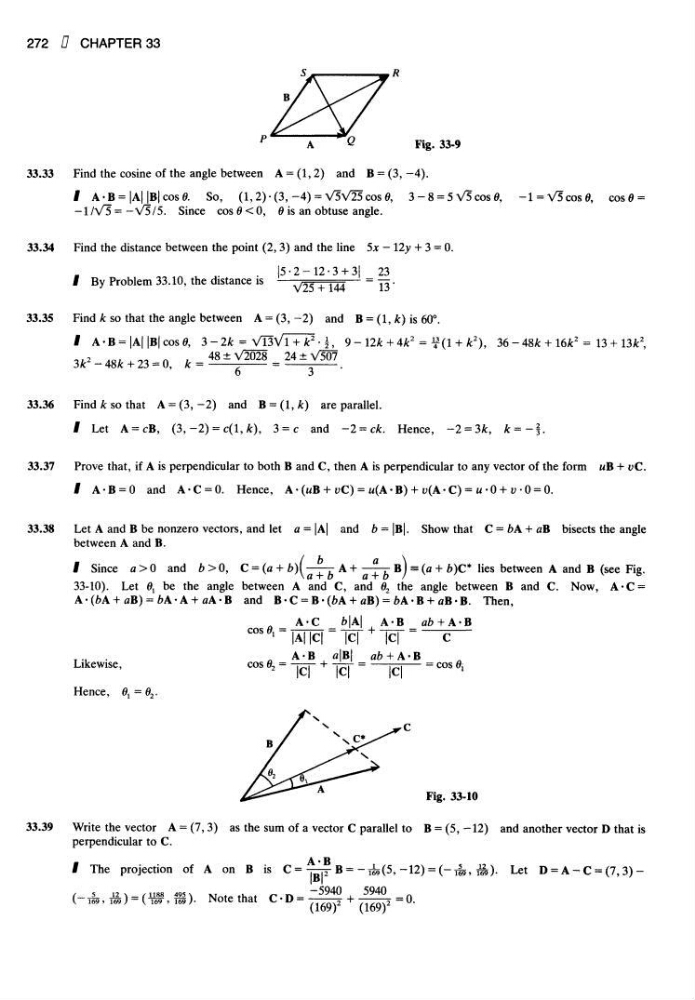
Fig. 33-9
33.33 Find the cosine of the angle between A = (1,2) and B = (3, -4).
A • B = |A| |B| cos 8. So, (1, 2)-(3, -4) = V3V25cos0, 3-8 = 5V5cos0, -l = V5cos0, cosfl =
-1 /V5 = -V5/5. Since cos 0 < 0, 0 is an obtuse angle.
33.34 Find the distance between the point (2,3) and the line 5* - I2y + 3 = 0.
By Problem 33.10, the distance is
33.35 Find A: so that the angle between A = (3,-2) and B = (1, k) is 60°.
A-B = |A||B|cos0, 3-2fc =
9 - 12* + 4k
2 = % (I + k
2 ), 36 - 48k + 16k
2 = 13 + 13fc
2
3fc
2 - 48A: + 23 = 0, k =
33.36 Find k so that A = (3, -2) and B = (1, k) are parallel.
Let A = cB, (3, -2) = c(l, k), 3 = c and -2 = ck. Hence, -2 = 3k, fc=-§.
33.37
Prove that, if A is perpendicular to both B and C, then A is perpendicular to any vector of the form «B + vC.
A-B = 0 and A-C = 0. Hence, A-(MB + vC) = w(A-B) + u(A-C) = u -0 + v -0 = 0.
33.38 Let A and B be nonzero vectors, and let a = |A| and fo=|B|. Show that C = bA.+ aB bisects the angle
between A and B.
Since a>0 and b>0, C = (a + b)\
= (a + b)C* lies between A and B (see Fig.
33-10). Let 6 l be the angle between A and C, and 6 2 the angle between B and C. Now, A-C =
A-(fcA+aB) = 6A-A+aA-B and B-C = B-(feA +«B) = 6A-B +aB-B. Then,
Likewise,
Hence, 0 X = 0 2 .
Fig. 33-10
33.39 Write the vector A = (7, 3) as the sum of a vector C parallel to B = (5,-12) and another vector D that is
perpendicular to C.
The projection of A on B is C =
B = -ife(5,-12) = (-&,&). Let D = A-C = (7,3)Note that C • D =
= 0.
CHAPTER 33
Fig. 33-9
33.33 Find the cosine of the angle between A = (1,2) and B = (3, -4).
A • B = |A| |B| cos 8. So, (1, 2)-(3, -4) = V3V25cos0, 3-8 = 5V5cos0, -l = V5cos0, cosfl =
-1 /V5 = -V5/5. Since cos 0 < 0, 0 is an obtuse angle.
33.34 Find the distance between the point (2,3) and the line 5* - I2y + 3 = 0.
By Problem 33.10, the distance is
33.35 Find A: so that the angle between A = (3,-2) and B = (1, k) is 60°.
A-B = |A||B|cos0, 3-2fc =
9 - 12* + 4k
2 = % (I + k
2 ), 36 - 48k + 16k
2 = 13 + 13fc
2
3fc
2 - 48A: + 23 = 0, k =
33.36 Find k so that A = (3, -2) and B = (1, k) are parallel.
Let A = cB, (3, -2) = c(l, k), 3 = c and -2 = ck. Hence, -2 = 3k, fc=-§.
33.37
Prove that, if A is perpendicular to both B and C, then A is perpendicular to any vector of the form «B + vC.
A-B = 0 and A-C = 0. Hence, A-(MB + vC) = w(A-B) + u(A-C) = u -0 + v -0 = 0.
33.38 Let A and B be nonzero vectors, and let a = |A| and fo=|B|. Show that C = bA.+ aB bisects the angle
between A and B.
Since a>0 and b>0, C = (a + b)\
= (a + b)C* lies between A and B (see Fig.
33-10). Let 6 l be the angle between A and C, and 6 2 the angle between B and C. Now, A-C =
A-(fcA+aB) = 6A-A+aA-B and B-C = B-(feA +«B) = 6A-B +aB-B. Then,
Likewise,
Hence, 0 X = 0 2 .
Fig. 33-10
33.39 Write the vector A = (7, 3) as the sum of a vector C parallel to B = (5,-12) and another vector D that is
perpendicular to C.
The projection of A on B is C =
B = -ife(5,-12) = (-&,&). Let D = A-C = (7,3)Note that C • D =
= 0.