

270
CHAPTER 33
33.17
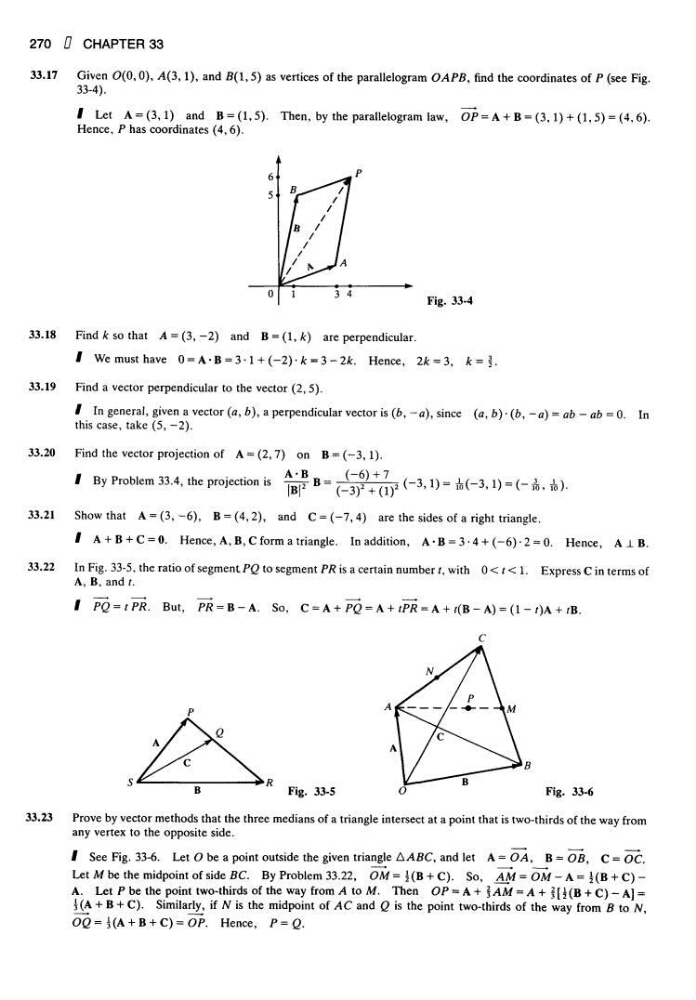
Given O(0,0), A(3,1), and B(l, 5) as vertices of the parallelogram OAPB, find the coordinates of P (see Fig.
33-4).
Let A = (3,1) and B = (l,5). Then, by the parallelogram law, OP = A + B = (3,1) + (1, 5) = (4, 6).
Hence, P has coordinates (4,6).
Fig. 33-4
33.18
Find k so that A = (3,-2) and B = (!,&) are perpendicular.
We must have 0 = A-B = 3-1 + (-2)- k = 3 -2k. Hence, 2k = 3, *=§.
33.19
Find a vector perpendicular to the vector (2, 5).
In general, given a vector (a, b), a perpendicular vector is (b, -a), since (a, b) • (b, -a) = ab - ab = 0. In
this case, take (5, -2).
33.20 Find the vector projection of A = (2, 7) on B = (-3,1).
By Problem 33.4, the projection is
B =
(-3,l)=A(-3,l) = (-tJs,&).
33.21
Show that A = (3,-6), B = (4,2), and C = (-7, 4) are the sides of a right triangle.
A + B + C = 0. Hence, A, B, C form a triangle. In addition, A-B = 3-4 + (-6)-2 = 0. Hence, A J_ B.
33.22
In Fig. 33-5, the ratio of segment PQ to segment PR is a certain number f, with 0
PQ = tPR. But, Ptf = B-A. So, C = A+P<2 = A + fP/? = A + r(B-A) = (l-r)A + rB.
Fig. 33-5
Fig. 33-6
33.23 Prove by vector methods that the three medians of a triangle intersect at a point that is two-thirds of the way from
any vertex to the opposite side.
See Fig. 33-6. Let O be a point outside the given triangle A ABC, and let A= OA, B = OB, C=OC.
Let M be the midpoint of side BC. By Problem 33.22, 0M=z(B + C). So, AM= OM - A = jr(B + C)A. Let P be the point two-thirds of the way from A to M. Then OP = A + § AM = A + f [ £ (B + C) - A] =
s(
A + B + C). Similarly, if N is the midpoint of AC and Q is the point two-thirds of the way from B to N,
OQ= HA + B + C)=OP. Hence, P=Q.
CHAPTER 33
33.17
Given O(0,0), A(3,1), and B(l, 5) as vertices of the parallelogram OAPB, find the coordinates of P (see Fig.
33-4).
Let A = (3,1) and B = (l,5). Then, by the parallelogram law, OP = A + B = (3,1) + (1, 5) = (4, 6).
Hence, P has coordinates (4,6).
Fig. 33-4
33.18
Find k so that A = (3,-2) and B = (!,&) are perpendicular.
We must have 0 = A-B = 3-1 + (-2)- k = 3 -2k. Hence, 2k = 3, *=§.
33.19
Find a vector perpendicular to the vector (2, 5).
In general, given a vector (a, b), a perpendicular vector is (b, -a), since (a, b) • (b, -a) = ab - ab = 0. In
this case, take (5, -2).
33.20 Find the vector projection of A = (2, 7) on B = (-3,1).
By Problem 33.4, the projection is
B =
(-3,l)=A(-3,l) = (-tJs,&).
33.21
Show that A = (3,-6), B = (4,2), and C = (-7, 4) are the sides of a right triangle.
A + B + C = 0. Hence, A, B, C form a triangle. In addition, A-B = 3-4 + (-6)-2 = 0. Hence, A J_ B.
33.22
In Fig. 33-5, the ratio of segment PQ to segment PR is a certain number f, with 0
PQ = tPR. But, Ptf = B-A. So, C = A+P<2 = A + fP/? = A + r(B-A) = (l-r)A + rB.
Fig. 33-5
Fig. 33-6
33.23 Prove by vector methods that the three medians of a triangle intersect at a point that is two-thirds of the way from
any vertex to the opposite side.
See Fig. 33-6. Let O be a point outside the given triangle A ABC, and let A= OA, B = OB, C=OC.
Let M be the midpoint of side BC. By Problem 33.22, 0M=z(B + C). So, AM= OM - A = jr(B + C)A. Let P be the point two-thirds of the way from A to M. Then OP = A + § AM = A + f [ £ (B + C) - A] =
s(
A + B + C). Similarly, if N is the midpoint of AC and Q is the point two-thirds of the way from B to N,
OQ= HA + B + C)=OP. Hence, P=Q.