

PLANAR VECTORS
269
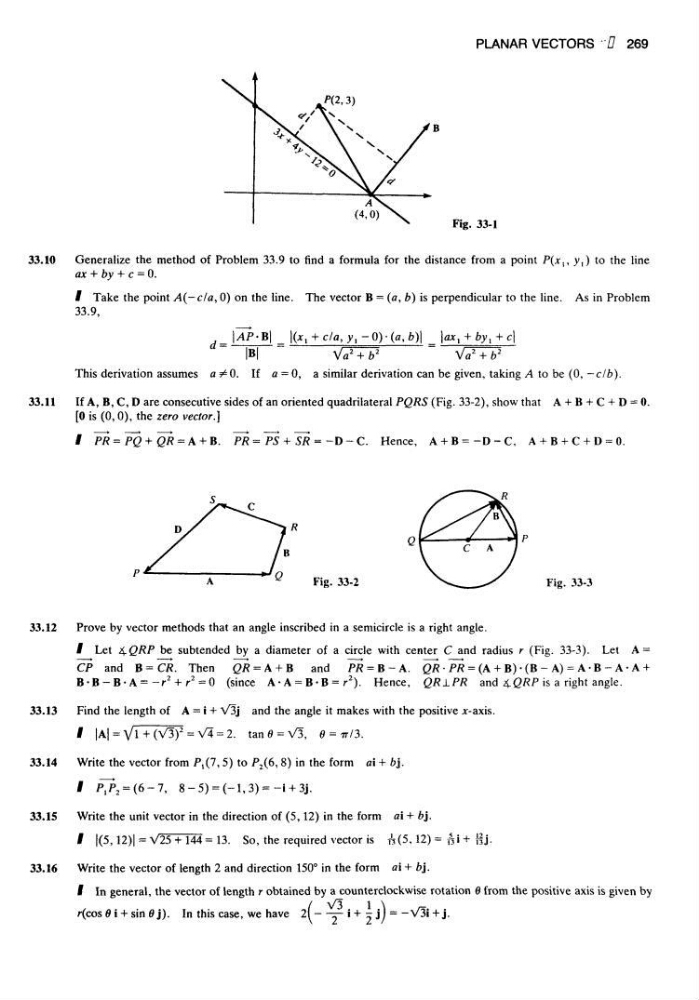
Fig. 33-1
33.10
Generalize the method of Problem 33.9 to find a formula for the distance from a point P(x,, y,) to the line
ax + by + c = 0.
Take the point A(—cla, 0) on the line. The vector B = (a, b) is perpendicular to the line. As in Problem
33.9,
This derivation assumes a 5^0. If a = 0, a similar derivation can be given, taking A to be (0, -c/b).
33.11
If A, B, C, D are consecutive sides of an oriented quadrilateral PQRS (Fig. 33-2), show that A + B + C + D = 0.
[0 is (0,0), the zero vector.]
PR = PQ + QR = A + B. PR= PS + SR = -D - C. Hence, A + B=-D-C, A + B + C + D = 0.
Fig. 33-2
Fig. 33-3
33.12
Prove by vector methods that an angle inscribed in a semicircle is a right angle.
Let %.QRP be subtended by a diameter of a circle with center C and radius r (Fig. 33-3). Let A =
CP and B=Ctf. Then QR = \ + B and Pfl = B-A. Q/?-Pfl = (A + B)-(B-A) = A-B-A-A +
B-B-B-A= -r
2 + r
2 = 0 (since A- A = B-B = r
2 ). Hence, QRLPR and 4QRP is a right angle.
33.13
Find the length of A = i + V3j and the angle it makes with the positive x-axis.
33.14
Write the vector from P,(7, 5) to P 2 (6, 8) in the form ai + bj.
P l P 2 = (6-7, 8-5) = (-l,3)=-l + 3j.
33.15
Write the unit vector in the direction of (5,12) in the form ai + bj.
|(5,12)|= V25 +144 =13. So, the required vector is iV(5,12) = &i + nj33.16
Write the vector of length 2 and direction 150° in the form ai + bj.
In general, the vector of length r obtained by a counterclockwise rotation 6 from the positive axis is given by
r(cos 0 i + sin 9 j). In this case, we have 2
= -V5i+j.
Download
from Wow! eBook
269
Fig. 33-1
33.10
Generalize the method of Problem 33.9 to find a formula for the distance from a point P(x,, y,) to the line
ax + by + c = 0.
Take the point A(—cla, 0) on the line. The vector B = (a, b) is perpendicular to the line. As in Problem
33.9,
This derivation assumes a 5^0. If a = 0, a similar derivation can be given, taking A to be (0, -c/b).
33.11
If A, B, C, D are consecutive sides of an oriented quadrilateral PQRS (Fig. 33-2), show that A + B + C + D = 0.
[0 is (0,0), the zero vector.]
PR = PQ + QR = A + B. PR= PS + SR = -D - C. Hence, A + B=-D-C, A + B + C + D = 0.
Fig. 33-2
Fig. 33-3
33.12
Prove by vector methods that an angle inscribed in a semicircle is a right angle.
Let %.QRP be subtended by a diameter of a circle with center C and radius r (Fig. 33-3). Let A =
CP and B=Ctf. Then QR = \ + B and Pfl = B-A. Q/?-Pfl = (A + B)-(B-A) = A-B-A-A +
B-B-B-A= -r
2 + r
2 = 0 (since A- A = B-B = r
2 ). Hence, QRLPR and 4QRP is a right angle.
33.13
Find the length of A = i + V3j and the angle it makes with the positive x-axis.
33.14
Write the vector from P,(7, 5) to P 2 (6, 8) in the form ai + bj.
P l P 2 = (6-7, 8-5) = (-l,3)=-l + 3j.
33.15
Write the unit vector in the direction of (5,12) in the form ai + bj.
|(5,12)|= V25 +144 =13. So, the required vector is iV(5,12) = &i + nj33.16
Write the vector of length 2 and direction 150° in the form ai + bj.
In general, the vector of length r obtained by a counterclockwise rotation 6 from the positive axis is given by
r(cos 0 i + sin 9 j). In this case, we have 2
= -V5i+j.
Download
from Wow! eBook