

24.83
24.84
24.85
24.86
24.87
24.88
Show that
EXPONENTIAL FUNCTIONS
203
Set x = 1 in the formula of Problem 24.74.
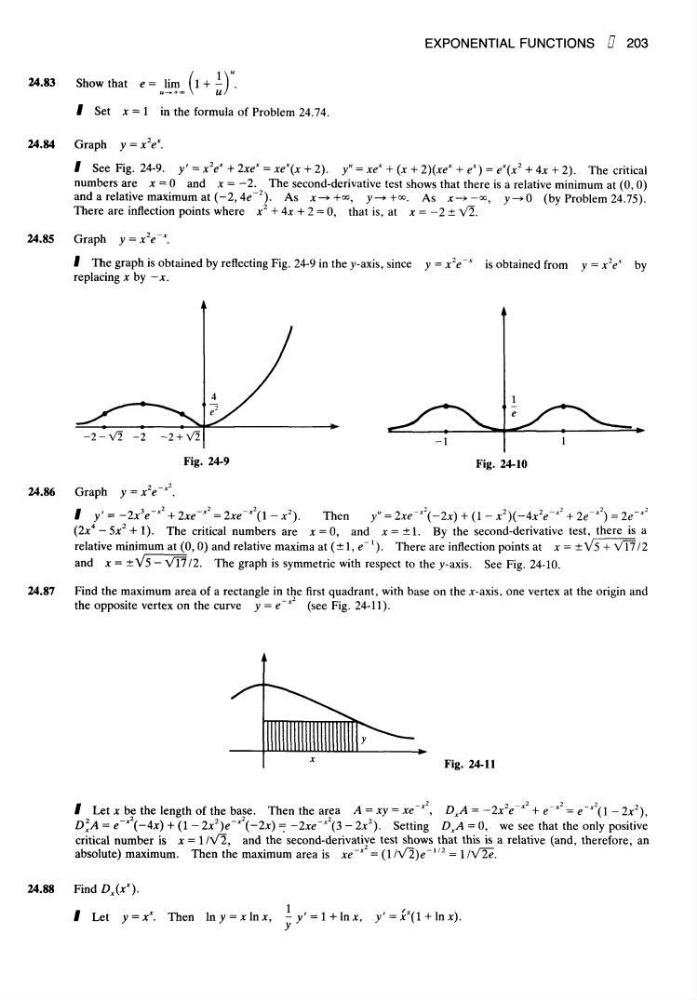
Graph y = x V.
See Fig. 24-9. / = xV + 2xe' = xe'(x + 2). y" = xe" + (x + 2)(xe* + e") = e"(x
2 + 4x + 2). The critical
numbers are x = 0 and x = -2. The second-derivative test shows that there is a relative minimum at (0, 0)
and a relative maximum at (-2, 4e~
2 ). As *-»+«>, y—»+<». AS *->-«, y-*0 (by Problem 24.75).
There are inflection points where x
2 + 4x + 2 = 0, that is, at x = -2 ± V2.
Graph y = x
2 e ".
The graph is obtained by reflecting Fig. 24-9 in the y-axis, since y = x2e * is obtained from y = x2e* by
replacing x by —x.
Fig. 24-9
Fig. 24-10
Graph y = x
2 e
(2x -5x +1). The critical numbers are x = 0, and x=±l. By the second-derivative test, there is a
relative minimum at (0,0) and relative maxima at (±1, e '). There are inflection points at x = ±V5 + VT7/2
and x = ±V5 - V17/2. The graph is symmetric with respect to the y-axis. See Fig. 24-10.
Find the maximum area of a rectangle in the first quadrant, with base on the *-axis, one vertex at the origin and
the opposite vertex on the curve y = e ' (see Fig. 24-11).
Fig. 24-11
Find D,(x*).
Let y = x". Then In y = x In x,
y' = -1x3e~' + 2xe~x = 2xe~" (1 - x2). Then y" = 2xe'"\-2x) + (1 - x2)(-4x2e~*2 + 2e~'*) = 2e~*2
Let x be the length of the base. Then the area A=xy = xe ' , DXA = -2x2e " + e * = e~'\l - 2x2),
DlA = e~*\-4x) + (l-2x
2 )e~*\-2x)=-2xe~'\3-2x
2 ). Setting D X A = 0, we see that the only positive
critical number is x - 1/V2, and the second-derivative test shows that this is a relative (and, therefore, an
absolute) maximum. Then the maximum area is xe~* = (l/V
r 2)e"
1 '
2 = \/V2e.
24.84
24.85
24.86
24.87
24.88
Show that
EXPONENTIAL FUNCTIONS
203
Set x = 1 in the formula of Problem 24.74.
Graph y = x V.
See Fig. 24-9. / = xV + 2xe' = xe'(x + 2). y" = xe" + (x + 2)(xe* + e") = e"(x
2 + 4x + 2). The critical
numbers are x = 0 and x = -2. The second-derivative test shows that there is a relative minimum at (0, 0)
and a relative maximum at (-2, 4e~
2 ). As *-»+«>, y—»+<». AS *->-«, y-*0 (by Problem 24.75).
There are inflection points where x
2 + 4x + 2 = 0, that is, at x = -2 ± V2.
Graph y = x
2 e ".
The graph is obtained by reflecting Fig. 24-9 in the y-axis, since y = x2e * is obtained from y = x2e* by
replacing x by —x.
Fig. 24-9
Fig. 24-10
Graph y = x
2 e
(2x -5x +1). The critical numbers are x = 0, and x=±l. By the second-derivative test, there is a
relative minimum at (0,0) and relative maxima at (±1, e '). There are inflection points at x = ±V5 + VT7/2
and x = ±V5 - V17/2. The graph is symmetric with respect to the y-axis. See Fig. 24-10.
Find the maximum area of a rectangle in the first quadrant, with base on the *-axis, one vertex at the origin and
the opposite vertex on the curve y = e ' (see Fig. 24-11).
Fig. 24-11
Find D,(x*).
Let y = x". Then In y = x In x,
y' = -1x3e~' + 2xe~x = 2xe~" (1 - x2). Then y" = 2xe'"\-2x) + (1 - x2)(-4x2e~*2 + 2e~'*) = 2e~*2
Let x be the length of the base. Then the area A=xy = xe ' , DXA = -2x2e " + e * = e~'\l - 2x2),
DlA = e~*\-4x) + (l-2x
2 )e~*\-2x)=-2xe~'\3-2x
2 ). Setting D X A = 0, we see that the only positive
critical number is x - 1/V2, and the second-derivative test shows that this is a relative (and, therefore, an
absolute) maximum. Then the maximum area is xe~* = (l/V
r 2)e"
1 '
2 = \/V2e.