

202
CHAPTER 24
24.72
24.73
24.74
24.75
24.76
24.77
24.78
24.79
24.80
24.81
24.82
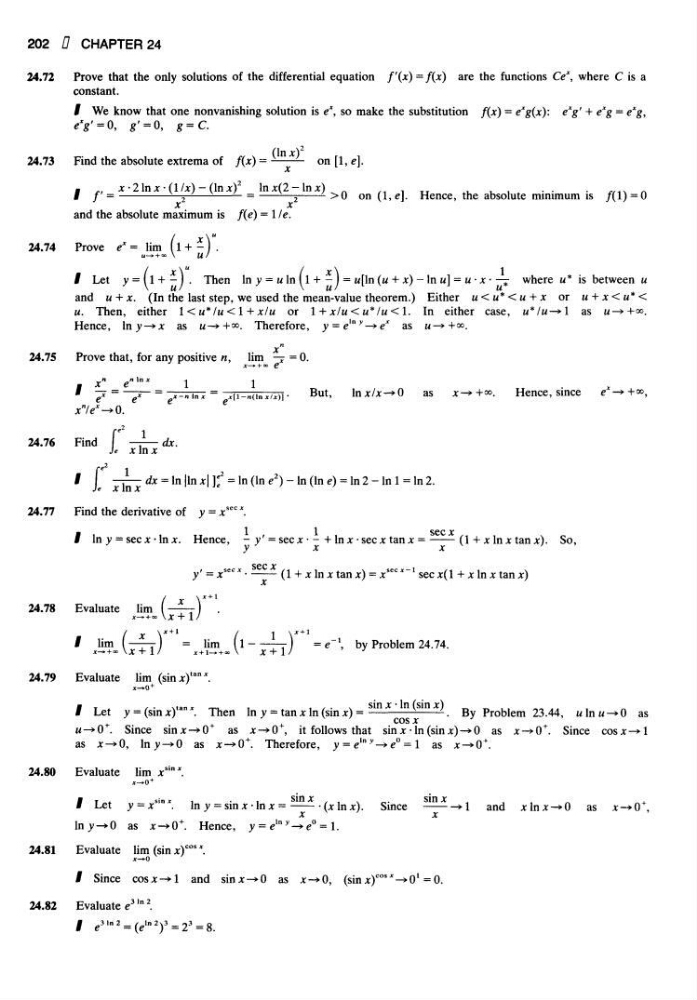
Prove that the only solutions of the differential equation /'(*)
= /(•*) are the functions Ce", where C is i
constant.
We know that one nonvanishing solution is e", so make the substitution f(x) = e*g(x): e*g' + e*g = e"g,
e*g' = 0, g' = 0, g=C.
Find the absolute extrema of
on (l,e]. Hence, the absolute minimum is /(1)=0
and the absolute maximum is f{e) = 1 /e.
Then
where a* is between u
Let
Prove
and
(In the last step, we used the mean-value theorem.) Either
In either case.
Therefore,
or
Then, either
Hence,
Prove that, for any positive
Hence, since
e —> +»,
But,
lnx/x-*Q
as *-»+».
Find
Find the derivative of y = ;c
sec *.
Evaluate
Evaluate
By Problem 23.44, wlnw-^0 as
Then In y = tan x In (sin *)
Let
Evaluate
Evaluate
Since cosjc-»l and sinx-»0 as x-»0, (sinjc)
co0
1 =0.
Evaluate e
3 ln 2
.
as j:-»0, Iny^O as x->0
+ . Therefore, y = e
lny ->e° = 1 as jc-*0
+ .
M^0
+ . Since sin^;-»0
+
as x-*Q
+ , it follows that sin x • In (sin x) -»0 as x-»0
+ . Since cos*-»l
by Problem 24.74.
Since
In y — sec x • In x. Hence,
So,
Let y = x
s> "*. In .y = sin X • In
and xlnx-*0 as x-*Q
+ ,
lny->0 as *->0
+ . Hence, y = e
lny ->e° = 1.
e
31n2 = (e
ln2 )
3 = 2
3 = 8.
CHAPTER 24
24.72
24.73
24.74
24.75
24.76
24.77
24.78
24.79
24.80
24.81
24.82
Prove that the only solutions of the differential equation /'(*)
= /(•*) are the functions Ce", where C is i
constant.
We know that one nonvanishing solution is e", so make the substitution f(x) = e*g(x): e*g' + e*g = e"g,
e*g' = 0, g' = 0, g=C.
Find the absolute extrema of
on (l,e]. Hence, the absolute minimum is /(1)=0
and the absolute maximum is f{e) = 1 /e.
Then
where a* is between u
Let
Prove
and
(In the last step, we used the mean-value theorem.) Either
In either case.
Therefore,
or
Then, either
Hence,
Prove that, for any positive
Hence, since
e —> +»,
But,
lnx/x-*Q
as *-»+».
Find
Find the derivative of y = ;c
sec *.
Evaluate
Evaluate
By Problem 23.44, wlnw-^0 as
Then In y = tan x In (sin *)
Let
Evaluate
Evaluate
Since cosjc-»l and sinx-»0 as x-»0, (sinjc)
co
1 =0.
Evaluate e
3 ln 2
.
as j:-»0, Iny^O as x->0
+ . Therefore, y = e
lny ->e° = 1 as jc-*0
+ .
M^0
+ . Since sin^;-»0
+
as x-*Q
+ , it follows that sin x • In (sin x) -»0 as x-»0
+ . Since cos*-»l
by Problem 24.74.
Since
In y — sec x • In x. Hence,
So,
Let y = x
s> "*. In .y = sin X • In
and xlnx-*0 as x-*Q
+ ,
lny->0 as *->0
+ . Hence, y = e
lny ->e° = 1.
e
31n2 = (e
ln2 )
3 = 2
3 = 8.