

24.89
Prove that
f We use mathematical induction. For n = l, D x (x
a In x) = D x (\n x) = l/x, and 01/x-l/x. Now assume the formula true for n: D"(x"~
l Inx) = (n - 1)1 Ix, and we must prove it true for n +1:
D"
+ 1 (x"\nx) = nl/x. In fact,
Z>;
+ V In x) = D" x [D x (x • x"'
1 In x)]
= D"[x • D x (x"-' In x) + x"~
l In x] = D"{x[x"^
2 + (n- l)x"'
2 In *]} + D^x"'
1 In x)
This completes the induction.
24.91
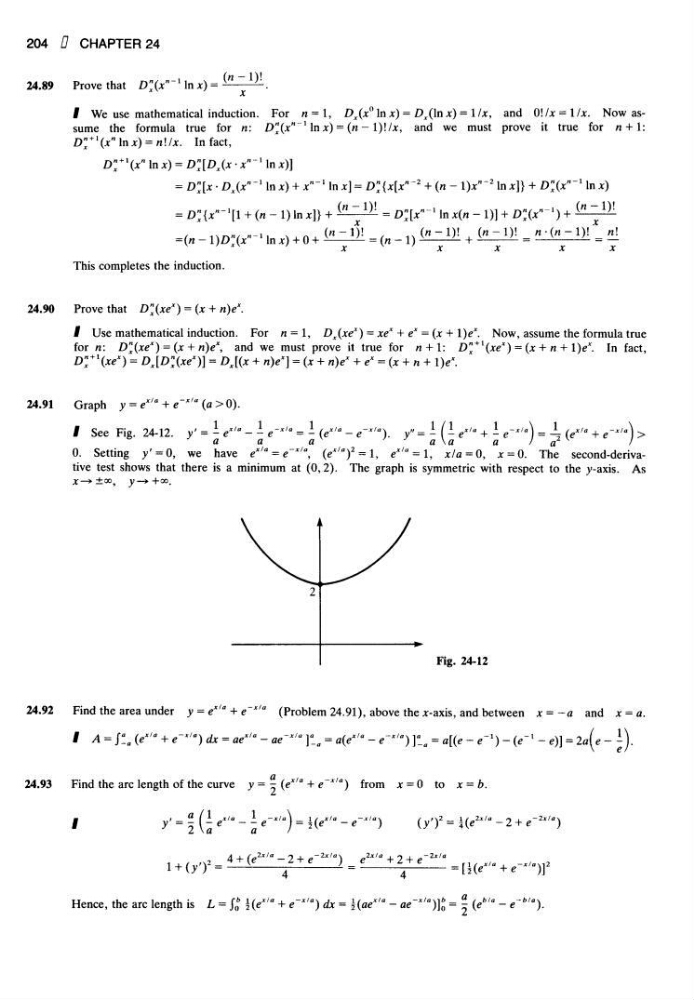
Graph y = e"
a + e'"
a (a > 0).
Fig. 24-12
Hence, the arc length is
24.92
24.93 Find the arc length of the curve
Find the area under y = e"
a + e "" (Problem 24.91), above the x-axis, and between x=-a and x = a.
204
CHAPTER 24
24.90
Prove that D
n
x (xe') = (x + n)e".
Use mathematical induction. For n = 1, D x (xe") = xe* + e" = (x + \)e*. Now, assume the formula true
for «: D"(xe") = (x + n)e", and we must prove it true for n + l: D"
+l (xe*) = (x + n + l)e*. In fact,
D"
+ l (xe") = D^D^xe*)] = D x [(x + n)e'] = (x + n)e* + e'= (x + n + l)e*.
See Fig. 24-12.
0. Setting y' = 0, we have
The second-derivative test shows that there is a minimum at (0,2). The graph is symmetric with respect to the y-axis. As
from x = 0 to x = b.
Prove that
f We use mathematical induction. For n = l, D x (x
a In x) = D x (\n x) = l/x, and 01/x-l/x. Now assume the formula true for n: D"(x"~
l Inx) = (n - 1)1 Ix, and we must prove it true for n +1:
D"
+ 1 (x"\nx) = nl/x. In fact,
Z>;
+ V In x) = D" x [D x (x • x"'
1 In x)]
= D"[x • D x (x"-' In x) + x"~
l In x] = D"{x[x"^
2 + (n- l)x"'
2 In *]} + D^x"'
1 In x)
This completes the induction.
24.91
Graph y = e"
a + e'"
a (a > 0).
Fig. 24-12
Hence, the arc length is
24.92
24.93 Find the arc length of the curve
Find the area under y = e"
a + e "" (Problem 24.91), above the x-axis, and between x=-a and x = a.
204
CHAPTER 24
24.90
Prove that D
n
x (xe') = (x + n)e".
Use mathematical induction. For n = 1, D x (xe") = xe* + e" = (x + \)e*. Now, assume the formula true
for «: D"(xe") = (x + n)e", and we must prove it true for n + l: D"
+l (xe*) = (x + n + l)e*. In fact,
D"
+ l (xe") = D^D^xe*)] = D x [(x + n)e'] = (x + n)e* + e'= (x + n + l)e*.
See Fig. 24-12.
0. Setting y' = 0, we have
The second-derivative test shows that there is a minimum at (0,2). The graph is symmetric with respect to the y-axis. As
from x = 0 to x = b.