

EXPONENTIAL FUNCTIONS
199
24.50
24.51
24.52
24.53
24.54
24.55
24.56
24.57
Find the absolute extrema of y = e""* on [— TT, ir].
Since e" is an increasing function of u, the maximum and minimum values of y correspond to the maximum
and minimum values of the exponent sin*, that is, 1 and —1. Hence, the absolute maximum is e (when
and the absolute minimum is e"
1 = l/e (when x = — IT 12).
if y = e"', where n is a positive integer, find the nth derivative y'"'.
If y = 2e
sin *, find y' and y".
Assume that the quantities x and y vary with time and are related by the equation y = 2 e"'
n *. If y increases at a
constant rate of 4 units per second, how fast is x changing when x = IT?
When
The acceleration of an object moving on the Ac-axis is 9e
3 '. Find a formula for the velocity v, if the velocity at time
t = 0 is 4 units per second.
How far does the object of Problem 24.54 move as its velocity increases from 4 to 10 units per second?
From Problem 24.54, i>=3e
3 ' + l. When v=4, t = 0. When v = 10, e
3
' = 3, 3< = ln3, f=im3.
The required distance is therefore
Find an equation of the tangent line to the curve y = 2e* at the point (0, 2).
The slope is the derivative y' = 2e* = 2e° = 2. Hence, an equation of the tangent line is
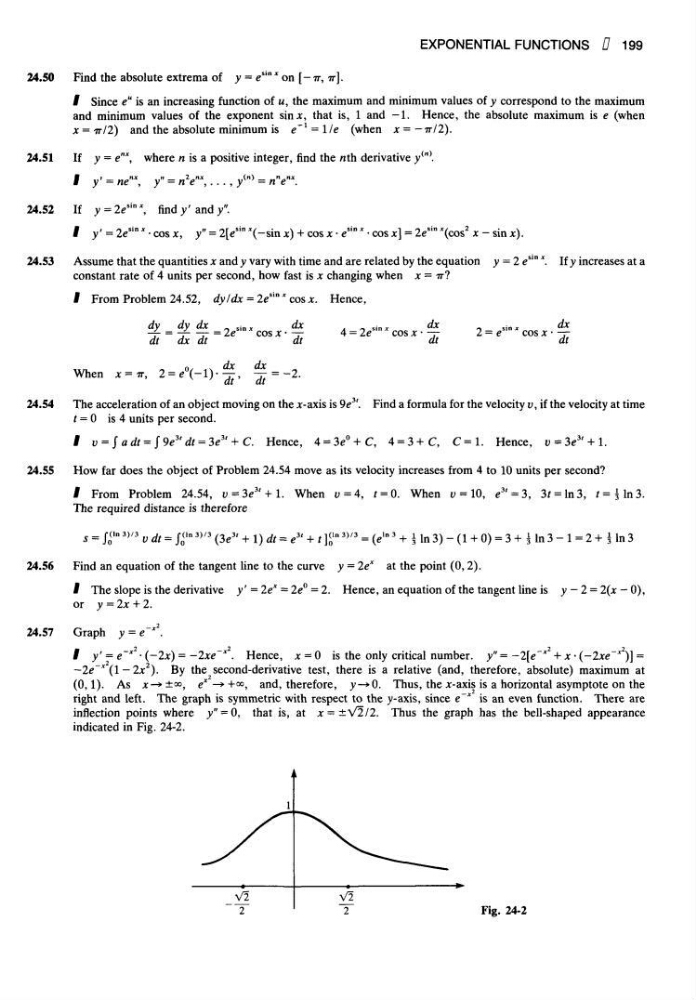
Graph y = e * .
Hence, x = 0 is the only critical number. /' = ~2[e * + x • (-2xe *
2 )] =
By the second-derivative test, there is a relative (and, therefore, absolute) maximum at
Thus, the *-axis is a horizontal asymptote on the
right and left. The graph is symmetric with respect to the y-axis, since e~
x is an even function. There are
inflection points where y" = 0, that is, at x=±V2/2.
indicated in Fig. 24-2.
(0,1). As x->±°°, e*-»+<», and, therefore,
Thus the graph has the bell-shaped appearance
Fig. 24-2
x = ir/2)
y' = ne
nx , y" = r^e™,..., y
(n) = n"e
nx .
v'=2e
sinj: -cosx, y' = 2[e
sini (-sinjc) + cosx-e
sinAt -cosx] = 2e
sinA: (cos
2 x-sinjc).
From Problem 24.52, dyldx = 2e"
a * cos x. Hence,
„ = / adt = $9e
3 'dt = 3e
3 ' + C. Hence, 4 = 3e°+C, 4 = 3+C, C = l. Hence, v=3e
3 ' + l.
y-2 = 2(x-0),
or y = 2x + 2.
y' = ex *-(-2x) = -2 X e-*\
~2e~'
2 (l-2x
2 ).
J = J 0
(ln3)/3 i;^ = / 0
3 ' + l)^=e
3 ' + r]^
n3)/3 = (e
ln3 + Hn3)-(l + 0) = 3+ Hn3-l = 2+ H"3
y=0.
199
24.50
24.51
24.52
24.53
24.54
24.55
24.56
24.57
Find the absolute extrema of y = e""* on [— TT, ir].
Since e" is an increasing function of u, the maximum and minimum values of y correspond to the maximum
and minimum values of the exponent sin*, that is, 1 and —1. Hence, the absolute maximum is e (when
and the absolute minimum is e"
1 = l/e (when x = — IT 12).
if y = e"', where n is a positive integer, find the nth derivative y'"'.
If y = 2e
sin *, find y' and y".
Assume that the quantities x and y vary with time and are related by the equation y = 2 e"'
n *. If y increases at a
constant rate of 4 units per second, how fast is x changing when x = IT?
When
The acceleration of an object moving on the Ac-axis is 9e
3 '. Find a formula for the velocity v, if the velocity at time
t = 0 is 4 units per second.
How far does the object of Problem 24.54 move as its velocity increases from 4 to 10 units per second?
From Problem 24.54, i>=3e
3 ' + l. When v=4, t = 0. When v = 10, e
3
' = 3, 3< = ln3, f=im3.
The required distance is therefore
Find an equation of the tangent line to the curve y = 2e* at the point (0, 2).
The slope is the derivative y' = 2e* = 2e° = 2. Hence, an equation of the tangent line is
Graph y = e * .
Hence, x = 0 is the only critical number. /' = ~2[e * + x • (-2xe *
2 )] =
By the second-derivative test, there is a relative (and, therefore, absolute) maximum at
Thus, the *-axis is a horizontal asymptote on the
right and left. The graph is symmetric with respect to the y-axis, since e~
x is an even function. There are
inflection points where y" = 0, that is, at x=±V2/2.
indicated in Fig. 24-2.
(0,1). As x->±°°, e*-»+<», and, therefore,
Thus the graph has the bell-shaped appearance
Fig. 24-2
x = ir/2)
y' = ne
nx , y" = r^e™,..., y
(n) = n"e
nx .
v'=2e
sinj: -cosx, y' = 2[e
sini (-sinjc) + cosx-e
sinAt -cosx] = 2e
sinA: (cos
2 x-sinjc).
From Problem 24.52, dyldx = 2e"
a * cos x. Hence,
„ = / adt = $9e
3 'dt = 3e
3 ' + C. Hence, 4 = 3e°+C, 4 = 3+C, C = l. Hence, v=3e
3 ' + l.
y-2 = 2(x-0),
or y = 2x + 2.
y' = ex *-(-2x) = -2 X e-*\
~2e~'
2 (l-2x
2 ).
J = J 0
(ln3)/3 i;^ = / 0
3 ' + l)^=e
3 ' + r]^
n3)/3 = (e
ln3 + Hn3)-(l + 0) = 3+ Hn3-l = 2+ H"3
y=0.