

198
CHAPTER 24
24.39
24.40
24.41
24.42
24.43
24.44
24.45
24.46
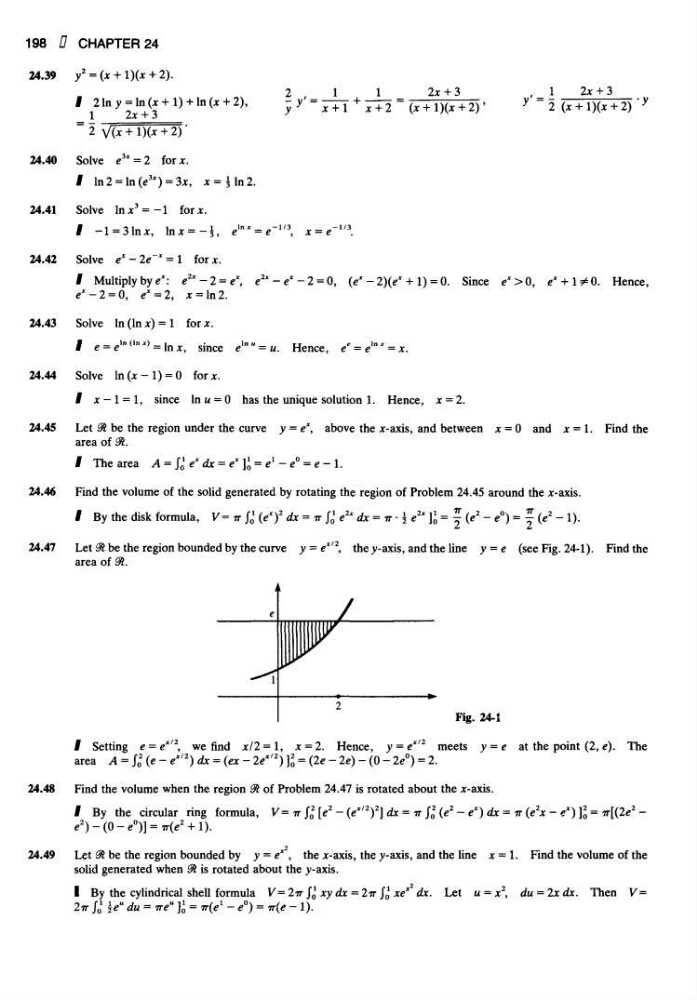
24.47
24.48
24.49
Solve e
3 ' = 2 for x.
Solve ln^;3 = -l for*.
Solve e*-2e * = 1 for*.
Multiply bye": e
2x -2 = e", e
2 " - e* -2 = 0, (e* - 2)(e* + 1) = 0. Since e* >0, e" + \*Q. Hence,
Solve In (In x) = 1 for *.
Let 91 be the region under the curve y = e', above the x-axis, and between x = 0 and x = 1. Find the
area of &.
The area ^ = J0' «*<& = e" ]10 = e1 - e° = e- 1.
Find the volume of the solid generated by rotating the region of Problem 24.45 around the x-axis.
By the disk formula,
Let & be the region bounded by the curve y = e"'
2 ,
area of 5?.
the y-axis, and the line y = e (see Fig. 24-1). Find the
Fig. 24-1
Find the volume when the region &t of Problem 24.47 is rotated about the jc-axis.
By the circular ring formula,
Let 3k be the region bounded by y = e" , the x-axis, the y-axis, and the line x = \. Find the volume of the
solid generated when 9? is rotated about the _y-axis.
By the cylindrical shell formula
Let M = jc
2
, dw = 2x dx. Then V =
y
2 = (* + l)(x + 2).
21n)' = ln(x + l) + ln(x + 2),
In2 = ln(e
3 *) = 3^:, x=$ln2.
e*-2 = 0, e" = 2, x = ln2.
Solve ln(jc-l) = 0 for*.
AT-1 = 1, since lnu = 0 has the unique solution 1. Hence, x = 2.
Setting e = e*
12 , we find x/2=l, x = 2. Hence, y = e"'
2
meets y = e at the point (2, e). The
area A = J 0
2 (e - e"
2 ) dx = (ex- 2e"
2 ) ]
2 = (2e - 2e) - (0 - 2e°) = 2.
e
2 ) - (0 - e
0 )] = rr(e
2 + I).
e = e>Min*) = lnjCj sjnce em« = M Hence> e' = e^" = Xi
-l = 31njt, ln* = -i,* =
CHAPTER 24
24.39
24.40
24.41
24.42
24.43
24.44
24.45
24.46
24.47
24.48
24.49
Solve e
3 ' = 2 for x.
Solve ln^;3 = -l for*.
Solve e*-2e * = 1 for*.
Multiply bye": e
2x -2 = e", e
2 " - e* -2 = 0, (e* - 2)(e* + 1) = 0. Since e* >0, e" + \*Q. Hence,
Solve In (In x) = 1 for *.
Let 91 be the region under the curve y = e', above the x-axis, and between x = 0 and x = 1. Find the
area of &.
The area ^ = J0' «*<& = e" ]10 = e1 - e° = e- 1.
Find the volume of the solid generated by rotating the region of Problem 24.45 around the x-axis.
By the disk formula,
Let & be the region bounded by the curve y = e"'
2 ,
area of 5?.
the y-axis, and the line y = e (see Fig. 24-1). Find the
Fig. 24-1
Find the volume when the region &t of Problem 24.47 is rotated about the jc-axis.
By the circular ring formula,
Let 3k be the region bounded by y = e" , the x-axis, the y-axis, and the line x = \. Find the volume of the
solid generated when 9? is rotated about the _y-axis.
By the cylindrical shell formula
Let M = jc
2
, dw = 2x dx. Then V =
y
2 = (* + l)(x + 2).
21n)' = ln(x + l) + ln(x + 2),
In2 = ln(e
3 *) = 3^:, x=$ln2.
e*-2 = 0, e" = 2, x = ln2.
Solve ln(jc-l) = 0 for*.
AT-1 = 1, since lnu = 0 has the unique solution 1. Hence, x = 2.
Setting e = e*
12 , we find x/2=l, x = 2. Hence, y = e"'
2
meets y = e at the point (2, e). The
area A = J 0
2 (e - e"
2 ) dx = (ex- 2e"
2 ) ]
2 = (2e - 2e) - (0 - 2e°) = 2.
e
2 ) - (0 - e
0 )] = rr(e
2 + I).
e = e>Min*) = lnjCj sjnce em« = M Hence> e' = e^" = Xi
-l = 31njt, ln* = -i,* =