

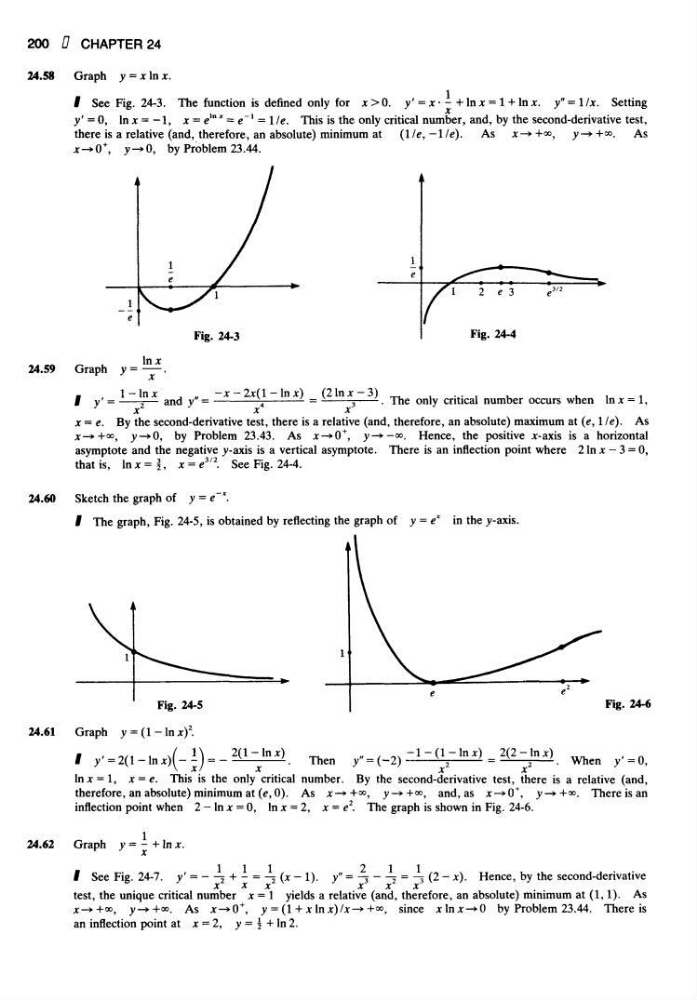
Graph y = x In x.
24.59
Graph
Fig. 24-3
Fig. 24-4
Sketch the graph of y = e ".
The graph, Fig. 24-5, is obtained by reflecting the graph of y = e* in the _y-axis.
24.61
Fig. 24-6
Then
When y=0,
lnx = l, x = e. This is the only critical number. By the second-derivative test, there is a relative (and,
therefore, an absolute) minimum at (e, 0). As *-»+«, y->+
00 , and, as x-*Q
+ , y-»+oo. There is an
inflection point when 2 - In x = 0, In x = 2, x = e
2 . The graph is shown in Fig. 24-6.
24.62
Fig. 24-5
See Fig. 24-7.
Hence, by the second-derivative
test, the unique critical number x = 1 yields a relative (and, therefore, an absolute) minimum at (1,1). As
x-*+°°, y—»+00. As Ac-»0
+ , y = (1 +xlnx)/x-* +°°, since x\nx—»0 by Problem 23.44. There is
an inflection point at x = 2, y = \ + In 2.
200
CHAPTER 24
See Fig. 24-3. The function is defined only for x>0. y'=*
Setting
y'=0, lnjt=—1, x = e =e —1/e. This is the only critical number, and, by the second-denvative test,
there is a relative (and, therefore, an absolute) minimum at (1/e,—1/e). As AC—»+<», y—»+«>. As
jt-»0
+ , j-^0, by Problem 23.44.
and
The only critical number occurs when In x = 1,
x = e. By the second-derivative test, there is a relative (and, therefore, an absolute) maximum at (e, 1 le). As
x-*+<*>, .y—»0, by Problem 23.43. As x—»0
+ , y—*—°°. Hence, the positive Jt-axis is a horizontal
asymptote and the negative y-axis is a vertical asymptote. There is an inflection point where 2 In x - 3 = 0,
that is, In x = 1, x = e
3 '
2 . See Fig. 24-4.
24.60
24.58
Graph y = (1-In*)
2 .
Graph
In
y" = l/x.
+ In x = 1 + In x.
24.59
Graph
Fig. 24-3
Fig. 24-4
Sketch the graph of y = e ".
The graph, Fig. 24-5, is obtained by reflecting the graph of y = e* in the _y-axis.
24.61
Fig. 24-6
Then
When y=0,
lnx = l, x = e. This is the only critical number. By the second-derivative test, there is a relative (and,
therefore, an absolute) minimum at (e, 0). As *-»+«, y->+
00 , and, as x-*Q
+ , y-»+oo. There is an
inflection point when 2 - In x = 0, In x = 2, x = e
2 . The graph is shown in Fig. 24-6.
24.62
Fig. 24-5
See Fig. 24-7.
Hence, by the second-derivative
test, the unique critical number x = 1 yields a relative (and, therefore, an absolute) minimum at (1,1). As
x-*+°°, y—»+00. As Ac-»0
+ , y = (1 +xlnx)/x-* +°°, since x\nx—»0 by Problem 23.44. There is
an inflection point at x = 2, y = \ + In 2.
200
CHAPTER 24
See Fig. 24-3. The function is defined only for x>0. y'=*
Setting
y'=0, lnjt=—1, x = e =e —1/e. This is the only critical number, and, by the second-denvative test,
there is a relative (and, therefore, an absolute) minimum at (1/e,—1/e). As AC—»+<», y—»+«>. As
jt-»0
+ , j-^0, by Problem 23.44.
and
The only critical number occurs when In x = 1,
x = e. By the second-derivative test, there is a relative (and, therefore, an absolute) maximum at (e, 1 le). As
x-*+<*>, .y—»0, by Problem 23.43. As x—»0
+ , y—*—°°. Hence, the positive Jt-axis is a horizontal
asymptote and the negative y-axis is a vertical asymptote. There is an inflection point where 2 In x - 3 = 0,
that is, In x = 1, x = e
3 '
2 . See Fig. 24-4.
24.60
24.58
Graph y = (1-In*)
2 .
Graph
In
y" = l/x.
+ In x = 1 + In x.