

For the triangle of Problem 3.33, find an equation of the perpendicular bisector of side AB.
The midpoint N of AB is ((1+ 8)/2, (2 +l)/2) = (9/2,3/2). The slope of AB is (2- !)/(!- 8) = -$.
Hence, the slope of the desired line is the negative reciprocal of -7, that is, 7. Thus, the slope-intercept
equation of the perpendicular bisector has the form y = lx + b. Since (9/2,3/2) lies on the line, | =
7(|) + b. So, fe = i - f = -30. Thus, the desired equation is y = Ix - 30.
If a line L has the equation 3x + 2y = 4, prove that a point P(.x, y) is above L if and only if 3x + 2y > 4.
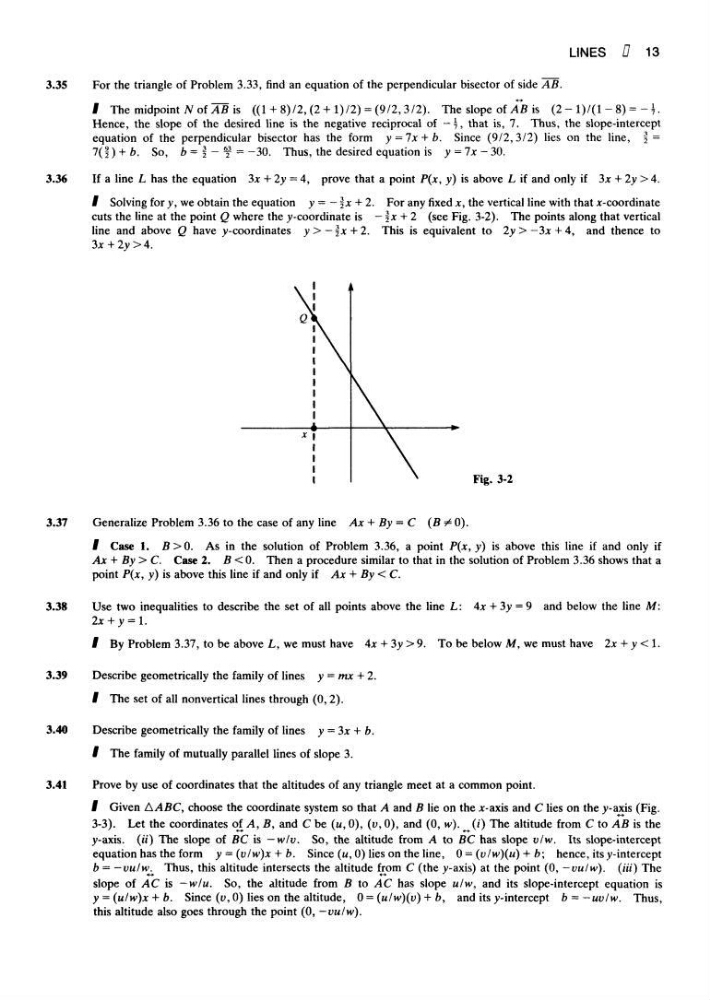
Solving for y, we obtain the equation y=—\x + 2. For any fixed x, the vertical line with that x-coordinate
cuts the line at the point Q where the y-coordinate is —\x + 2 (see Fig. 3-2). The points along that vertical
line and above Q have y-coordinates y>— \x + 2. This is equivalent to 2y>-3* + 4, and thence to
3* + 2y> 4.
Fig. 3-2
Generalize Problem 3.36 to the case of any line Ax + By = C (B^ 0).
Case 1. B > 0. As in the solution of Problem 3.36, a point P(x, y) is above this line if and only if
Ax + By>C. Case 2. B < 0. Then a procedure similar to that in the solution of Problem 3.36 shows that a
point P(x, y) is above this line if and only if Ax + By
2x + y = 1.
By Problem 3.37, to be above L, we must have 4* + 3y>9. To be below M, we must have 2x + y
The set of all nonvertical lines through (0,2).
Describe geometrically the family of lines y = 3x + b.
The family of mutually parallel lines of slope 3.
Prove by use of coordinates that the altitudes of any triangle meet at a common point.
Given AABC, choose the coordinate system so that A and B lie on the x-axis and C lies on the y-axis (Fig.
3-3). Let the coordinates of A, B, and C be («, 0), (v, 0), and (0, w). ^(i) The altitude from C to AB is the
y-axis. («') The slope of BC is — w/v. So, the altitude from A to BC has slope vlw. Its slope-intercept
equation has the form y = (v/w)x + b. Since (M, 0) lies on the line, 0 = (v/w)(u) + b; hence, its y-intercept
b = — vu/w^ Thus, this altitude intersects the altitude from C (the y-axis) at the point (0, -vulw). (Hi) The
slope of AC is —w/u. So, the altitude from B to AC has slope ulw, and its slope-intercept equation is
y = (ulw)x + b. Since (v, 0) lies on the altitude, 0 = (u/w)(v) + b, and its y-intercept b = —uv/w. Thus,
this altitude also goes through the point (0, — vulw).
LINES
13
3.35
3.36
3.37
3.38
3.39
3.40
3.41
The midpoint N of AB is ((1+ 8)/2, (2 +l)/2) = (9/2,3/2). The slope of AB is (2- !)/(!- 8) = -$.
Hence, the slope of the desired line is the negative reciprocal of -7, that is, 7. Thus, the slope-intercept
equation of the perpendicular bisector has the form y = lx + b. Since (9/2,3/2) lies on the line, | =
7(|) + b. So, fe = i - f = -30. Thus, the desired equation is y = Ix - 30.
If a line L has the equation 3x + 2y = 4, prove that a point P(.x, y) is above L if and only if 3x + 2y > 4.
Solving for y, we obtain the equation y=—\x + 2. For any fixed x, the vertical line with that x-coordinate
cuts the line at the point Q where the y-coordinate is —\x + 2 (see Fig. 3-2). The points along that vertical
line and above Q have y-coordinates y>— \x + 2. This is equivalent to 2y>-3* + 4, and thence to
3* + 2y> 4.
Fig. 3-2
Generalize Problem 3.36 to the case of any line Ax + By = C (B^ 0).
Case 1. B > 0. As in the solution of Problem 3.36, a point P(x, y) is above this line if and only if
Ax + By>C. Case 2. B < 0. Then a procedure similar to that in the solution of Problem 3.36 shows that a
point P(x, y) is above this line if and only if Ax + By
2x + y = 1.
By Problem 3.37, to be above L, we must have 4* + 3y>9. To be below M, we must have 2x + y
The set of all nonvertical lines through (0,2).
Describe geometrically the family of lines y = 3x + b.
The family of mutually parallel lines of slope 3.
Prove by use of coordinates that the altitudes of any triangle meet at a common point.
Given AABC, choose the coordinate system so that A and B lie on the x-axis and C lies on the y-axis (Fig.
3-3). Let the coordinates of A, B, and C be («, 0), (v, 0), and (0, w). ^(i) The altitude from C to AB is the
y-axis. («') The slope of BC is — w/v. So, the altitude from A to BC has slope vlw. Its slope-intercept
equation has the form y = (v/w)x + b. Since (M, 0) lies on the line, 0 = (v/w)(u) + b; hence, its y-intercept
b = — vu/w^ Thus, this altitude intersects the altitude from C (the y-axis) at the point (0, -vulw). (Hi) The
slope of AC is —w/u. So, the altitude from B to AC has slope ulw, and its slope-intercept equation is
y = (ulw)x + b. Since (v, 0) lies on the altitude, 0 = (u/w)(v) + b, and its y-intercept b = —uv/w. Thus,
this altitude also goes through the point (0, — vulw).
LINES
13
3.35
3.36
3.37
3.38
3.39
3.40
3.41