

CHAPTER 3
3.42
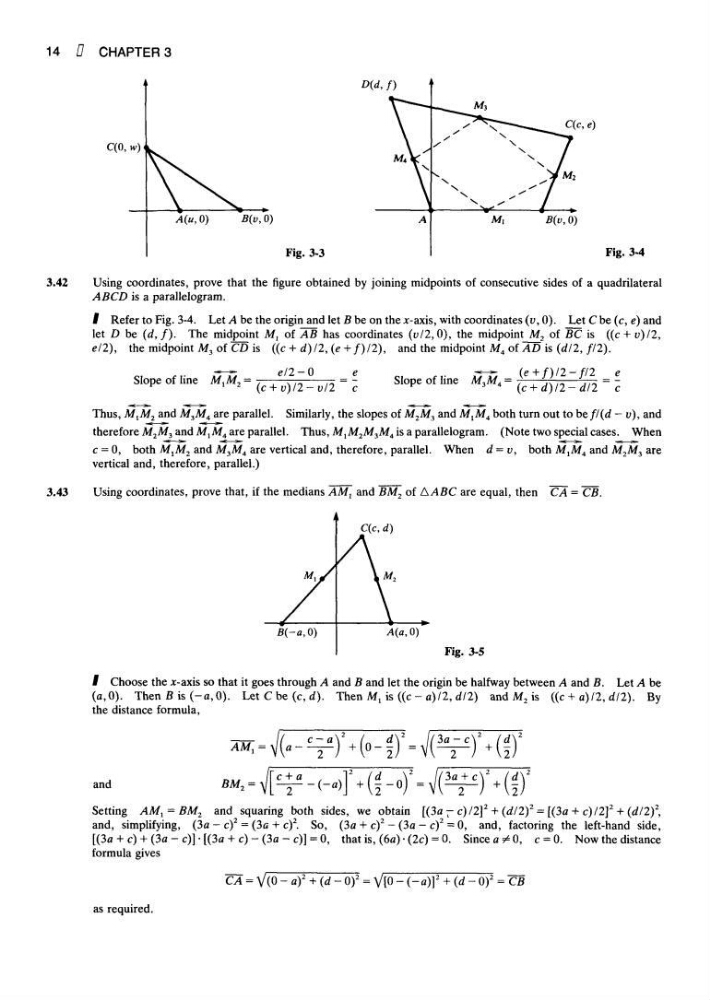
Fig. 3-4
Using coordinates, prove that the figure obtained by joining midpoints of consecutive sides of a quadrilateral
ABCD is a parallelogram.
Refer to Fig. 3-4. Let A be the origin and let B be on the *-axis, with coordinates (v, 0). Let C be (c, e) and
let D be (d, f). The midpoint M, of AB has coordinates (v/2,0), the midpoint_M 2 of 1C is ((c + v)/2,
e/2), the midpoint M 3 of CD is ((c + d)/2, (e +/)/2), and the midpoint M 4 of ~AD is (d/2, f/2).
Slope of line
Thus, M t M 2 and M 3 M 4 are parallel. Similarly, the slopes of M 2 M 3 and MjM 4 both turn out to be//(d — u), and
therefore M 2 M 3 and M, M 4 are parallel. Thus, M 1 M 2 M 3 M 4 is a parallelogram. (Note two special cases. When
c = 0, both MjM2 and M3M4 are vertical and, therefore, parallel. When d=v, both MjM4 and M2M3 are
vertical and, therefore, parallel.)
3.43
Using coordinates, prove that, if the medians AM l and BM 2 of l\ABC are equal, then CA = CB.
I Choose the jc-axis so that it goes through A and B and let the origin be halfway between A and B. Let A be
(a, 0). Then B is (-a, 0). Let C be (c, d). Then Aft is ((c - a)/2, d/2) and M2 is ((c + a) 12, d/2). By
the distance formula,
Setting AM1 = BM2 and squaring both sides, we obtain [(3a r c)/2]2 + (d/2)2 = [(3a + c)/2]2 + (d/2)2,
and, simplifying, (3a - c)
2 = (3c + c)
2
. So, (3a + c)
2 - (3a - c)
2 = 0, and, factoring the left-hand side,
t(3a + c) + (3a - c)] • [(3a + c) - (3a - c)] = 0, that is, (6a) • (2c) = 0. Since a 5^0, c = 0. Now the distance
formula gives
as required.
Fig. 3-3
Slope of line
and
Fig. 3-5
14
3.42
Fig. 3-4
Using coordinates, prove that the figure obtained by joining midpoints of consecutive sides of a quadrilateral
ABCD is a parallelogram.
Refer to Fig. 3-4. Let A be the origin and let B be on the *-axis, with coordinates (v, 0). Let C be (c, e) and
let D be (d, f). The midpoint M, of AB has coordinates (v/2,0), the midpoint_M 2 of 1C is ((c + v)/2,
e/2), the midpoint M 3 of CD is ((c + d)/2, (e +/)/2), and the midpoint M 4 of ~AD is (d/2, f/2).
Slope of line
Thus, M t M 2 and M 3 M 4 are parallel. Similarly, the slopes of M 2 M 3 and MjM 4 both turn out to be//(d — u), and
therefore M 2 M 3 and M, M 4 are parallel. Thus, M 1 M 2 M 3 M 4 is a parallelogram. (Note two special cases. When
c = 0, both MjM2 and M3M4 are vertical and, therefore, parallel. When d=v, both MjM4 and M2M3 are
vertical and, therefore, parallel.)
3.43
Using coordinates, prove that, if the medians AM l and BM 2 of l\ABC are equal, then CA = CB.
I Choose the jc-axis so that it goes through A and B and let the origin be halfway between A and B. Let A be
(a, 0). Then B is (-a, 0). Let C be (c, d). Then Aft is ((c - a)/2, d/2) and M2 is ((c + a) 12, d/2). By
the distance formula,
Setting AM1 = BM2 and squaring both sides, we obtain [(3a r c)/2]2 + (d/2)2 = [(3a + c)/2]2 + (d/2)2,
and, simplifying, (3a - c)
2 = (3c + c)
2
. So, (3a + c)
2 - (3a - c)
2 = 0, and, factoring the left-hand side,
t(3a + c) + (3a - c)] • [(3a + c) - (3a - c)] = 0, that is, (6a) • (2c) = 0. Since a 5^0, c = 0. Now the distance
formula gives
as required.
Fig. 3-3
Slope of line
and
Fig. 3-5
14