

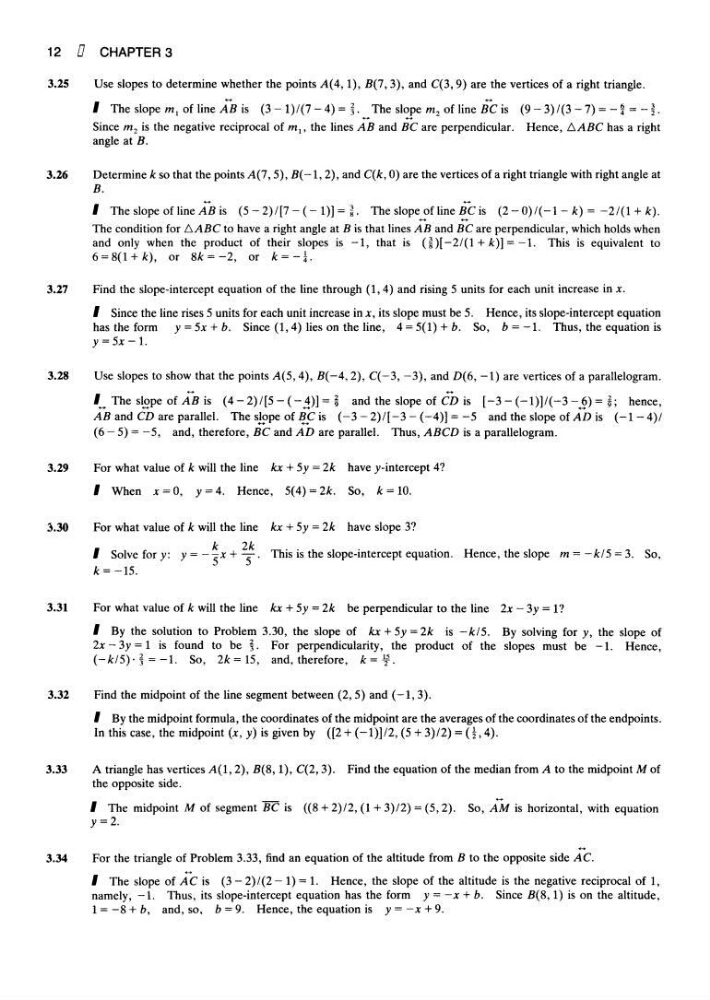
Use slopes to determine whether the points A(4,1), 5(7, 3), and C(3,9) are the vertices of a right triangle.
The slope m 1 of line AB is (3 - l)/(7-4) = f. The slope w 2 of line BC is (9 -3)/(3 -7) = -f = -|.
Since m 2 is the negative reciprocal of m } , the lines AB and BC are perpendicular. Hence, A ABC has a right
angle at B.
Determine k so that the points A(7,5), B(-l, 2), and C(k, 0) are the vertices of a right triangle with right angle at
B.
The slope of line AB is (5-2)/[7-(-1)] = §. The slope of line BC is (2-0)/(-l - *) = -2/(l + it).
The condition for A ABC to have a right angle at B is that lines AB and BC are perpendicular, which holds when
and only when the product of their slopes is —1, that is (|)[—2/(l + k)] = —I. This is equivalent to
6 = 8(1 + *), or 8* = -2, or k=-\.
Find the slope-intercept equation of the line through (1,4) and rising 5 units for each unit increase in x.
Since the line rises 5 units for each unit increase in x, its slope must be 5. Hence, its slope-intercept equation
has the form y = 5x + b. Since (1,4) lies on the line, 4 = 5(l) + b. So, b = — 1. Thus, the equation is
y = 5x-l.
Use slopes to show that the points A(5, 4), B(-4, 2), C(-3, -3), and D(6, -1) are vertices of a parallelogram.
The slope of AB is (4-2)/[5 - (-4)] = | and the slope of CD is [-3 - (-l)]/(-3 -j6) = |; hence,
AB and CD are parallel. The slope of BC is (-3 - 2)/[-3 - (-4)] = -5 and the slope of AD is (-1 - 4)/
(6 — 5) = -5, and, therefore, BC and AD are parallel. Thus, ABCD is a parallelogram.
For what value of k will the line kx + 5y = 2k have ^-intercept 4?
When * = 0, y = 4. Hence, 5(4) = 2*. So, k = 10.
For what value of k will the line kx + 5y - 2k have slope 3?
Solve for y:
A: =-15.
For what value of k will the line kx + 5y = 2k be perpendicular to the line 2x — 3_y = 1?
By the solution to Problem 3.30, the slope of kx + 5y = 2k is —k/5. By solving for y, the slope of
2x — 3y — 1 is found to be |. For perpendicularity, the product of the slopes must be — 1. Hence,
(~fc/5)-i = -1. So, 2k= 15, and, therefore, k=%.
Find the midpoint of the line segment between (2, 5) and (—1, 3).
By the midpoint formula, the coordinates of the midpoint are the averages of the coordinates of the endpoints.
In this case, the midpoint (x, y) is given by ([2 + (-l)]/2, (5 + 3)/2) = (|, 4).
A triangle has vertices A(l,2), B(8,1), C(2,3). Find the equation of the median from A to the midpoint M of
the opposite side.
The midpoint M of segment BC is ((8 + 2)/2, (1 + 3)/2) = (5,2). So, AM is horizontal, with equation
y = 2.
For the triangle of Problem 3.33, find an equation of the altitude from B to the opposite side AC.
The slope of AC is (3 - 2)/(2 — 1) = 1. Hence, the slope of the altitude is the negative reciprocal of 1,
namely, —1. Thus, its slope-intercept equation has the form y = — x + b. Since B(8,1) is on the altitude,
1 = -8 + b, and, so, b = 9. Hence, the equation is y = -x + 9.
CHAPTER 3
12
3.25
3.26
3.27
3.28
3.29
3.30
3.31
3.32
3.33
3.34
This is the slope-intercept equation. Hence, the slope m = —k/5 = 3. So,
The slope m 1 of line AB is (3 - l)/(7-4) = f. The slope w 2 of line BC is (9 -3)/(3 -7) = -f = -|.
Since m 2 is the negative reciprocal of m } , the lines AB and BC are perpendicular. Hence, A ABC has a right
angle at B.
Determine k so that the points A(7,5), B(-l, 2), and C(k, 0) are the vertices of a right triangle with right angle at
B.
The slope of line AB is (5-2)/[7-(-1)] = §. The slope of line BC is (2-0)/(-l - *) = -2/(l + it).
The condition for A ABC to have a right angle at B is that lines AB and BC are perpendicular, which holds when
and only when the product of their slopes is —1, that is (|)[—2/(l + k)] = —I. This is equivalent to
6 = 8(1 + *), or 8* = -2, or k=-\.
Find the slope-intercept equation of the line through (1,4) and rising 5 units for each unit increase in x.
Since the line rises 5 units for each unit increase in x, its slope must be 5. Hence, its slope-intercept equation
has the form y = 5x + b. Since (1,4) lies on the line, 4 = 5(l) + b. So, b = — 1. Thus, the equation is
y = 5x-l.
Use slopes to show that the points A(5, 4), B(-4, 2), C(-3, -3), and D(6, -1) are vertices of a parallelogram.
The slope of AB is (4-2)/[5 - (-4)] = | and the slope of CD is [-3 - (-l)]/(-3 -j6) = |; hence,
AB and CD are parallel. The slope of BC is (-3 - 2)/[-3 - (-4)] = -5 and the slope of AD is (-1 - 4)/
(6 — 5) = -5, and, therefore, BC and AD are parallel. Thus, ABCD is a parallelogram.
For what value of k will the line kx + 5y = 2k have ^-intercept 4?
When * = 0, y = 4. Hence, 5(4) = 2*. So, k = 10.
For what value of k will the line kx + 5y - 2k have slope 3?
Solve for y:
A: =-15.
For what value of k will the line kx + 5y = 2k be perpendicular to the line 2x — 3_y = 1?
By the solution to Problem 3.30, the slope of kx + 5y = 2k is —k/5. By solving for y, the slope of
2x — 3y — 1 is found to be |. For perpendicularity, the product of the slopes must be — 1. Hence,
(~fc/5)-i = -1. So, 2k= 15, and, therefore, k=%.
Find the midpoint of the line segment between (2, 5) and (—1, 3).
By the midpoint formula, the coordinates of the midpoint are the averages of the coordinates of the endpoints.
In this case, the midpoint (x, y) is given by ([2 + (-l)]/2, (5 + 3)/2) = (|, 4).
A triangle has vertices A(l,2), B(8,1), C(2,3). Find the equation of the median from A to the midpoint M of
the opposite side.
The midpoint M of segment BC is ((8 + 2)/2, (1 + 3)/2) = (5,2). So, AM is horizontal, with equation
y = 2.
For the triangle of Problem 3.33, find an equation of the altitude from B to the opposite side AC.
The slope of AC is (3 - 2)/(2 — 1) = 1. Hence, the slope of the altitude is the negative reciprocal of 1,
namely, —1. Thus, its slope-intercept equation has the form y = — x + b. Since B(8,1) is on the altitude,
1 = -8 + b, and, so, b = 9. Hence, the equation is y = -x + 9.
CHAPTER 3
12
3.25
3.26
3.27
3.28
3.29
3.30
3.31
3.32
3.33
3.34
This is the slope-intercept equation. Hence, the slope m = —k/5 = 3. So,