

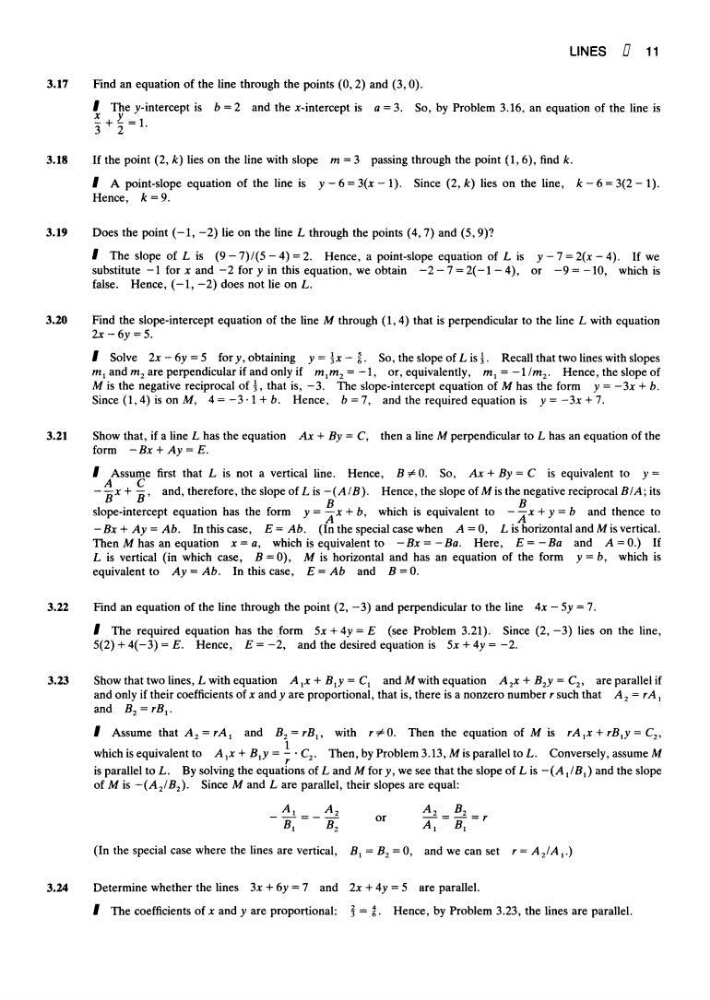
Find an equation of the line through the points (0,2) and (3,0).
The y-intercept is b = 2 and the ^-intercept is a = 3. So, by Problem 3.16, an equation of the line is
If the point (2, k) lies on the line with slope m = 3 passing through the point (1, 6), find k.
A point-slope equation of the line is y — 6 = 3(x — 1). Since (2, k) lies on the line, k — 6 = 3(2-1).
Hence, k = 9.
Does the point (-1, -2) lie on the line L through the points (4,7) and (5,9)?
The slope of L is (9 - 7)7(5 - 4) = 2. Hence, a point-slope equation of L is y-7 = 2(x- 4). If we
substitute —1 for x and -2 for y in this equation, we obtain —2 — 7 = 2(-l — 4), or —9 = -10, which is
false. Hence, (—1, —2) does not lie on L.
Find the slope-intercept equation of the line M through (1,4) that is perpendicular to the line L with equation
2x - 6y = 5.
Solve 2x - 6y = 5 for y, obtaining y = \x — f. So, the slope of L is j. Recall that two lines with slopes
m 1 and m 2 are perpendicular if and only if w,w 2 = —1, or, equivalently, m, = —1 Im 2 . Hence, the slope of
M is the negative reciprocal of 3, that is, -3. The slope-intercept equation of M has the form y = -3x + b.
Since (1,4) is on M, 4=—3-1 + fe. Hence, b = 7, and the required equation is y = -3x + 1.
Show that, if a line L has the equation Ax + By - C, then a line M perpendicular to L has an equation of the
form - Bx + Ay = E.
Assume first that L is not a vertical line. Hence, B ^ 0. So, Ax + By — C is equivalent to y =
slope-intercept equation has the form
-Bx + Ay = Ab. In this case, E = Ab. (In the special case when A = 0, L is horizontal and M is vertical.
Then M has an equation x = a, which is equivalent to -Bx = -Ba. Here, E = -Ba and A - 0.) If
L is vertical (in which case, B = 0), M is horizontal and has an equation of the form y = b, which is
equivalent to Ay = Ab. In this case, E = Ab and B = 0.
Find an equation of the line through the point (2, -3) and perpendicular to the line 4x - 5y = 7.
The required equation has the form 5* + 4>' = E (see Problem 3.21). Since (2,—3) lies on the line,
5(2) + 4(-3) = E. Hence, E=~2, and the desired equation is 5x + 4y=-2.
Show that two lines, L with equation A 1 x + B l y=C 1 and M with equation A z x + B 2 y = C 2 , are parallel if
and only if their coefficients of x and y are proportional, that is, there is a nonzero number r such that A 2 = rA,
and B 2 = rB l .
Assume that A 2 = rA l and B 2 = rB l , with r^O. Then the equation of M is rA t x + rB t y = C 2 ,
which is equivalent to A^x + B,}> = - • C 2 . Then, by Problem 3.13, Mis parallel to L. Conversely, assume M
is parallel to L. By solving the equations of L and M for y, we see that the slope of L is — (A ,/B,) and the slope
of M is ~(A 2 /B 2 ). Since M and L are parallel, their slopes are equal:
nr
(In the special case where the lines are vertical, B l = B 2 = 0, and we can set r = A 2 /A,.)
Determine whether the lines 3x + 6y = 7 and 2x + 4y = 5 are parallel.
The coefficients of x and y are proportional: § = g. Hence, by Problem 3.23, the lines are parallel.
LINES
11
3.17
3.18
3.19
3.20
3.21
3.22
3.23
3.24
and, therefore, the slope of L is —(AIB). Hence, the slope of M is the negative reciprocal BIA; its
and thence to
which is equivalent to
The y-intercept is b = 2 and the ^-intercept is a = 3. So, by Problem 3.16, an equation of the line is
If the point (2, k) lies on the line with slope m = 3 passing through the point (1, 6), find k.
A point-slope equation of the line is y — 6 = 3(x — 1). Since (2, k) lies on the line, k — 6 = 3(2-1).
Hence, k = 9.
Does the point (-1, -2) lie on the line L through the points (4,7) and (5,9)?
The slope of L is (9 - 7)7(5 - 4) = 2. Hence, a point-slope equation of L is y-7 = 2(x- 4). If we
substitute —1 for x and -2 for y in this equation, we obtain —2 — 7 = 2(-l — 4), or —9 = -10, which is
false. Hence, (—1, —2) does not lie on L.
Find the slope-intercept equation of the line M through (1,4) that is perpendicular to the line L with equation
2x - 6y = 5.
Solve 2x - 6y = 5 for y, obtaining y = \x — f. So, the slope of L is j. Recall that two lines with slopes
m 1 and m 2 are perpendicular if and only if w,w 2 = —1, or, equivalently, m, = —1 Im 2 . Hence, the slope of
M is the negative reciprocal of 3, that is, -3. The slope-intercept equation of M has the form y = -3x + b.
Since (1,4) is on M, 4=—3-1 + fe. Hence, b = 7, and the required equation is y = -3x + 1.
Show that, if a line L has the equation Ax + By - C, then a line M perpendicular to L has an equation of the
form - Bx + Ay = E.
Assume first that L is not a vertical line. Hence, B ^ 0. So, Ax + By — C is equivalent to y =
slope-intercept equation has the form
-Bx + Ay = Ab. In this case, E = Ab. (In the special case when A = 0, L is horizontal and M is vertical.
Then M has an equation x = a, which is equivalent to -Bx = -Ba. Here, E = -Ba and A - 0.) If
L is vertical (in which case, B = 0), M is horizontal and has an equation of the form y = b, which is
equivalent to Ay = Ab. In this case, E = Ab and B = 0.
Find an equation of the line through the point (2, -3) and perpendicular to the line 4x - 5y = 7.
The required equation has the form 5* + 4>' = E (see Problem 3.21). Since (2,—3) lies on the line,
5(2) + 4(-3) = E. Hence, E=~2, and the desired equation is 5x + 4y=-2.
Show that two lines, L with equation A 1 x + B l y=C 1 and M with equation A z x + B 2 y = C 2 , are parallel if
and only if their coefficients of x and y are proportional, that is, there is a nonzero number r such that A 2 = rA,
and B 2 = rB l .
Assume that A 2 = rA l and B 2 = rB l , with r^O. Then the equation of M is rA t x + rB t y = C 2 ,
which is equivalent to A^x + B,}> = - • C 2 . Then, by Problem 3.13, Mis parallel to L. Conversely, assume M
is parallel to L. By solving the equations of L and M for y, we see that the slope of L is — (A ,/B,) and the slope
of M is ~(A 2 /B 2 ). Since M and L are parallel, their slopes are equal:
nr
(In the special case where the lines are vertical, B l = B 2 = 0, and we can set r = A 2 /A,.)
Determine whether the lines 3x + 6y = 7 and 2x + 4y = 5 are parallel.
The coefficients of x and y are proportional: § = g. Hence, by Problem 3.23, the lines are parallel.
LINES
11
3.17
3.18
3.19
3.20
3.21
3.22
3.23
3.24
and, therefore, the slope of L is —(AIB). Hence, the slope of M is the negative reciprocal BIA; its
and thence to
which is equivalent to