

CHAPTER 3
Find the slope and y-intercept of the line given by the equation 7x + 4y = 8.
If we solve the equation Ix + 4y = 8 for y, we obtain the equation y = — \x + 2, which is the
slope-intercept equation. Hence, the slope m = — I and the y-intercept b = 2.
Show that every line has an equation of the form Ax + By = C, where A and B are not both 0, and that,
conversely, every such equation is the equation of a line.
If a given line is vertical, it has an equation x = C. In this case, we can let A = 1 and B = 0. If the
given line is not vertical, it has a slope-intercept equation y = mx + b, or, equivalently, — mx + y = b. So,
let A — — m, 5 = 1, and C = b. Conversely, assume that we are given an equation Ax + By = C, with
A and B not both 0. If B = 0, the equation is equivalent to x= CIA, which is the equation of a vertical
line. If B ^ 0, solve the equation for y:
with slope
Find an equation of the line L through (-1,4) and parallel to the line M with the equation 3x + 4y = 2.
Remember that two lines are parallel if and only if their slopes are equal. If we solve 3x + 4y = 2 for y,
namely, y = —f*+ i, we obtain the slope-intercept equation for M. Hence, the slope of M is — | and,
therefore, the slope of the parallel line L also is -|. So, L has a slope-intercept equation of the form
y=-\x + b. Since L goes through (-1,4), 4= -\ • (-1) + b, and, therefore, fc=4-i="- Thus, the
equation of L is y = - \x + T •
Show that the lines parallel to a line Ax + By = C are those lines having equations of the form Ax + By = E
for some E. (Assume that B =£ 0.)
If we solve Ax + By = C for y, we obtain the slope-intercept equation
-A/B. Given a parallel line, it must also have slope —A/B and, therefore, has a slope-intercept equation
equation Ax + By = E must have slope -A/B (obtained by putting the equation in slope-intercept form) and
is, therefore, parallel to the line with equation Ax + By = C.
Find an equation of the line through (2, 3) and parallel to the line with the equation 4x — 2y = 7.
By Problem 3.13, the required line must have an equation of the form 4x - 2y = E. Since (2, 3) lies on the
line, 4(2) - 2(3) = E. So, £ = 8-6 = 2. Hence, the desired equation is 4x - 2y = 2.
Find an equation of the line through (2,3) and parallel to the line with the equation y = 5.
Since y = 5 is the equation of a horizontal line, the required parallel line is horizontal. Since it passes
through (2, 3), an equation for it is y = 3.
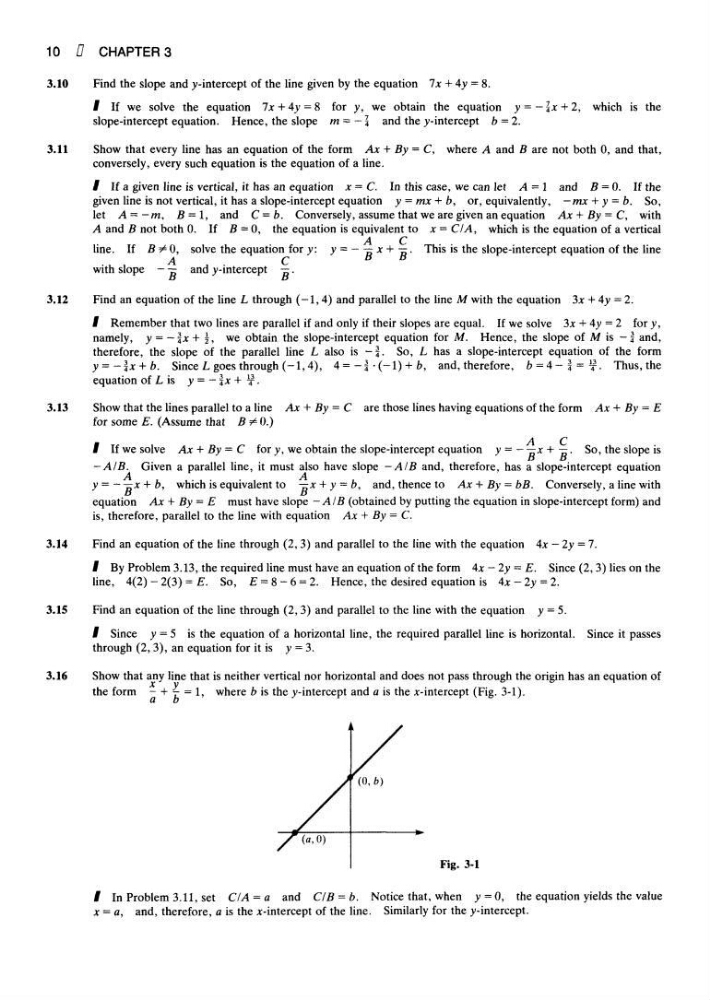
Show that any line that is neither vertical nor horizontal and does not pass through the origin has an equation of
the form
In Problem 3.11, set CIA = a and CIB = b. Notice that, when y = 0, the equation yields the value
x = a, and, therefore, a is the x-intercept of the line. Similarly for the y-intercept.
Fig. 3-1
3.10
3.11
3.12
3.13
3.14
3.15
3.16
10
This is the slope-intercept equation of the line
and y-intercept
So, the slope is
and, thence to Ax + By = bB. Conversely, a line with
which is equivalent to
where b is the y-intercept and a is the ^-intercept (Fig. 3-1).
Find the slope and y-intercept of the line given by the equation 7x + 4y = 8.
If we solve the equation Ix + 4y = 8 for y, we obtain the equation y = — \x + 2, which is the
slope-intercept equation. Hence, the slope m = — I and the y-intercept b = 2.
Show that every line has an equation of the form Ax + By = C, where A and B are not both 0, and that,
conversely, every such equation is the equation of a line.
If a given line is vertical, it has an equation x = C. In this case, we can let A = 1 and B = 0. If the
given line is not vertical, it has a slope-intercept equation y = mx + b, or, equivalently, — mx + y = b. So,
let A — — m, 5 = 1, and C = b. Conversely, assume that we are given an equation Ax + By = C, with
A and B not both 0. If B = 0, the equation is equivalent to x= CIA, which is the equation of a vertical
line. If B ^ 0, solve the equation for y:
with slope
Find an equation of the line L through (-1,4) and parallel to the line M with the equation 3x + 4y = 2.
Remember that two lines are parallel if and only if their slopes are equal. If we solve 3x + 4y = 2 for y,
namely, y = —f*+ i, we obtain the slope-intercept equation for M. Hence, the slope of M is — | and,
therefore, the slope of the parallel line L also is -|. So, L has a slope-intercept equation of the form
y=-\x + b. Since L goes through (-1,4), 4= -\ • (-1) + b, and, therefore, fc=4-i="- Thus, the
equation of L is y = - \x + T •
Show that the lines parallel to a line Ax + By = C are those lines having equations of the form Ax + By = E
for some E. (Assume that B =£ 0.)
If we solve Ax + By = C for y, we obtain the slope-intercept equation
-A/B. Given a parallel line, it must also have slope —A/B and, therefore, has a slope-intercept equation
equation Ax + By = E must have slope -A/B (obtained by putting the equation in slope-intercept form) and
is, therefore, parallel to the line with equation Ax + By = C.
Find an equation of the line through (2, 3) and parallel to the line with the equation 4x — 2y = 7.
By Problem 3.13, the required line must have an equation of the form 4x - 2y = E. Since (2, 3) lies on the
line, 4(2) - 2(3) = E. So, £ = 8-6 = 2. Hence, the desired equation is 4x - 2y = 2.
Find an equation of the line through (2,3) and parallel to the line with the equation y = 5.
Since y = 5 is the equation of a horizontal line, the required parallel line is horizontal. Since it passes
through (2, 3), an equation for it is y = 3.
Show that any line that is neither vertical nor horizontal and does not pass through the origin has an equation of
the form
In Problem 3.11, set CIA = a and CIB = b. Notice that, when y = 0, the equation yields the value
x = a, and, therefore, a is the x-intercept of the line. Similarly for the y-intercept.
Fig. 3-1
3.10
3.11
3.12
3.13
3.14
3.15
3.16
10
This is the slope-intercept equation of the line
and y-intercept
So, the slope is
and, thence to Ax + By = bB. Conversely, a line with
which is equivalent to
where b is the y-intercept and a is the ^-intercept (Fig. 3-1).