

184 0 CHAPTER 22
22.56
Find the volume of the solid of revolution obtained by rotating about the jc-axis the region in the first quadrant
bounded by the curve x
2 '
3 + y
2 '
3 = a
2 '
3 and the coordinate axes.
22.57
The base of a certain solid is an equilateral triangle of side b, with one vertex at the origin and an altitude along the
positive j;-axis. Each plane perpendicular to the .it-axis intersects the solid in a square with one side in the base of
the solid. Find the volume.
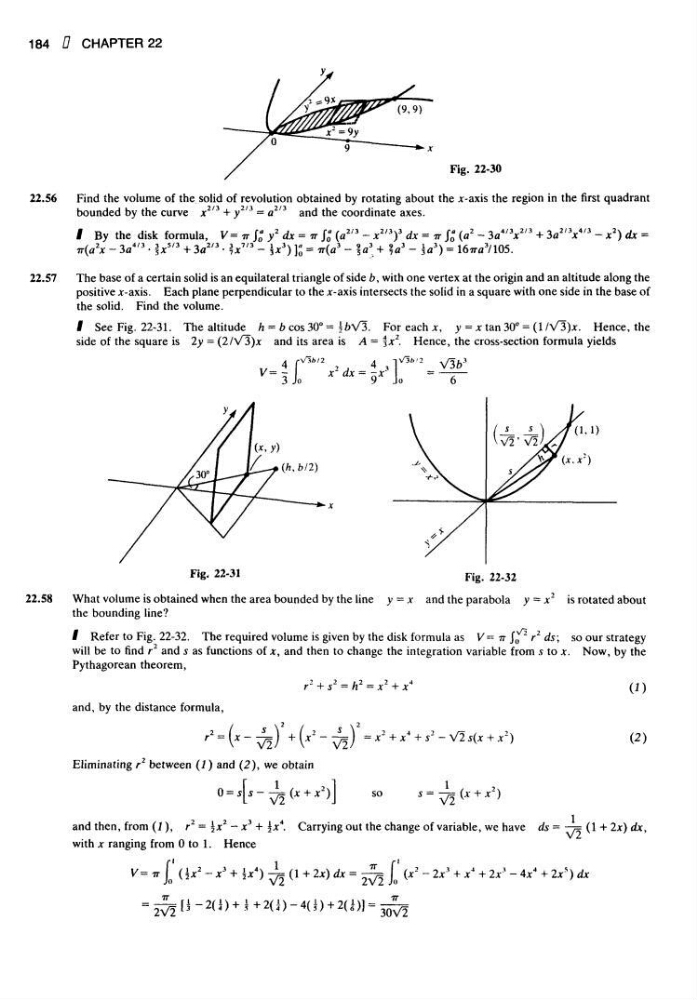
See Fig. 22-31. The altitude h = b cos 30° = \bV3. For each x, y = x tan 30° = (1A/3)*. Hence, the
side of the square is 2y = (2/V3)x and its area is A= \x
2 . Hence, the cross-section formula yields
Fig. 22-31
Fig. 22-32
22.58
What volume is obtained when the area bounded by the line y = x and the parabola y = x
2
is rotated about
the bounding line?
Refer to Fig. 22-32. The required volume is given by the disk formula as V = TT J 0
2 r
2 ds; so our strategy
will be to find r
2 and s as functions of x, and then to change the integration variable from s to x. Now, by the
Pythagorean theorem,
and, by the distance formula,
Eliminating r
2 between (1) and (2), we obtain
(I)
(2)
so
and then, from (1), r
2 = \x
2 - x
3 + j*
4
. Carrying out the change of variable, we have
with x ranging from 0 to 1. Hence
Fig. 22-30
By the disk formula, V= IT ft / dx = TT $° 0 (a
213 - x
2 '
3 )
3 dx = IT J° (a
2 ~ 3a*'
3 x
2 '
3 + 3«
2 'V'
3 - x
2 ) dx =
TT(a
2 x - 3 fl
4 '
3 • lx
513 + 3a
2 '
3 • lx"
3 - \x
3 ) }" 0 = Tr(a
3 - \a
3 + |«
3 - |a
3 ) = 167r«
3
/105.
i- + s
2 = h
2 = x
2 + x
4
22.56
Find the volume of the solid of revolution obtained by rotating about the jc-axis the region in the first quadrant
bounded by the curve x
2 '
3 + y
2 '
3 = a
2 '
3 and the coordinate axes.
22.57
The base of a certain solid is an equilateral triangle of side b, with one vertex at the origin and an altitude along the
positive j;-axis. Each plane perpendicular to the .it-axis intersects the solid in a square with one side in the base of
the solid. Find the volume.
See Fig. 22-31. The altitude h = b cos 30° = \bV3. For each x, y = x tan 30° = (1A/3)*. Hence, the
side of the square is 2y = (2/V3)x and its area is A= \x
2 . Hence, the cross-section formula yields
Fig. 22-31
Fig. 22-32
22.58
What volume is obtained when the area bounded by the line y = x and the parabola y = x
2
is rotated about
the bounding line?
Refer to Fig. 22-32. The required volume is given by the disk formula as V = TT J 0
2 r
2 ds; so our strategy
will be to find r
2 and s as functions of x, and then to change the integration variable from s to x. Now, by the
Pythagorean theorem,
and, by the distance formula,
Eliminating r
2 between (1) and (2), we obtain
(I)
(2)
so
and then, from (1), r
2 = \x
2 - x
3 + j*
4
. Carrying out the change of variable, we have
with x ranging from 0 to 1. Hence
Fig. 22-30
By the disk formula, V= IT ft / dx = TT $° 0 (a
213 - x
2 '
3 )
3 dx = IT J° (a
2 ~ 3a*'
3 x
2 '
3 + 3«
2 'V'
3 - x
2 ) dx =
TT(a
2 x - 3 fl
4 '
3 • lx
513 + 3a
2 '
3 • lx"
3 - \x
3 ) }" 0 = Tr(a
3 - \a
3 + |«
3 - |a
3 ) = 167r«
3
/105.
i- + s
2 = h
2 = x
2 + x
4