

VOLUME
183
22.50
A solid has a circular base of radius r. Find the volume of the solid if every planar section perpendicular to a fixed
diameter is a semicircle.
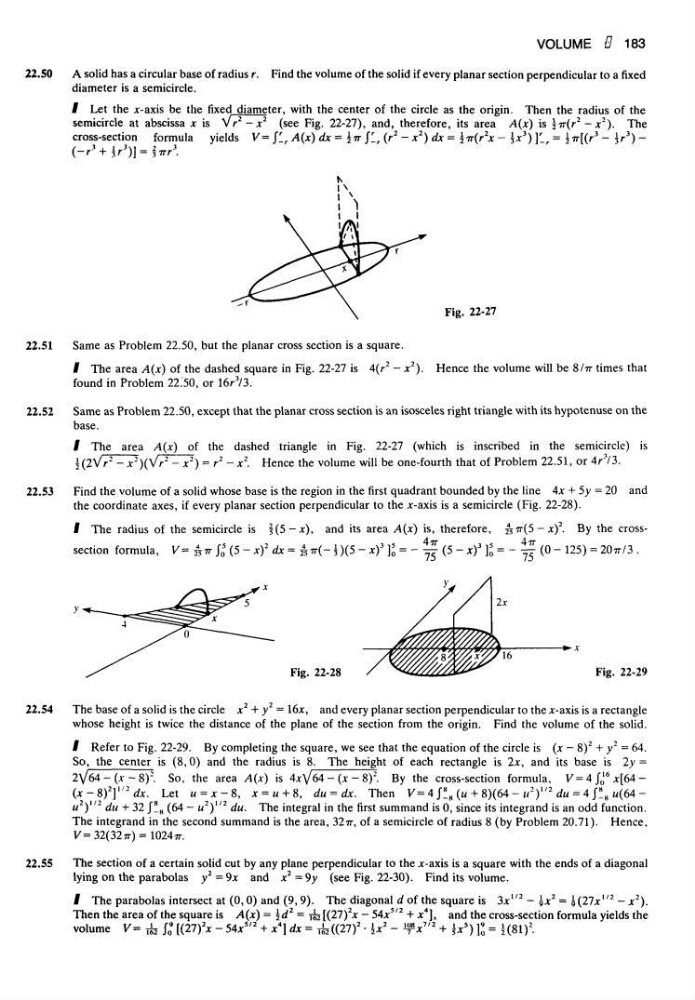
Fig. 22-27
22.51
Same as Problem 22.50, but the planar cross section is a square.
The area A(x) of the dashed square in Fig. 22-27 is 4(r
2 - x
2 ). Hence the volume will be S/TT times that
found in Problem 22.50, or 16r
3
/3.
22.52
Same as Problem 22.50, except that the planar cross section is an isosceles right triangle with its hypotenuse on the
base.
22.53
Find the volume of a solid whose base is the region in the first quadrant bounded by the line 4x + 5y = 20 and
the coordinate axes, if every planar section perpendicular to the x-axis is a semicircle (Fig. 22-28).
The radius of the semicircle is |(5-x), and its area ^W 's> therefore, ^Tr(5-x)2. By the crosssection formula, V= %tr J (5 - x)2 dx = £TT(- $)(5 - x)1 }50 = - ^| (5 - x)3 ]« = - jj (0 - 125) = 2077/3 .
0
5
Fig. 22-28
Fig. 22-29
22.54
The base of a solid is the circle x
2 + y
2 = 16*, and every planar section perpendicular to the jr-axis is a rectangle
whose height is twice the distance of the plane of the section from the origin. Find the volume of the solid.
Refer to Fig. 22-29. By completing the square, we see that the equation of the circle is (x - 8)
2 + y
z = 64.
So, the center is (8,0) and the radius is 8. The height of each rectangle is 2x, and its base is 2y =
2V64 - (A- - 8)
2
. So, the area A(x) is 4x^/64 - (x - 8)
2
. By the cross-section formula, V= 4 J 0
16 jc[64 -
(;t-8)
2 ]"
2 dx. Let M = jc-8, x = u + 8, du = dx. Then V=4 Jf g (« + 8)(64- ir)"
2 d« = 4 J! 8 u(64 -
H
2 )"
2 dw + 32 J! 8 (64 - u
2 )"
2 du. The integral in the first summand is 0, since its integrand is an odd function.
The integrand in the second summand is the area, 3277, of a semicircle of radius 8 (by Problem 20.71). Hence,
V= 32(327r) = 102477.
22.55
The section of a certain solid cut by any plane perpendicular to the jc-axis is a square with the ends of a diagonal
lying on the parabolas y
2 =9x and x
2 =9y (see Fig. 22-30). Find its volume.
The parabolas intersect at (0,0) and (9, 9). The diagonal d of the square is 3*"
2 - §jt
2 = $(27;c"
2 - x
2 ).
Then the area of the square is A(x) = \d
2 = ^ [(27)
2
x - 54x
5 '
2 + x
4 ], and the cross-section formula yields the
volume K= jfe / 0
9 [(27)
2
* - 54jc
5 '
2 + x
4 ] dx = Tfe((27)
2 • {x
2 - ^x"
2 + i*
5
) ft = |(81)
2
.
Let the *-axis be the fixed diameter, with the center of the circle as the origin. Then the radius of the
semicircle at abscissa x is V/2 - x
2
(see Fig. 22-27), and, therefore, its area A(x) is \TT(T* - x
1 ). The
cross-section formula yields V= \'_ r A(x) dx = ±TT f
r _ r (r
2 - x
2 ) dx = ±ir(r
2 x - $x
3 ) ]
r _ r = ±ir[(r
3 - ^r
3 ) -
(-r*+$r
3 )}=t7rr\
The area A(x) of the dashed triangle in Fig. 22-27 (which is inscribed in the semicircle) is
j(2Vr
2 - A2 )(Vr - x
2 ) = r
2 - x
2 . Hence the volume will be one-fourth that of Problem 22.51, or 4/3 /3.
183
22.50
A solid has a circular base of radius r. Find the volume of the solid if every planar section perpendicular to a fixed
diameter is a semicircle.
Fig. 22-27
22.51
Same as Problem 22.50, but the planar cross section is a square.
The area A(x) of the dashed square in Fig. 22-27 is 4(r
2 - x
2 ). Hence the volume will be S/TT times that
found in Problem 22.50, or 16r
3
/3.
22.52
Same as Problem 22.50, except that the planar cross section is an isosceles right triangle with its hypotenuse on the
base.
22.53
Find the volume of a solid whose base is the region in the first quadrant bounded by the line 4x + 5y = 20 and
the coordinate axes, if every planar section perpendicular to the x-axis is a semicircle (Fig. 22-28).
The radius of the semicircle is |(5-x), and its area ^W 's> therefore, ^Tr(5-x)2. By the crosssection formula, V= %tr J (5 - x)2 dx = £TT(- $)(5 - x)1 }50 = - ^| (5 - x)3 ]« = - jj (0 - 125) = 2077/3 .
0
5
Fig. 22-28
Fig. 22-29
22.54
The base of a solid is the circle x
2 + y
2 = 16*, and every planar section perpendicular to the jr-axis is a rectangle
whose height is twice the distance of the plane of the section from the origin. Find the volume of the solid.
Refer to Fig. 22-29. By completing the square, we see that the equation of the circle is (x - 8)
2 + y
z = 64.
So, the center is (8,0) and the radius is 8. The height of each rectangle is 2x, and its base is 2y =
2V64 - (A- - 8)
2
. So, the area A(x) is 4x^/64 - (x - 8)
2
. By the cross-section formula, V= 4 J 0
16 jc[64 -
(;t-8)
2 ]"
2 dx. Let M = jc-8, x = u + 8, du = dx. Then V=4 Jf g (« + 8)(64- ir)"
2 d« = 4 J! 8 u(64 -
H
2 )"
2 dw + 32 J! 8 (64 - u
2 )"
2 du. The integral in the first summand is 0, since its integrand is an odd function.
The integrand in the second summand is the area, 3277, of a semicircle of radius 8 (by Problem 20.71). Hence,
V= 32(327r) = 102477.
22.55
The section of a certain solid cut by any plane perpendicular to the jc-axis is a square with the ends of a diagonal
lying on the parabolas y
2 =9x and x
2 =9y (see Fig. 22-30). Find its volume.
The parabolas intersect at (0,0) and (9, 9). The diagonal d of the square is 3*"
2 - §jt
2 = $(27;c"
2 - x
2 ).
Then the area of the square is A(x) = \d
2 = ^ [(27)
2
x - 54x
5 '
2 + x
4 ], and the cross-section formula yields the
volume K= jfe / 0
9 [(27)
2
* - 54jc
5 '
2 + x
4 ] dx = Tfe((27)
2 • {x
2 - ^x"
2 + i*
5
) ft = |(81)
2
.
Let the *-axis be the fixed diameter, with the center of the circle as the origin. Then the radius of the
semicircle at abscissa x is V/2 - x
2
(see Fig. 22-27), and, therefore, its area A(x) is \TT(T* - x
1 ). The
cross-section formula yields V= \'_ r A(x) dx = ±TT f
r _ r (r
2 - x
2 ) dx = ±ir(r
2 x - $x
3 ) ]
r _ r = ±ir[(r
3 - ^r
3 ) -
(-r*+$r
3 )}=t7rr\
The area A(x) of the dashed triangle in Fig. 22-27 (which is inscribed in the semicircle) is
j(2Vr
2 - A2 )(Vr - x
2 ) = r
2 - x
2 . Hence the volume will be one-fourth that of Problem 22.51, or 4/3 /3.