

CHAPTER 23
The Natural Logarithm
23.1
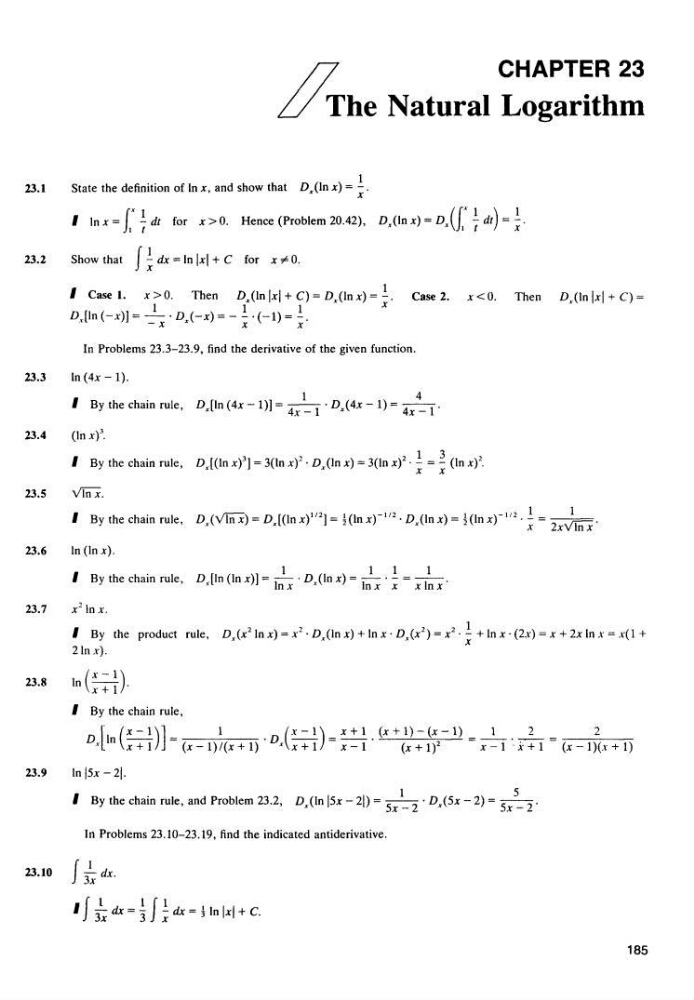
State the definition of In x, and show that D^(ln jc) =
In* =
dt for x > 0 Hence (Problem 20.42),
23.2
Show that
dx = In 1*1 + C for x * 0
Case 1. x> 0. Then
Case 2.
Then
In Problems 23.3-23.9, find the derivative of the given function.
23.3
In (4* - 1).
By the chain rule,
23.4
(In x)
3 .
By the chain rule, D A .[(ln x)
3 ] = 3(ln x)- • D x (\n x) = 3(ln x)
2 •
23.5
23.6
By the chain rule, D^VHTx) = D,[(ln x)"
2 ] = ^(Inx)'
1 '
2 • D f (\nx)= ^Inx)'
1 '
2 • - =
In (In*).
By the chain rule, DJln (In x)] =
23.7
x
2 In x.
By the product rule, D x (x
2 In x) = x
2 • D x (\n x) + In x • D v (x
2 ) = x
2 •
23.8
In
By the chain rule,
23.9
ln|5*-2|.
By the chain rule, and Problem 23.2, D,(ln \5x - 2|) =
In Problems 23.10-23.19, find the indicated antiderivative.
23.10
185
In
+ In x • (2.v) = x + 2x In .v = .v(l +
2 In*).
•D,(lnx) =
_ !_
x'
D,(ln*)=D A
D,(ln|*| + C) = D,(ln*) =
D,(ln \x\ + C) =
x<0.
D,[ln(4*-l)] =
•D,(4*-l) =
•D,(5*-2) =
dx.
D,[ln (-*)] =
• D,(-x) = - -(-!) =
VhT7.
dx =
dx=$ \n\x\ + C.
The Natural Logarithm
23.1
State the definition of In x, and show that D^(ln jc) =
In* =
dt for x > 0 Hence (Problem 20.42),
23.2
Show that
dx = In 1*1 + C for x * 0
Case 1. x> 0. Then
Case 2.
Then
In Problems 23.3-23.9, find the derivative of the given function.
23.3
In (4* - 1).
By the chain rule,
23.4
(In x)
3 .
By the chain rule, D A .[(ln x)
3 ] = 3(ln x)- • D x (\n x) = 3(ln x)
2 •
23.5
23.6
By the chain rule, D^VHTx) = D,[(ln x)"
2 ] = ^(Inx)'
1 '
2 • D f (\nx)= ^Inx)'
1 '
2 • - =
In (In*).
By the chain rule, DJln (In x)] =
23.7
x
2 In x.
By the product rule, D x (x
2 In x) = x
2 • D x (\n x) + In x • D v (x
2 ) = x
2 •
23.8
In
By the chain rule,
23.9
ln|5*-2|.
By the chain rule, and Problem 23.2, D,(ln \5x - 2|) =
In Problems 23.10-23.19, find the indicated antiderivative.
23.10
185
In
+ In x • (2.v) = x + 2x In .v = .v(l +
2 In*).
•D,(lnx) =
_ !_
x'
D,(ln*)=D A
D,(ln|*| + C) = D,(ln*) =
D,(ln \x\ + C) =
x<0.
D,[ln(4*-l)] =
•D,(4*-l) =
•D,(5*-2) =
dx.
D,[ln (-*)] =
• D,(-x) = - -(-!) =
VhT7.
dx =
dx=$ \n\x\ + C.