

AREA AND ARC LENGTH
171
Fig. 21-28
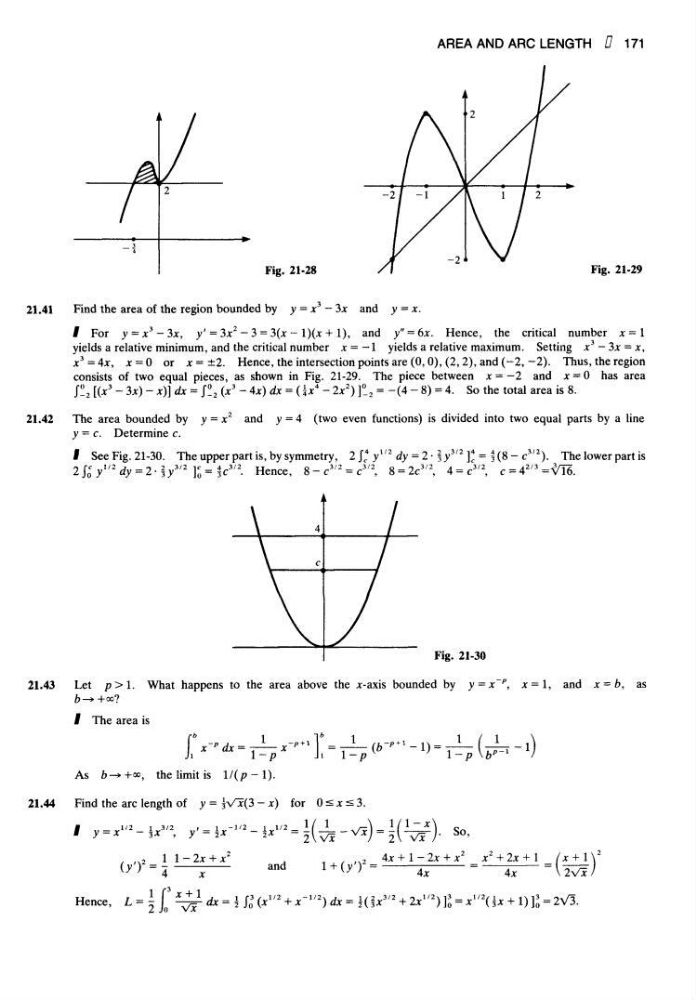
Fig. 21-29
21.41
Find the area of the region bounded by y — x — 3* and y = x.
For y = x
3 — 3x, y' = 3x — 3 = 3(x - l)(x + 1), and y" = 6x. Hence, the critical number x = \
yields a relative minimum, and the critical number x=—\ yields a relative maximum. Setting x
3 — 3>x = x,
x
3 = 4x, x = 0 or x = ±2. Hence, the intersection points are (0,0), (2, 2), and (-2, -2). Thus, the region
consists of two equal pieces, as shown in Fig. 21-29. The piece between x = -2 and x = 0 has area
J! 2 [(x
3 - 3x) -x)]dx = J! 2 (*
3 - 4x) dx = (i*
4 - 2x
2 ) ]°_ 2 = -(4 - 8) = 4. So the total area is 8.
21.42
The area bounded by y = x
2
and y = 4 (two even functions) is divided into two equal parts by a line
y = c. Determine c.
See Fig. 21-30. The upper part is, by symmetry, 2 J c
4 y
112 dy = 2- iy
3 '
2 ]* = 5(8- c
3 '
2 ). The lower part is
2tiy
ll2 dy = 2-%y
3 '
2 ]
C
0 = $c
3 '
2 . Hence, 8-c
3/2 = c
3 '
2 , 8 = 2c
3 '
2 , 4=c
3 '
2 , c = 4
2/3 =^16.
Fig. 21-30
21.43
Let
What happens to the area above the *-axis bounded by v = x
p , x = \, and x = b, as
The area is
As
the limit is
21.44
Find the arc length of
for
So,
and
Hence,
171
Fig. 21-28
Fig. 21-29
21.41
Find the area of the region bounded by y — x — 3* and y = x.
For y = x
3 — 3x, y' = 3x — 3 = 3(x - l)(x + 1), and y" = 6x. Hence, the critical number x = \
yields a relative minimum, and the critical number x=—\ yields a relative maximum. Setting x
3 — 3>x = x,
x
3 = 4x, x = 0 or x = ±2. Hence, the intersection points are (0,0), (2, 2), and (-2, -2). Thus, the region
consists of two equal pieces, as shown in Fig. 21-29. The piece between x = -2 and x = 0 has area
J! 2 [(x
3 - 3x) -x)]dx = J! 2 (*
3 - 4x) dx = (i*
4 - 2x
2 ) ]°_ 2 = -(4 - 8) = 4. So the total area is 8.
21.42
The area bounded by y = x
2
and y = 4 (two even functions) is divided into two equal parts by a line
y = c. Determine c.
See Fig. 21-30. The upper part is, by symmetry, 2 J c
4 y
112 dy = 2- iy
3 '
2 ]* = 5(8- c
3 '
2 ). The lower part is
2tiy
ll2 dy = 2-%y
3 '
2 ]
C
0 = $c
3 '
2 . Hence, 8-c
3/2 = c
3 '
2 , 8 = 2c
3 '
2 , 4=c
3 '
2 , c = 4
2/3 =^16.
Fig. 21-30
21.43
Let
What happens to the area above the *-axis bounded by v = x
p , x = \, and x = b, as
The area is
As
the limit is
21.44
Find the arc length of
for
So,
and
Hence,