

21.35
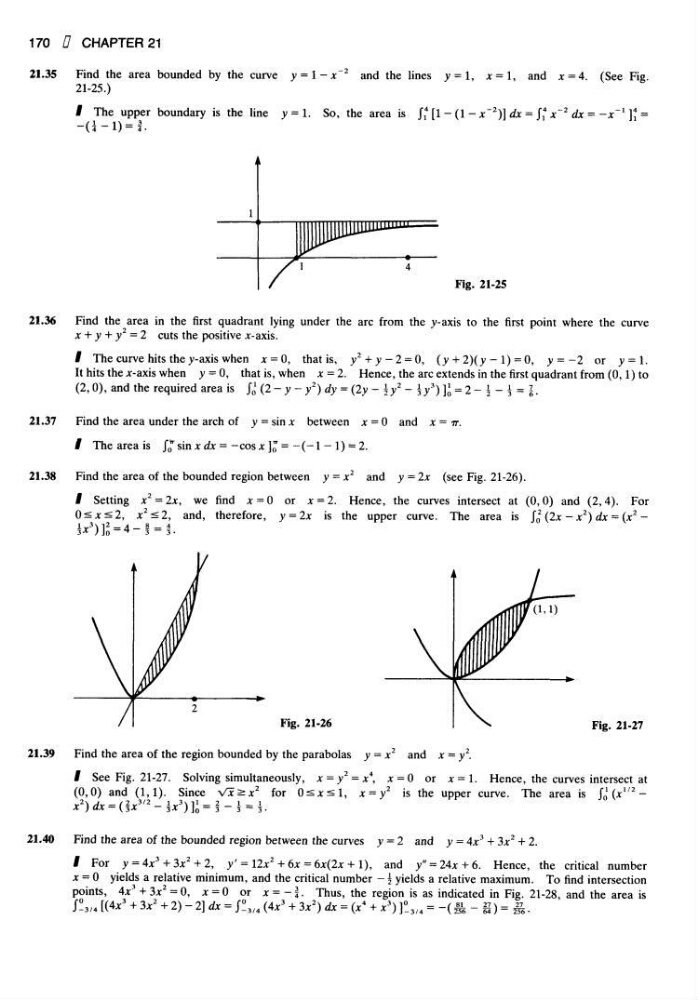
Find the area bounded by the curve y = l-x
2 and the lines y = l, x = l, and x=4. (See Fig.
21-25.)
The upper boundary is the line y = l. So, the area is J\
4 [1 - (1 - x~
2 )] dx = f,
4 x~
2 dx = -x~
l I
4 =
-a-l)=f.
Fig. 21-25
21.36
Find the area in the first quadrant lying under the arc from the _y-axis to the first point where the curve
x + y + y
2 = 2 cuts the positive A:-axis.
It hits the x-axis when y = 0, that is, when x = 2. Hence, the arc extends in the first quadrant from (0,1) to
(2,0), and the required area is ft (2 - y - y2) dy = (2y - \y2 - iy3) ]J = 2 - \ - \ = J.
21.37
Find the area under the arch of y = sin;t between x = Q and x = IT.
The area is J 0 " sin xdx= -cos x ]„ = -(-1 - 1) = 2.
21.38
Find the area of the bounded region between y = x and y = 2* (see Fig. 21-26).
Setting x
2 = 2x, we find x = 0 or * = 2. Hence, the curves intersect at (0,0) and (2,4). For
0
2 (2* - x
2 ) dx = (x
2 -
1 ,,
3 \ ^
2 — A
8 _ 4
3* ) J o ~
4 ~ 3 - 3Fig. 21-26
Fig. 21-27
21.39
Find the area of the region bounded by the parabolas y = x
2
and x = y
2 .
I See Fig. 21-27. Solving simultaneously, * = y
2 = ;t
4
, x = Q or jc=l. Hence, the curves intersect at
(0,0) and (1,1). Since Vx > x
2
for 0
2
is the upper curve. The area is f,!(*
1/2 -
^rfr-O^-J^Ji-i-l-l.
21.40
Find the area of the bounded region between the curves y = 2 and y = 4jc
3 + 3x
2 + 2.
For y = 4x
3 + 3x
2 + 2, y'= l2x
2 + 6x = 6x(2x + 1), and y" = 24x + 6. Hence, the critical number
j: = 0 yields a relative minimum, and the critical number -1 yields a relative maximum. To find intersection
points, 4*
3 + 3x
2 = 0, x = 0 or x = -1. Thus, the region is as indicated in Fig. 21-28, and the area is
J! 3/4 [(4*
3 + 3*
2 + 2) - 2] dx = J! 3/4 (4*
3 + 3*
2
) dx = (*
4 + *
3
) ]°_ 3M = -(& - g) = &.
170
CHAPTER 21
The curve hits they-axis when x = 0, that is, y2 + y-2 = 0, (y + 2)(y - 1) = 0, y = -2 or y = \.
Find the area bounded by the curve y = l-x
2 and the lines y = l, x = l, and x=4. (See Fig.
21-25.)
The upper boundary is the line y = l. So, the area is J\
4 [1 - (1 - x~
2 )] dx = f,
4 x~
2 dx = -x~
l I
4 =
-a-l)=f.
Fig. 21-25
21.36
Find the area in the first quadrant lying under the arc from the _y-axis to the first point where the curve
x + y + y
2 = 2 cuts the positive A:-axis.
It hits the x-axis when y = 0, that is, when x = 2. Hence, the arc extends in the first quadrant from (0,1) to
(2,0), and the required area is ft (2 - y - y2) dy = (2y - \y2 - iy3) ]J = 2 - \ - \ = J.
21.37
Find the area under the arch of y = sin;t between x = Q and x = IT.
The area is J 0 " sin xdx= -cos x ]„ = -(-1 - 1) = 2.
21.38
Find the area of the bounded region between y = x and y = 2* (see Fig. 21-26).
Setting x
2 = 2x, we find x = 0 or * = 2. Hence, the curves intersect at (0,0) and (2,4). For
0
2 (2* - x
2 ) dx = (x
2 -
1 ,,
3 \ ^
2 — A
8 _ 4
3* ) J o ~
4 ~ 3 - 3Fig. 21-26
Fig. 21-27
21.39
Find the area of the region bounded by the parabolas y = x
2
and x = y
2 .
I See Fig. 21-27. Solving simultaneously, * = y
2 = ;t
4
, x = Q or jc=l. Hence, the curves intersect at
(0,0) and (1,1). Since Vx > x
2
for 0
is the upper curve. The area is f,!(*
1/2 -
^rfr-O^-J^Ji-i-l-l.
21.40
Find the area of the bounded region between the curves y = 2 and y = 4jc
3 + 3x
2 + 2.
For y = 4x
3 + 3x
2 + 2, y'= l2x
2 + 6x = 6x(2x + 1), and y" = 24x + 6. Hence, the critical number
j: = 0 yields a relative minimum, and the critical number -1 yields a relative maximum. To find intersection
points, 4*
3 + 3x
2 = 0, x = 0 or x = -1. Thus, the region is as indicated in Fig. 21-28, and the area is
J! 3/4 [(4*
3 + 3*
2 + 2) - 2] dx = J! 3/4 (4*
3 + 3*
2
) dx = (*
4 + *
3
) ]°_ 3M = -(& - g) = &.
170
CHAPTER 21
The curve hits they-axis when x = 0, that is, y2 + y-2 = 0, (y + 2)(y - 1) = 0, y = -2 or y = \.