

172
21.45
21.46
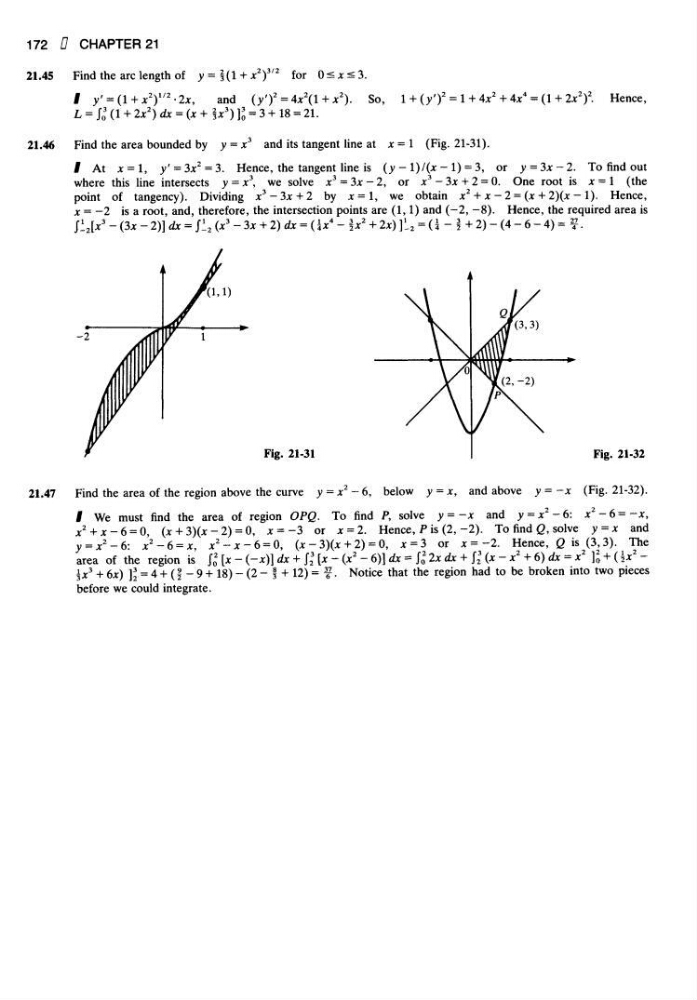
Find the area bounded by y = x
3
and its tangent line at x = 1 (Fig. 21-31).
At x = l, y'=3x
2 =3. Hence, the tangent line is (y - !)/(* - 1) = 3, or y = 3x-2. To find out
where this line intersects y = x
3 , we solve x
3 = 3x - 2, or x
3 - 3x + 2 = 0. One root is x = 1 (the
point of tangency). Dividing x
3 -3x + 2 by x = l, we obtain x
2 + x -2 = (x + 2)(x -1). Hence,
x = — 2 is a root, and, therefore, the intersection points are (1,1) and (—2, —8). Hence, the required area is
J1 2 [*
3 -(3* -2)] dx = ^ 2 (x
3 -3*+ 2) dx = (^-lx
2 + 2x)t 2 = (l-§+2)- (4-6-4)=?.
Fig. 21-31
Fig. 21-32
21.47
Find the area of the region above the curve y = *
2 -6, below v = x, and above y=-x (Fig. 21-32).
We must find the area of region OPQ. To find P, solve y = -x and y = *
2 -6: x
2 -6=-x,
x
2 + x-6 = 0, (x + 3)(x -2) = 0, * = -3 or x = 2. Hence, P is (2,-2). To find Q, solve y = x and
y = x
2 -6: x
2 -6 = x, x
2 -x-6 = Q, (x-3)(x + 2) = 0, * = 3 or x = -2. Hence, Q is (3,3). The
area of the region is J
2 [x - (-x)] dx + J
3 [x - (x
2 - 6)] dx = J 0
2 2x dx + / 2
3 (x - x
2 + 6) dx = x
2 ]
2 + ({x
2 -
^x
3 + 6x) }\.= 4 + (§ - 9 + 18) - (2 - f + 12) = f. Notice that the region had to be broken into two pieces
before we could integrate.
Find the arc length of y=l(l + x
2 )
3 '
2
for Os *=£ 3.
CHAPTER 21
y' = (l + x2)l'2-2x, and (y')2 = 4x2(l +x2). So, 1 + (y')2 = 1 + 4x2 + 4xA = (1 + 2x2)2. Hence,
L = J 0
3 (1 +2*
2 )
Download
from Wow! eBook
21.45
21.46
Find the area bounded by y = x
3
and its tangent line at x = 1 (Fig. 21-31).
At x = l, y'=3x
2 =3. Hence, the tangent line is (y - !)/(* - 1) = 3, or y = 3x-2. To find out
where this line intersects y = x
3 , we solve x
3 = 3x - 2, or x
3 - 3x + 2 = 0. One root is x = 1 (the
point of tangency). Dividing x
3 -3x + 2 by x = l, we obtain x
2 + x -2 = (x + 2)(x -1). Hence,
x = — 2 is a root, and, therefore, the intersection points are (1,1) and (—2, —8). Hence, the required area is
J1 2 [*
3 -(3* -2)] dx = ^ 2 (x
3 -3*+ 2) dx = (^-lx
2 + 2x)t 2 = (l-§+2)- (4-6-4)=?.
Fig. 21-31
Fig. 21-32
21.47
Find the area of the region above the curve y = *
2 -6, below v = x, and above y=-x (Fig. 21-32).
We must find the area of region OPQ. To find P, solve y = -x and y = *
2 -6: x
2 -6=-x,
x
2 + x-6 = 0, (x + 3)(x -2) = 0, * = -3 or x = 2. Hence, P is (2,-2). To find Q, solve y = x and
y = x
2 -6: x
2 -6 = x, x
2 -x-6 = Q, (x-3)(x + 2) = 0, * = 3 or x = -2. Hence, Q is (3,3). The
area of the region is J
2 [x - (-x)] dx + J
3 [x - (x
2 - 6)] dx = J 0
2 2x dx + / 2
3 (x - x
2 + 6) dx = x
2 ]
2 + ({x
2 -
^x
3 + 6x) }\.= 4 + (§ - 9 + 18) - (2 - f + 12) = f. Notice that the region had to be broken into two pieces
before we could integrate.
Find the arc length of y=l(l + x
2 )
3 '
2
for Os *=£ 3.
CHAPTER 21
y' = (l + x2)l'2-2x, and (y')2 = 4x2(l +x2). So, 1 + (y')2 = 1 + 4x2 + 4xA = (1 + 2x2)2. Hence,
L = J 0
3 (1 +2*
2 )
Download
from Wow! eBook