

AREA AND ARC LENGTH
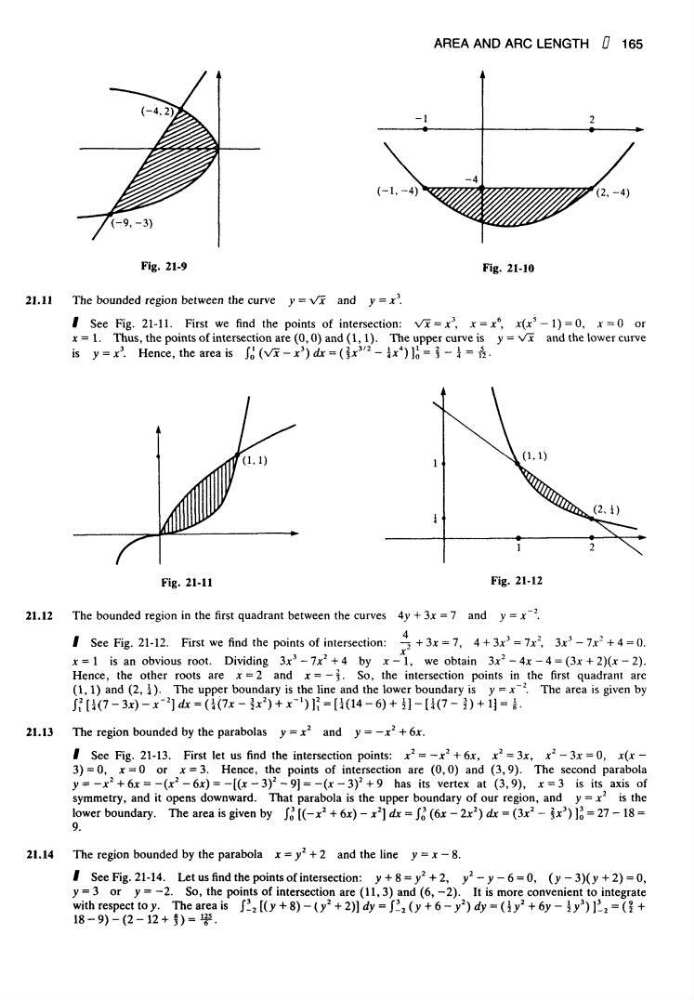
Fig. 21-9
Fig. 21-10
21.11 The bounded region between the curve y =
See Fig. 21-11. First we find the points of intersection:
jc = l. Thus, the points of intersection are (0,0) and (1,1). The upper curve is y —
• y = x
3 .
is
Hence, the area is /„' (Vx - x
3 ) dx = (I*
3 '
2 - U") M = i - I = n •
Fig. 21-11
Fig. 21-12
21.12 The bounded region in the first quadrant between the curves 4y + 3x = 7 and y = x
2 .
See Fig. 21-12. First we find the points of intersection:
x-l is an obvious root. Dividing 3x
3 - 7x
2 + 4 by x — l, we obtain 3x
2 — 4x -4 = (3x + 2)(x - 2).
Hence, the other roots are x = 2 and x=—f. So, the intersection points in the first quadrant are
(1,1) and (2, |). The upper boundary is the line and the lower boundary is y = x~
2 . The area is given by
165
and the lower curve
or
and y = x .
21.13
The region bounded by the parabolas y = x
2 and y — —x
2 + 6x.
See Fig. 21-13. First let us find the intersection points: x2 = -x2 + 6x, x2 = 3x, x2-3x = 0, x(x -
3) = 0, AC = 0 or jt = 3. Hence, the points of intersection are (0,0) and (3,9). The second parabola
y= -x
2 + 6x = -(x
2 -6x)= -[(*-3)
2 -9] = -(jtr-3)
2 + 9 has its vertex at (3,9), x = 3 is its axis of
symmetry, and it opens downward. That parabola is the upper boundary of our region, and y = x
2
is the
lower boundary. The area is given by J
3 [(-x
2 + 6x) - x
2 ] dx = J 0
3 (6* - 2*2) dx = (3x2 - §x3) ]3 = 27 - 18 =
9.
21.14
The region bounded by the parabola x = y
2 + 2 and the line y = x — 8.
See Fig. 21-14. Let us find the points of intersection: y + 8 = y
2 +2, y
2 -y-6 = Q, (y -3)(y + 2) = 0,
y = 3 or y=-2. So, the points of intersection are (11,3) and (6,-2). It is more convenient to integrate
with respect toy. The area is J! 2 [(y + 8) - (y
2 + 2)] dy = J! 2 (y + 6 - y
2 ) dy = ($y* + 6y- \y
3 ) ]
3 _ 2 = (f +
18-9)-(2-12-f 1)=^.
x = x
6 , *(jt
5 -l) = 0, A-=0
+ 3x = 7, 4 + 3*
3 = lx\ 3*
3 - lx- + 4 = 0.
Fig. 21-9
Fig. 21-10
21.11 The bounded region between the curve y =
See Fig. 21-11. First we find the points of intersection:
jc = l. Thus, the points of intersection are (0,0) and (1,1). The upper curve is y —
• y = x
3 .
is
Hence, the area is /„' (Vx - x
3 ) dx = (I*
3 '
2 - U") M = i - I = n •
Fig. 21-11
Fig. 21-12
21.12 The bounded region in the first quadrant between the curves 4y + 3x = 7 and y = x
2 .
See Fig. 21-12. First we find the points of intersection:
x-l is an obvious root. Dividing 3x
3 - 7x
2 + 4 by x — l, we obtain 3x
2 — 4x -4 = (3x + 2)(x - 2).
Hence, the other roots are x = 2 and x=—f. So, the intersection points in the first quadrant are
(1,1) and (2, |). The upper boundary is the line and the lower boundary is y = x~
2 . The area is given by
165
and the lower curve
or
and y = x .
21.13
The region bounded by the parabolas y = x
2 and y — —x
2 + 6x.
See Fig. 21-13. First let us find the intersection points: x2 = -x2 + 6x, x2 = 3x, x2-3x = 0, x(x -
3) = 0, AC = 0 or jt = 3. Hence, the points of intersection are (0,0) and (3,9). The second parabola
y= -x
2 + 6x = -(x
2 -6x)= -[(*-3)
2 -9] = -(jtr-3)
2 + 9 has its vertex at (3,9), x = 3 is its axis of
symmetry, and it opens downward. That parabola is the upper boundary of our region, and y = x
2
is the
lower boundary. The area is given by J
3 [(-x
2 + 6x) - x
2 ] dx = J 0
3 (6* - 2*2) dx = (3x2 - §x3) ]3 = 27 - 18 =
9.
21.14
The region bounded by the parabola x = y
2 + 2 and the line y = x — 8.
See Fig. 21-14. Let us find the points of intersection: y + 8 = y
2 +2, y
2 -y-6 = Q, (y -3)(y + 2) = 0,
y = 3 or y=-2. So, the points of intersection are (11,3) and (6,-2). It is more convenient to integrate
with respect toy. The area is J! 2 [(y + 8) - (y
2 + 2)] dy = J! 2 (y + 6 - y
2 ) dy = ($y* + 6y- \y
3 ) ]
3 _ 2 = (f +
18-9)-(2-12-f 1)=^.
x = x
6 , *(jt
5 -l) = 0, A-=0
+ 3x = 7, 4 + 3*
3 = lx\ 3*
3 - lx- + 4 = 0.