

21.7
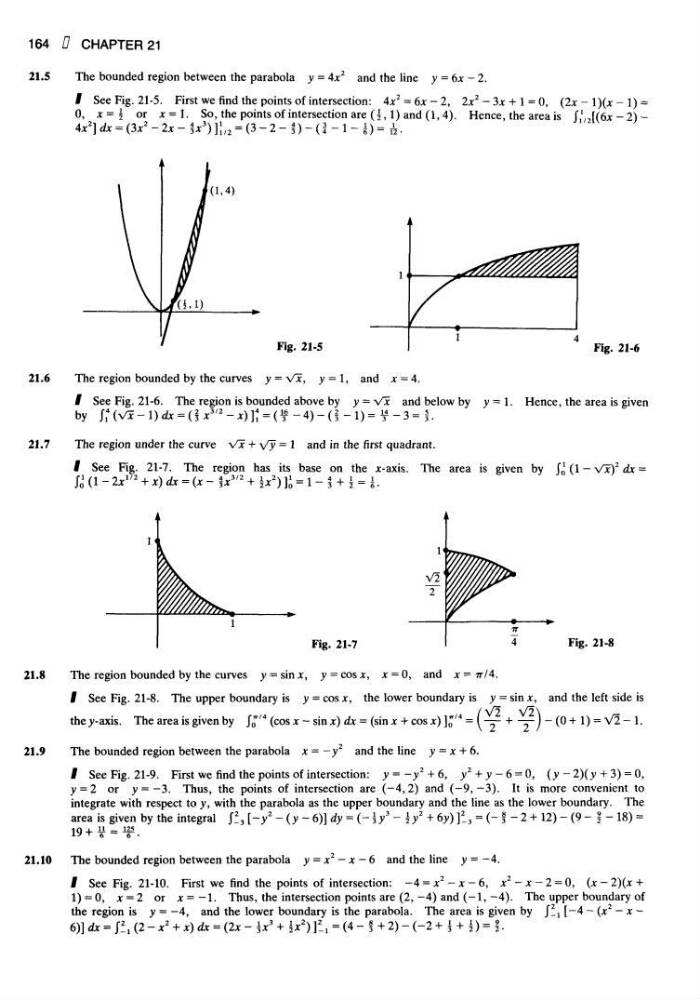
Fig. 21-5
21.6
The region bounded by the curves y = Vx, y = l, and x = 4.
Fig. 21-6
164
CHAPTER 21
21.5
The bounded region between the parabola y = 4x
2
and the line y - 6x - 2.
See Fig. 21-5. First we find the points of intersection: 4x2 = 6x-2, 2x2 - 3x + I = 0, (2x - l)(x - 11 =
or x = l. So, the points of intersection are (1,1) and (1,4). Hence, the area is il, 2 [(6x-2)~
See Fig. 21-6. The region is bounded above by
and below by y = 1. Hence, the area is given
by
The region under the curve
and in the first quadrant.
See Fig. 21-7. The region has its base on the x-axis. The area is given by
Fig. 21-7
Fig. 21-8
21.8
The region bounded by the curves y = sin x, y = cos x, x = 0, and x = 7T/4,
See Fie. 21-8. The upper boundary is y = cos x, the lower boundary is y = sin x, and the left side is
the y-axis. The area is given by
21.9
The bounded region between the parabola x = -y
2
and the line y = x + 6.
See Fig. 21-9. First we find the points of intersection: y = -y
2 + 6, y
2 + y-6 = 0, (y -2)(y + 3) = 0,
y = 2 or y=-3. Thus, the points of intersection are (-4,2) and (-9,-3). It is more convenient to
integrate with respect to y, with the parabola as the upper boundary and the line as the lower boundary. The
area is given by the integral f* [-y2 - (y - 6)1 dy = (- iy3 - ^y2 + 6y) ]2_, = (- f - 2 + 12) - (9 - 1 - 18) =
21.10 The bounded region between the parabola y = x
2 - x - 6 and the line y = -4.
See Fig. 21-10. First we find the points of intersection: -4 = x
2 - x - 6, x
2 - x - 2 = 0, (x - 2)(x +
1) = 0, x = 2 or x = -I. Thus, the intersection points are (2, -4) and (-1, -4). The upper boundary of
the region is y = —4, and the lower boundary is the parabola. The area is given by J^j [-4 — (x
2 — x -
6)]dx = $
2 _l(2-x2 + x)dx = (2x-lx3+kx2)t1 = (4-l+2)-(-2+l + i2)=92.
U, x=k
4*
2 ]
3 )]| /2 = (3-2-i)-(!-l-i)=i.
(cos x — sin x) dx = (sin x + cos x) ],
-(0+1) =
- 1
y]
Fig. 21-5
21.6
The region bounded by the curves y = Vx, y = l, and x = 4.
Fig. 21-6
164
CHAPTER 21
21.5
The bounded region between the parabola y = 4x
2
and the line y - 6x - 2.
See Fig. 21-5. First we find the points of intersection: 4x2 = 6x-2, 2x2 - 3x + I = 0, (2x - l)(x - 11 =
or x = l. So, the points of intersection are (1,1) and (1,4). Hence, the area is il, 2 [(6x-2)~
See Fig. 21-6. The region is bounded above by
and below by y = 1. Hence, the area is given
by
The region under the curve
and in the first quadrant.
See Fig. 21-7. The region has its base on the x-axis. The area is given by
Fig. 21-7
Fig. 21-8
21.8
The region bounded by the curves y = sin x, y = cos x, x = 0, and x = 7T/4,
See Fie. 21-8. The upper boundary is y = cos x, the lower boundary is y = sin x, and the left side is
the y-axis. The area is given by
21.9
The bounded region between the parabola x = -y
2
and the line y = x + 6.
See Fig. 21-9. First we find the points of intersection: y = -y
2 + 6, y
2 + y-6 = 0, (y -2)(y + 3) = 0,
y = 2 or y=-3. Thus, the points of intersection are (-4,2) and (-9,-3). It is more convenient to
integrate with respect to y, with the parabola as the upper boundary and the line as the lower boundary. The
area is given by the integral f* [-y2 - (y - 6)1 dy = (- iy3 - ^y2 + 6y) ]2_, = (- f - 2 + 12) - (9 - 1 - 18) =
21.10 The bounded region between the parabola y = x
2 - x - 6 and the line y = -4.
See Fig. 21-10. First we find the points of intersection: -4 = x
2 - x - 6, x
2 - x - 2 = 0, (x - 2)(x +
1) = 0, x = 2 or x = -I. Thus, the intersection points are (2, -4) and (-1, -4). The upper boundary of
the region is y = —4, and the lower boundary is the parabola. The area is given by J^j [-4 — (x
2 — x -
6)]dx = $
2 _l(2-x2 + x)dx = (2x-lx3+kx2)t1 = (4-l+2)-(-2+l + i2)=92.
U, x=k
4*
2 ]
3 )]| /2 = (3-2-i)-(!-l-i)=i.
(cos x — sin x) dx = (sin x + cos x) ],
-(0+1) =
- 1
y]