

CHAPTER 21
21.15
The region bounded by the parabolas y = x
2 — x and y = x — x
2 .
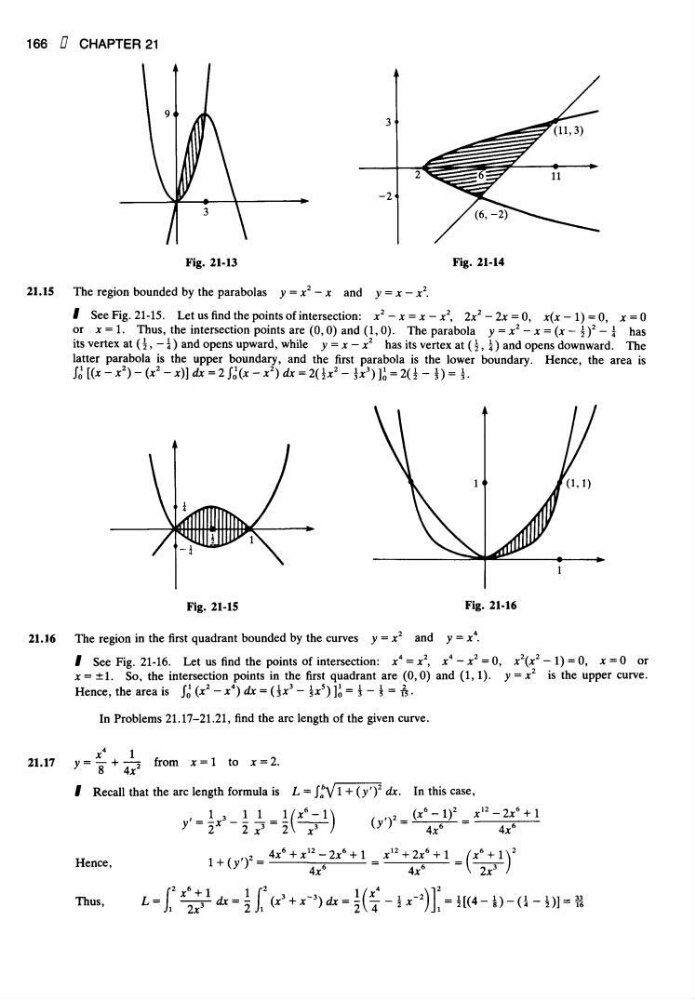
See Fig. 21-15. Let us find the points of intersection: x2 - x = x - x2, 2x2 - 2x = 0, x(x - 1) = 0, x = 0
or x = 1. Thus, the intersection points are (0,0) and (1,0). The parabola y = x2 - x = (x - \ )2 - \ has
its vertex at ( \, - \ ) and opens upward, while y = x - x2 has its vertex at (|, J) and opens downward. The
latter parabola is the upper boundary, and the first parabola is the lower boundary. Hence, the area is
Fig. 21-15
Fig. 21-16
21.16
The region in the first quadrant bounded by the curves y = x
2
and y — x*.
See Fig. 21-16. Let us find the points of intersection: x* = x
1 , x
4 - x
2 = 0, x
2 (x
2 - 1) = 0, * = 0 or
x = ±1. So, the intersection points in the first quadrant are (0,0) and (1,1). y = x
2
is the upper curve.
Hence, the area is /„' (x2 - x4) dx = (Jjt3 - |*5) ] J = } - \ = *.
In Problems 21.17-21.21, find the arc length of the given curve.
21.17
y =
Recall that the arc length formula is
Hence,
Thus,
to
dx. In this case,
from x = 1
Fig. 21-13
Fig. 21-14
166
x = 2.
K[(x-x2)-(x2-x)]dx = 2ti(x-x2)dx = 2(±)]1X0 = 2tt-l)=:li.
21.15
The region bounded by the parabolas y = x
2 — x and y = x — x
2 .
See Fig. 21-15. Let us find the points of intersection: x2 - x = x - x2, 2x2 - 2x = 0, x(x - 1) = 0, x = 0
or x = 1. Thus, the intersection points are (0,0) and (1,0). The parabola y = x2 - x = (x - \ )2 - \ has
its vertex at ( \, - \ ) and opens upward, while y = x - x2 has its vertex at (|, J) and opens downward. The
latter parabola is the upper boundary, and the first parabola is the lower boundary. Hence, the area is
Fig. 21-15
Fig. 21-16
21.16
The region in the first quadrant bounded by the curves y = x
2
and y — x*.
See Fig. 21-16. Let us find the points of intersection: x* = x
1 , x
4 - x
2 = 0, x
2 (x
2 - 1) = 0, * = 0 or
x = ±1. So, the intersection points in the first quadrant are (0,0) and (1,1). y = x
2
is the upper curve.
Hence, the area is /„' (x2 - x4) dx = (Jjt3 - |*5) ] J = } - \ = *.
In Problems 21.17-21.21, find the arc length of the given curve.
21.17
y =
Recall that the arc length formula is
Hence,
Thus,
to
dx. In this case,
from x = 1
Fig. 21-13
Fig. 21-14
166
x = 2.
K[(x-x2)-(x2-x)]dx = 2ti(x-x2)dx = 2(±)]1X0 = 2tt-l)=:li.