

128 0 CHAPTER 16
16.45
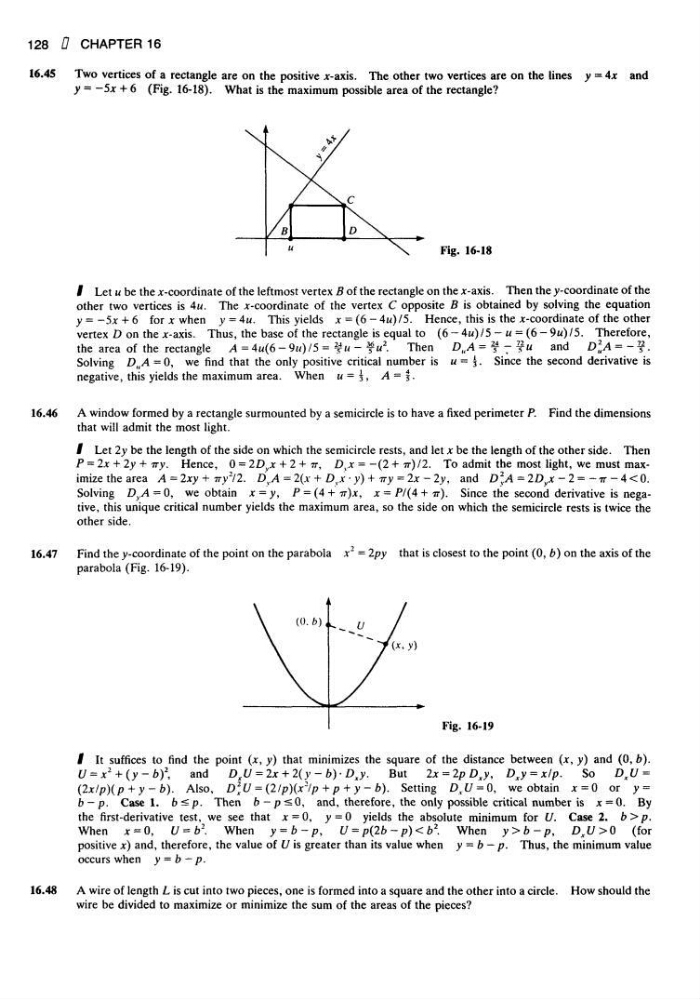
Two vertices of a rectangle are on the positive x-axis. The other two vertices are on the lines y = 4*
y = -5x + 6 (Fig. 16-18). What is the maximum possible area of the rectangle?
and
Fig. 16-18
I Let M be the x-coordinate of the leftmost vertex B of the rectangle on the x-axis. Then the y-coordinate of the
other two vertices is 4«. The x-coordinate of the vertex C opposite B is obtained by solving the equation
y=-5x + 6 for x when y=4u. This yields x = (6-4w)/5. Hence, this is the x-coordinate of the other
vertex D on the x-axis. Thus, the base of the rectangle is equal to (6-4u)/5 - u = (6-9u)/5. Therefore,
the area of the rectangle A =4w(6- 9u)/5 = f u - f u
2 . Then D U A = f 7 f u and D
2
u A = -%.
Solving D U A = 0, we find that the only positive critical number is M = 3. Since the second derivative is
negative, this yields the maximum area. When w=3, A=\.
16.46
A window formed by a rectangle surmounted by a semicircle is to have a fixed perimeter P. Find the dimensions
that will admit the most light.
I Let 2y be the length of the side on which the semicircle rests, and let x be the length of the other side. Then
P = 2x + 2y + Try. Hence, 0 = 2D } ,x + 2+ TT, D y x = -(2+ ir) 12. To admit the most light, we must maximize the area A = 2xy + iry
2 /2. D^.A = 2(.v + D v ..v y) + Try = 2x - 2y, and D
2 A = 2D y x - 2 = -TT -4<0.
Solving D y A = Q, we obtain x = y, P = (4 + TT)X, x = /V(4+7r). Since the second derivative is negative, this unique critical number yields the maximum area, so the side on which the semicircle rests is twice the
other side.
16.47
Find the y-coordinate of the point on the parabola
parabola (Fig. 16-19).
Ar
2 = 2py that is closest to the point (0, b) on the axis of the
Fig. 16-19
I It suffices to find the point (x, y) that minimizes the square of the distance between (x, y) and (0, b).
U = x
2 + (y-b)
2 ,
and D X U = 2x + 2(y - b)- D x y.
But 2x = 2pD x y, D x y = xlp. So D X U =
(2x/p)(p + y-b). Also, D
2 U = (2/p)(x
2 /p +p + y - b). Setting D v t/ = 0, we obtain x = 0 or y =
b — p. Case 1. b-^p. Then fe-psO, and, therefore, the only possible critical number is jt=0. By
the first-derivative test, we see that x = 0, y=0 yields the absolute minimum for U. Case 2. b>p.
When x = 0, U = b2. When y = b-p, U = p(2b - p) < b2. When y>b-p, D,t/>0 (for
positive x) and, therefore, the value of U is greater than its value when y = b - p. Thus, the minimum value
occurs when y = b - p.
16.48
A wire of length L is cut into two pieces, one is formed into a square and the other into a circle,
wire be divided to maximize or minimize the sum of the areas of the pieces?
How should the
16.45
Two vertices of a rectangle are on the positive x-axis. The other two vertices are on the lines y = 4*
y = -5x + 6 (Fig. 16-18). What is the maximum possible area of the rectangle?
and
Fig. 16-18
I Let M be the x-coordinate of the leftmost vertex B of the rectangle on the x-axis. Then the y-coordinate of the
other two vertices is 4«. The x-coordinate of the vertex C opposite B is obtained by solving the equation
y=-5x + 6 for x when y=4u. This yields x = (6-4w)/5. Hence, this is the x-coordinate of the other
vertex D on the x-axis. Thus, the base of the rectangle is equal to (6-4u)/5 - u = (6-9u)/5. Therefore,
the area of the rectangle A =4w(6- 9u)/5 = f u - f u
2 . Then D U A = f 7 f u and D
2
u A = -%.
Solving D U A = 0, we find that the only positive critical number is M = 3. Since the second derivative is
negative, this yields the maximum area. When w=3, A=\.
16.46
A window formed by a rectangle surmounted by a semicircle is to have a fixed perimeter P. Find the dimensions
that will admit the most light.
I Let 2y be the length of the side on which the semicircle rests, and let x be the length of the other side. Then
P = 2x + 2y + Try. Hence, 0 = 2D } ,x + 2+ TT, D y x = -(2+ ir) 12. To admit the most light, we must maximize the area A = 2xy + iry
2 /2. D^.A = 2(.v + D v ..v y) + Try = 2x - 2y, and D
2 A = 2D y x - 2 = -TT -4<0.
Solving D y A = Q, we obtain x = y, P = (4 + TT)X, x = /V(4+7r). Since the second derivative is negative, this unique critical number yields the maximum area, so the side on which the semicircle rests is twice the
other side.
16.47
Find the y-coordinate of the point on the parabola
parabola (Fig. 16-19).
Ar
2 = 2py that is closest to the point (0, b) on the axis of the
Fig. 16-19
I It suffices to find the point (x, y) that minimizes the square of the distance between (x, y) and (0, b).
U = x
2 + (y-b)
2 ,
and D X U = 2x + 2(y - b)- D x y.
But 2x = 2pD x y, D x y = xlp. So D X U =
(2x/p)(p + y-b). Also, D
2 U = (2/p)(x
2 /p +p + y - b). Setting D v t/ = 0, we obtain x = 0 or y =
b — p. Case 1. b-^p. Then fe-psO, and, therefore, the only possible critical number is jt=0. By
the first-derivative test, we see that x = 0, y=0 yields the absolute minimum for U. Case 2. b>p.
When x = 0, U = b2. When y = b-p, U = p(2b - p) < b2. When y>b-p, D,t/>0 (for
positive x) and, therefore, the value of U is greater than its value when y = b - p. Thus, the minimum value
occurs when y = b - p.
16.48
A wire of length L is cut into two pieces, one is formed into a square and the other into a circle,
wire be divided to maximize or minimize the sum of the areas of the pieces?
How should the