

APPLIED MAXIMUM AND MINIMUM PROBLEMS 0 127
16.41
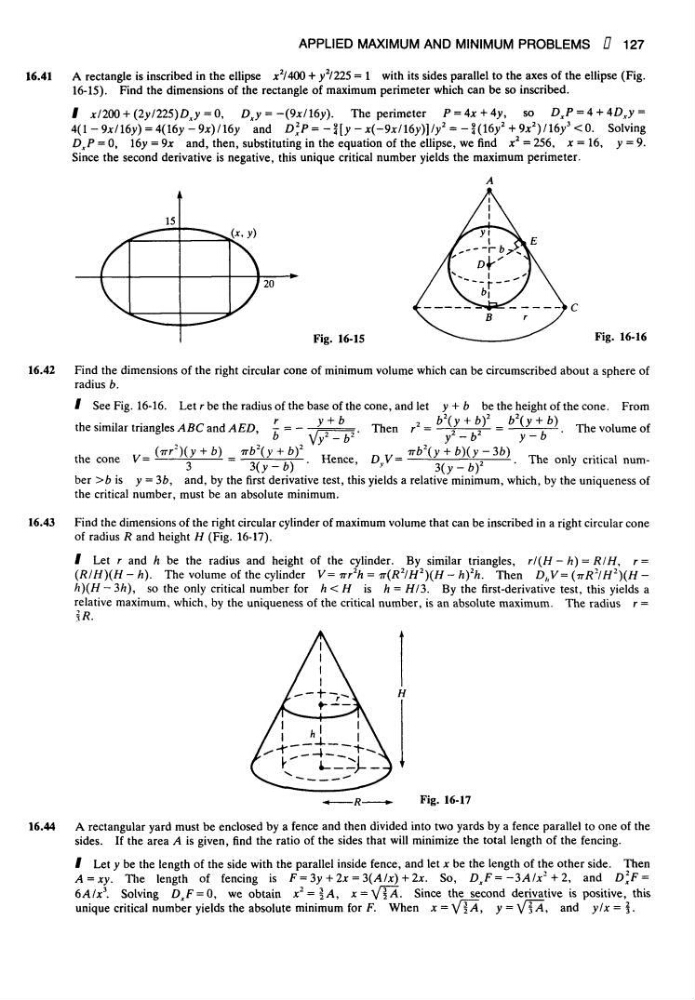
A rectangle is inscribed in the ellipse *
2
/400 + y
2 /225 = 1 with its sides parallel to the axes of the ellipse (Fig.
16-15). Find the dimensions of the rectangle of maximum perimeter which can be so inscribed.
I x/200 + (2y/225)Dsy = 0, Dxy = -(9x/16y). The perimeter P = 4x+4y, so DxP = 4 + 4Dxy =
4(l-9*/16.y) = 4(16y-9;t)/16.y and D\P= -\\y -x(-9x!16y)]/y2 = -?(16/ + 9*2)/16/<0. Solving
D r P = 0, I6y = 9x and, then, substituting in the equation of the ellipse, we find x
2 = 256, x = 16, y = 9.
Since the second derivative is negative, this unique critical number yields the maximum perimeter.
Fig. 16-15
Fig. 16-16
16.42
16.43
ber >b is y = 3b, and, by the first derivative test, this yields a relative minimum, which, by the uniqueness of
the critical number, must be an absolute minimum.
Find the dimensions of the right circular cylinder of maximum volume that can be inscribed in a right circular cone
of radius R and height H (Fig. 16-17).
I Let r and h be the radius and height of the cylinder. By similar triangles, r/(H-h) = R/H, r =
(RIH)(H-h).
The volume of the cylinder V= Trr
2 h = ir(R
2 /H
2 )(H- h)
2 h. Then D l ,V=(trR
2 /H
2 )(H -
h)(H — 3h), so the only critical number for h < H is h = H/3. By the first-derivative test, this yields a
relative maximum, which, by the uniqueness of the critical number, is an absolute maximum. The radius r =
16.44
A rectangular yard must be enclosed by a fence and then divided into two yards by a fence parallel to one of the
sides. If the area A is given, find the ratio of the sides that will minimize the total length of the fencing.
I Let y be the length of the side with the parallel inside fence, and let x be the length of the other side. Then
A = xy. The length of fencing is F = 3y + 2x = 3(A/x) + 2x. So, D X F= -3A/x
2 + 2, and D*F =
6A/x
3 . Solving D X F = Q, we obtain x
2 =\A, x = ^I\A. Since the second derivative is positive, this
unique critical number yields the absolute minimum for F. When
Find the dimensions of the right circular cone of minimum volume which can be circumscribed about a sphere of
radius b.
See Fig. 16-16. Let r be the radius of the base of the cone, and let y + b be the height of the cone. From
the similar triangles ABC and AED,
Then
The volume of
the cone
Hence,
The only critical numFig. 16-17
and
16.41
A rectangle is inscribed in the ellipse *
2
/400 + y
2 /225 = 1 with its sides parallel to the axes of the ellipse (Fig.
16-15). Find the dimensions of the rectangle of maximum perimeter which can be so inscribed.
I x/200 + (2y/225)Dsy = 0, Dxy = -(9x/16y). The perimeter P = 4x+4y, so DxP = 4 + 4Dxy =
4(l-9*/16.y) = 4(16y-9;t)/16.y and D\P= -\\y -x(-9x!16y)]/y2 = -?(16/ + 9*2)/16/<0. Solving
D r P = 0, I6y = 9x and, then, substituting in the equation of the ellipse, we find x
2 = 256, x = 16, y = 9.
Since the second derivative is negative, this unique critical number yields the maximum perimeter.
Fig. 16-15
Fig. 16-16
16.42
16.43
ber >b is y = 3b, and, by the first derivative test, this yields a relative minimum, which, by the uniqueness of
the critical number, must be an absolute minimum.
Find the dimensions of the right circular cylinder of maximum volume that can be inscribed in a right circular cone
of radius R and height H (Fig. 16-17).
I Let r and h be the radius and height of the cylinder. By similar triangles, r/(H-h) = R/H, r =
(RIH)(H-h).
The volume of the cylinder V= Trr
2 h = ir(R
2 /H
2 )(H- h)
2 h. Then D l ,V=(trR
2 /H
2 )(H -
h)(H — 3h), so the only critical number for h < H is h = H/3. By the first-derivative test, this yields a
relative maximum, which, by the uniqueness of the critical number, is an absolute maximum. The radius r =
16.44
A rectangular yard must be enclosed by a fence and then divided into two yards by a fence parallel to one of the
sides. If the area A is given, find the ratio of the sides that will minimize the total length of the fencing.
I Let y be the length of the side with the parallel inside fence, and let x be the length of the other side. Then
A = xy. The length of fencing is F = 3y + 2x = 3(A/x) + 2x. So, D X F= -3A/x
2 + 2, and D*F =
6A/x
3 . Solving D X F = Q, we obtain x
2 =\A, x = ^I\A. Since the second derivative is positive, this
unique critical number yields the absolute minimum for F. When
Find the dimensions of the right circular cone of minimum volume which can be circumscribed about a sphere of
radius b.
See Fig. 16-16. Let r be the radius of the base of the cone, and let y + b be the height of the cone. From
the similar triangles ABC and AED,
Then
The volume of
the cone
Hence,
The only critical numFig. 16-17
and