

APPLIED MAXIMUM AND MINIMUM PROBLEMS 0 129
16.49
Find the positive number x that exceeds its square by the largest amount.
I We must maximize f(x) = x - x
2
for positive x. Then /'(*) = 1-2* and /"(*) = -2. Hence, the
only critical number is x = \. Since the second derivative is negative, this unique critical number yields an
absolute maximum.
16.50
An east-west and a north-south road intersect at a point O. A diagonal road is to be constructed from a point E
east of O to a point N north of O passing through a town C that is a miles east and b miles north of O. Find the
distances of E and N from O if the area of &NOE is to be as small as possible.
I Let x be the ^-coordinate of E. Let v be the y-coordinate of N. By similar triangles, ylb = xl(x - a),
y = bx/(x - a). Hence, the area A of ANOE is given by A = \x bxl(x -a) = (b!2)x
2 /(x - a). Using the
quotient rule, D X A = (b/2)(x
2 - 2ax)/(x - a)
2
, and D
2 A = a
2 h/(x - a)
3
. Solving D X A = 0, we obtain
the critical number x = 2a. The second derivative is positive, since x> a is obviously necessary. Hence,
x = 2a yields the minimum area A. When x = 2a y = 2b.
16.51
A wire of length L is to be cut into two pieces, one to form a square and the other to form an equilateral triangle.
How should the wire be divided to maximize or to minimize the sum of the areas of the square and triangle?
I Let x be the part used for the triangle. Then the side of the triangle is x/3 and its height is jcV3/6. Hence,
the area of the triangle is |(*/3)(*V3/6) = V3x
2 /36. The side of the square is (L-x)/4, and its area is
[(L - x) /4]
2
. Hence, the total area A = V3x
2
/36 + [(L - x) /4]
2
. Then D X A = xV3 /18 ~(L-x) IS. Setting D X A = 0, we obtain the critical number x = 9L/(9 + 4V5). Since 0<*
clear that, since 16 < 12V3 < 16 + 12V3, the maximum area corresponds to x = 0, where everything goes
into the square, and the minimum value corresponds to the critical number.
16.52
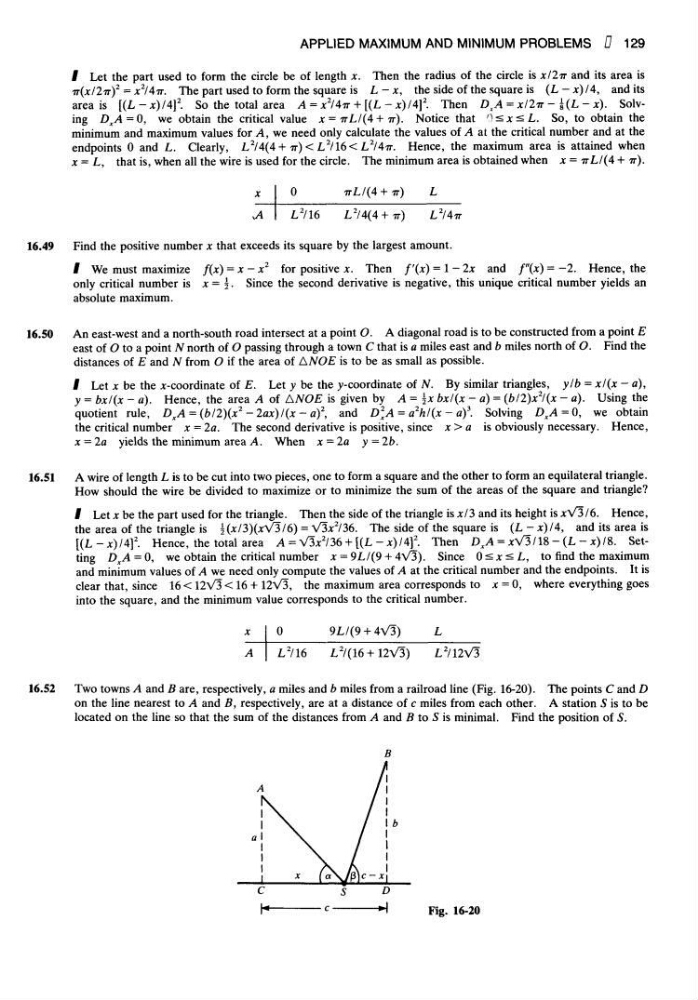
Two towns A and B are, respectively, a miles and b miles from a railroad line (Fig. 16-20). The points C and D
on the line nearest to A and B, respectively, are at a distance of c miles from each other. A station S is to be
located on the line so that the sum of the distances from A and B to S is minimal. Find the position of S.
Fig. 16-20
I Let the part used to form the circle be of length x. Then the radius of the circle is x/2ir and its area is
ir(jc/2ir)
2 = x
2 /4TT. The part used to form the square is L - x, the side of the square is (L - x) 14, and its
area is [(L-*)/4]
2 . So the total area A = x
2 /4ir + [(L - *)/4]
2 .
Then
D S A = x/2ir - %(L - x). Solving D X A = 0, we obtain the critical value x = irL/(4 + TT). Notice that 0
endpoints 0 and L. Clearly, L
2 /4(4+ TT)< L
2 /16< L
2 /4-n-. Hence, the maximum area is attained when
x = L, that is, when all the wire is used for the circle. The minimum area is obtained when x = irL/(4 + TT).
X
A
0
L
2 /16
wL/(4 + TT)
L
2 /4(4 + TT)
L
L
2 /4ir
At
^
0
L
2 /16
9L/(9 + 4V3)
L
2 /(16+12V3)
L
L
2 /12V3
16.49
Find the positive number x that exceeds its square by the largest amount.
I We must maximize f(x) = x - x
2
for positive x. Then /'(*) = 1-2* and /"(*) = -2. Hence, the
only critical number is x = \. Since the second derivative is negative, this unique critical number yields an
absolute maximum.
16.50
An east-west and a north-south road intersect at a point O. A diagonal road is to be constructed from a point E
east of O to a point N north of O passing through a town C that is a miles east and b miles north of O. Find the
distances of E and N from O if the area of &NOE is to be as small as possible.
I Let x be the ^-coordinate of E. Let v be the y-coordinate of N. By similar triangles, ylb = xl(x - a),
y = bx/(x - a). Hence, the area A of ANOE is given by A = \x bxl(x -a) = (b!2)x
2 /(x - a). Using the
quotient rule, D X A = (b/2)(x
2 - 2ax)/(x - a)
2
, and D
2 A = a
2 h/(x - a)
3
. Solving D X A = 0, we obtain
the critical number x = 2a. The second derivative is positive, since x> a is obviously necessary. Hence,
x = 2a yields the minimum area A. When x = 2a y = 2b.
16.51
A wire of length L is to be cut into two pieces, one to form a square and the other to form an equilateral triangle.
How should the wire be divided to maximize or to minimize the sum of the areas of the square and triangle?
I Let x be the part used for the triangle. Then the side of the triangle is x/3 and its height is jcV3/6. Hence,
the area of the triangle is |(*/3)(*V3/6) = V3x
2 /36. The side of the square is (L-x)/4, and its area is
[(L - x) /4]
2
. Hence, the total area A = V3x
2
/36 + [(L - x) /4]
2
. Then D X A = xV3 /18 ~(L-x) IS. Setting D X A = 0, we obtain the critical number x = 9L/(9 + 4V5). Since 0<*
clear that, since 16 < 12V3 < 16 + 12V3, the maximum area corresponds to x = 0, where everything goes
into the square, and the minimum value corresponds to the critical number.
16.52
Two towns A and B are, respectively, a miles and b miles from a railroad line (Fig. 16-20). The points C and D
on the line nearest to A and B, respectively, are at a distance of c miles from each other. A station S is to be
located on the line so that the sum of the distances from A and B to S is minimal. Find the position of S.
Fig. 16-20
I Let the part used to form the circle be of length x. Then the radius of the circle is x/2ir and its area is
ir(jc/2ir)
2 = x
2 /4TT. The part used to form the square is L - x, the side of the square is (L - x) 14, and its
area is [(L-*)/4]
2 . So the total area A = x
2 /4ir + [(L - *)/4]
2 .
Then
D S A = x/2ir - %(L - x). Solving D X A = 0, we obtain the critical value x = irL/(4 + TT). Notice that 0
endpoints 0 and L. Clearly, L
2 /4(4+ TT)< L
2 /16< L
2 /4-n-. Hence, the maximum area is attained when
x = L, that is, when all the wire is used for the circle. The minimum area is obtained when x = irL/(4 + TT).
X
A
0
L
2 /16
wL/(4 + TT)
L
2 /4(4 + TT)
L
L
2 /4ir
At
^
0
L
2 /16
9L/(9 + 4V3)
L
2 /(16+12V3)
L
L
2 /12V3